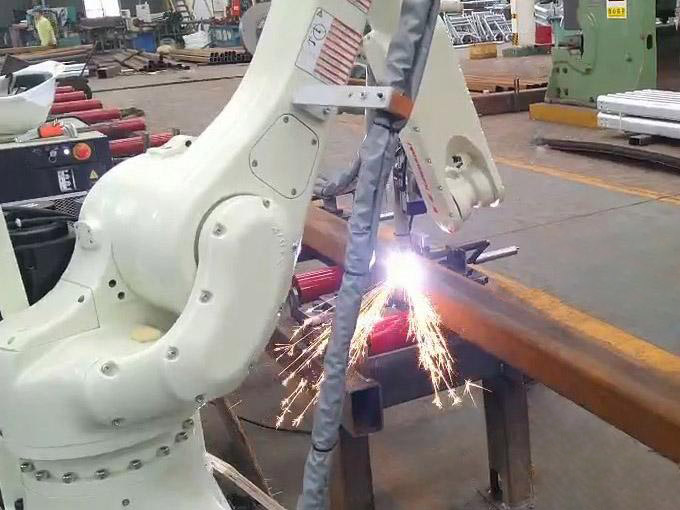
3D Robotic Laser Cutting Machine - Industrial Robot Cutting System
Dade Heavy Industry delivers 3D robotic laser cutting systems for complex 3D contours in aerospace, automotive, new energy vehicles, and industrial manufacturing. Multi-axis robot integration (5-axis, 6-axis, 7-axis with linear track) with fiber laser sources 2–12 kW (Raycus, IPG, MAX, nLight). Kawasaki RA20N, Fanuc M-20iD, Estun ER series. Cutting mild steel up to 25 mm, stainless up to 12 mm, aluminium up to 8 mm. Automated loading/unloading, fume extraction, and vision-guided path correction.
Kawasaki RA20N + Raycus 2-6 kW · Fanuc M-20iD + IPG 3-12 kW · 100,000 m² factory · 3D five-axis cutting expertise
3D Robotic Laser Cutting Configurations by Axis & Power
Dade integrates Kawasaki RA20N, Fanuc M-20iD, and Estun ER series robots with Raycus, IPG, MAX, and nLight fiber laser sources (2–12 kW). 5-axis, 6-axis, and 7-axis (with linear track) configurations available. All systems include capacitive height sensing, capacitive/inductive pierce detection, fume extraction, and automated loading/unloading options.
3D Robotic Laser Cutting Configurations by Axis & Power
|
Configuration |
Robot Model |
Laser Source |
Working Envelope |
Max Thickness (Mild Steel) |
Typical Applications |
|
5-axis |
Kawasaki RA20N |
Raycus 2-6 kW |
±90° A-axis, ±180° C-axis |
12 mm |
Automotive hydroformed tubes, exhaust components |
|
6-axis |
Fanuc M-20iD |
IPG 3-12 kW |
Full 6-axis articulation |
25 mm |
Aerospace frames, structural steel, heavy plate |
|
6-axis + 7th axis track |
Estun ER20 + 3m track |
Raycus 6-12 kW |
3 m linear + 6-axis |
25 mm |
Long structural beams, shipbuilding panels |
|
5-axis + rotary table |
Kawasaki RA20N + 500kg table |
IPG 4-8 kW |
5-axis + 360° rotary |
15 mm |
Pressure vessel nozzles, pipe cutting |
Cutting speeds and maximum thicknesses for fiber laser cutting with nitrogen/oxygen assist gas. Speeds are for single-pass cutting with optimized parameters. Actual speeds vary with material quality, assist gas pressure, and nozzle standoff.
3D Robotic Laser Cutting Performance by Material & Thickness
|
Material |
Thickness |
Laser Power |
Cut Speed |
Assist Gas |
Edge Quality |
|
Mild Steel (Q235/Q345) |
3 mm |
3 kW |
4.5 m/min |
O2 |
Rz ≤ 10 µm |
|
Mild Steel |
10 mm |
6 kW |
1.8 m/min |
O2 |
Rz ≤ 15 µm |
|
Mild Steel |
20 mm |
12 kW |
0.8 m/min |
O2 |
Rz ≤ 20 µm |
|
Stainless 304/316 |
2 mm |
3 kW |
8 m/min |
N2 |
Rz ≤ 5 µm |
|
Stainless 304/316 |
6 mm |
6 kW |
3 m/min |
N2 |
Rz ≤ 10 µm |
|
Stainless 304/316 |
12 mm |
12 kW |
1.2 m/min |
N2 |
Rz ≤ 15 µm |
|
Aluminium 5052/6061 |
2 mm |
3 kW |
12 m/min |
N2/Ar |
Rz ≤ 8 µm |
|
Aluminium 5052/6061 |
5 mm |
6 kW |
4 m/min |
N2/Ar |
Rz ≤ 12 µm |
|
Aluminium 5052/6061 |
8 mm |
12 kW |
2 m/min |
N2/Ar |
Rz ≤ 15 µm |
Industry Applications & Case Highlights
New Energy Vehicle Manufacturing
Battery tray cutting, motor housing trimming, structural frame cutting for EV platforms. 3D five-axis cutting of cast aluminium battery housings. Kawasaki RA20N + Raycus 3 kW. Cycle time reduced from 45 min (manual plasma) to 8 min per tray.
Automotive Hydroformed Tubes & Exhaust
5-axis cutting of hydroformed exhaust manifolds, EGR coolers, and tailor-welded blanks. Kawasaki RA20N ±90° A-axis, ±180° C-axis rotation. Cycle time 3 min per complex tube vs 25 min manual.
Aerospace & Defence
Titanium alloy (Ti-6Al-4V) airframe components, Inconel 718 engine parts. 6-axis Fanuc M-20iD + IPG 6 kW. Nitrogen assist for clean edges, post-cut machining allowance <0.1 mm.
Construction Machinery & Steel Structure
Excavator boom cutouts, bucket tooth profiles, structural steel beams up to 25 mm. 12 kW fiber laser, oxygen assist for mild steel up to 25 mm. Automated loading/unloading with magnetic grippers.
Pressure Vessels & Pipe Cutting
Pipe beveling, nozzle cutouts, flange facing on 3D rotary table. Stainless 304/316, duplex 2205, Inconel 625. Orbital cutting head with ±0.05 mm repeatability.
5-Axis vs 6-Axis: Which Do You Need?
The choice depends on workpiece geometry, access requirements, and production volume.
5-Axis vs 6-Axis Laser Cutting Comparison
|
Capability |
5-Axis (A/C rotary) |
6-Axis Articulated |
|
Workpiece Geometry |
Tubes, pipes, rotational parts |
Complex 3D contours, deep cavities |
|
Access Angle |
±90° tilt, 360° rotation |
Full spherical access |
|
Programming Complexity |
Moderate (CAM post-processor) |
High (full 6-DOF path planning) |
|
Cycle Time (tube cutting) |
Faster (dedicated kinematics) |
Slower (more axes to coordinate) |
|
Footprint |
Compact |
Larger (robot reach envelope) |
|
Typical Applications |
Tubes, pipes, rotational symmetries |
Complex 3D parts, deep pockets, undercuts |
Dade supplies both configurations. For tubular parts (exhaust, chassis tubes), 5-axis is faster and more cost-effective. For complex 3D parts (castings, forgings, aerospace), 6-axis provides full access.
Frequently Asked Questions
What materials can your 3D laser cutting systems cut?
Mild steel (up to 25 mm with 12 kW), stainless steel 304/316/2205 duplex (up to 12 mm), aluminium 5xxx/6xxx/5083 (up to 8 mm), titanium Ti-6Al-4V (up to 6 mm), Inconel 625/718 (up to 6 mm), galvanized steel, copper, brass. Reflective materials (copper, brass) use green/blue wavelength lasers.
What is the maximum workpiece size you can handle?
With 7th-axis linear track (up to 6 m stroke), we can cut parts up to 6 m length. Without track, robot reach envelope is typically 2.5–3 m diameter sphere. Rotary tables up to 2,000 kg capacity for large diameter pipes and vessels.
Can you cut formed/3D parts like hydroformed tubes?
Yes. 5-axis (±90° A-axis, ±180° C-axis) and 6-axis articulated robots follow complex 3D trajectories. Capacitive height sensing maintains constant standoff on curved surfaces. Typical applications: hydroformed exhaust manifolds, automotive structural tubes, aerospace ducting.
What laser source brands do you use?
We integrate Raycus, IPG Photonics, MAX Photonics, nLight, and JPT fiber laser sources (2–12 kW). Selection based on power stability, beam quality (BPP), service network in your region, and customer preference. All sources include chiller and power supply.
What is the lead time for a 3D laser cutting system?
Standard 5-axis tube cutting cell (3 kW): 8–12 weeks. 6-axis robotic cell (6 kW): 12–16 weeks. 7th-axis track system (12 kW): 14–20 weeks. Custom multi-robot cells: 18–28 weeks.
Do you provide offline programming software?
Yes. We provide offline programming software (based on RobotMaster / Octopuz / Mastercam post-processors) for path generation from CAD/CAM. Supports STEP, IGES, Parasolid. Includes collision detection, cycle time estimation, and automatic pierce/lead-in/lead-out optimization.
Request a 3D Laser Cutting Quotation
Send 3D CAD models (STEP/IGES/Parasolid), material specs, thicknesses, annual volume, edge quality requirements, and tolerance requirements. Technical quotations returned within 5–10 business days for complete RFQ packages.
Send Inquiry Now