







Battery & EV Manufacturing
Copper/aluminium busbar welding, tab-to-terminal, pouch cell sealing. 1–3 kW fiber laser with scanner head, 50–200 mm/s weld speed.
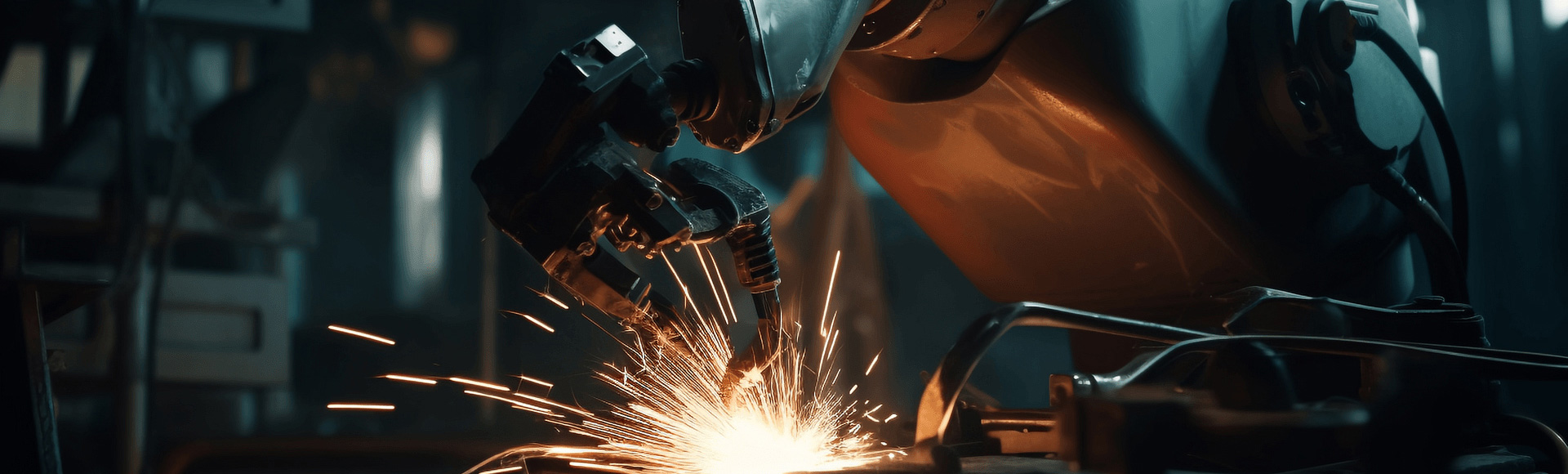
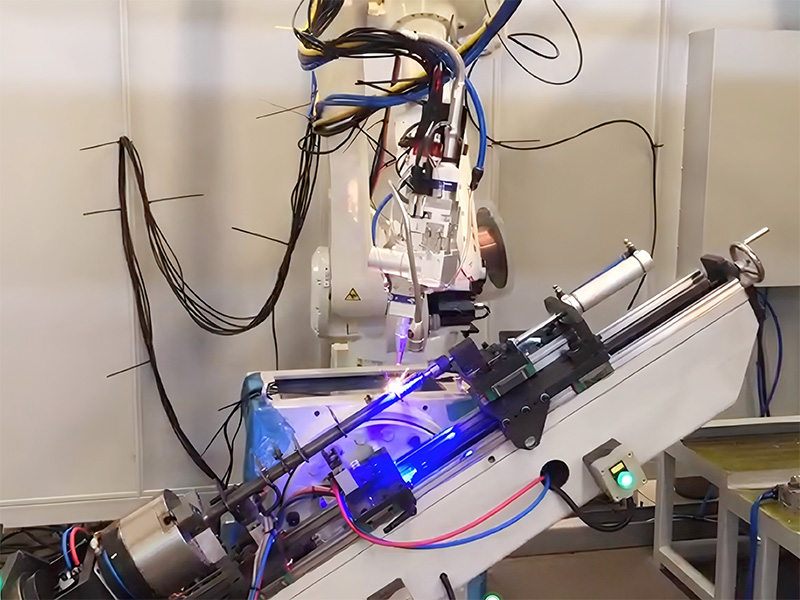
3D laser welding workstation for circuit breaker switches
Dade Heavy Industry (stock code 870547) supplies fiber laser welding systems from 1 kW to 12 kW: 6-axis robotic cells with scanner heads, handheld cobot welders for manual-to-automation transition, and hybrid MIG/laser hybrid cells. Applications: stainless steel 304/316, aluminium 5xxx/6xxx, copper battery tabs, dissimilar metal joints. 1,500+ laser welding systems delivered. Kawasaki, Fanuc, Estun, Han's Laser, Raycus, IPG, MAX, nLight integration.
Kawasaki certified agent (2025) · IATF 16949 · 100,000 m² factory · 1,500+ laser systems delivered
Copper/aluminium busbar welding, tab-to-terminal, pouch cell sealing. 1–3 kW fiber laser with scanner head, 50–200 mm/s weld speed.
304/316/2205 duplex tanks, piping, food/pharma equipment. 1.5–6 kW fiber, keyhole mode for 3–8 mm single-pass full penetration.
5xxx/6xxx series auto bodies, copper-aluminium battery tabs, steel-aluminium tailor-welded blanks. 2–6 kW with wobble/scanner heads.
Estun/Techman cobot + 1.5 kW fiber laser + ergonomic gun. Manual-to-auto transition for job shops. 0.5–3 mm stainless/steel/Al.
Galvo scanner heads 50–200 mm/s, multi-station time-sharing. Battery tabs, fuel cell bipolar plates, sensor housings. 50–200 m/min scan speed.
Laser keyhole + MIG fill for 6–12 mm thick plate. 50% faster than MIG alone, reduced heat input, lower distortion. Shipbuilding, heavy equipment.
Dade integrates Raycus, IPG, MAX, nLight, and JPT fiber laser sources with Kawasaki, Fanuc, Estun, and Han's Laser robot arms. Scanner heads from Precitec, RayTools, and Han's Laser. All systems include chiller, wire feeder (optional), fume extraction, and safety enclosure.
| Laser Power | Typical Robot | Max Penetration (Steel) | Typical Materials | Weld Speed | Typical Applications |
|---|---|---|---|---|---|
| 1.5 kW | 6-axis 6 kg cobot / handheld | 2.5 mm (steel) | SS 0.5–2 mm, Al 0.5–1.5 mm | 3–10 m/min | Handheld cobot, thin stainless, battery tabs |
| 2 kW | 6-axis 6–10 kg | 3.5 mm | SS 0.5–3 mm, Al 0.5–2 mm | 5–15 m/min | Stainless tanks, battery modules, sensors |
| 3 kW | 6-axis 10–12 kg | 5 mm | SS 1–4 mm, Al 1–3 mm, Cu 0.5–1.5 mm | 8–20 m/min | Battery packs, fuel cells, stainless piping |
| 4–6 kW | 6-axis 12–20 kg | 8 mm (keyhole) | SS 2–6 mm, Al 2–5 mm, Cu 1–2 mm | 10–30 m/min | EV battery trays, Al auto bodies, SS vessels |
| 8–12 kW | 6-axis 20 kg / gantry | 12–15 mm (keyhole) | SS 4–12 mm, Al 3–8 mm, Steel 4–10 mm | 15–50 m/min | Thick Al auto, shipbuilding panels, hybrid MIG |
Conduction mode (power density < 10⁶ W/cm²): shallow, wide weld pool. Ideal for thin sheets <2 mm, aesthetic seams, hermetic seals. Minimal spatter, excellent cosmetics.
Keyhole mode (power density > 10⁶ W/cm²): deep, narrow weld pool with vapor capillary. Single-pass full penetration 3–15 mm. High aspect ratio, minimal heat-affected zone. Requires precise focus control and shielding gas optimization.
| Material | Thickness | Recommended Mode | Typical Power |
|---|---|---|---|
| Stainless 304/316 | 0.5–2 mm | Conduction | 1–2 kW |
| Stainless 304/316 | 3–8 mm | Keyhole | 3–6 kW |
| Aluminium 5xxx/6xxx | 0.5–2 mm | Conduction | 1.5–3 kW |
| Aluminium 5xxx/6xxx | 3–6 mm | Keyhole + wobble | 4–8 kW |
| Copper (battery tabs) | 0.1–0.3 mm | Conduction (green/blue laser) | 0.5–1.5 kW |
| Dissimilar (Steel-Al) | 1–3 mm | Conduction + wobble | 2–4 kW |
Galvo scanner heads (Precitec, RayTools, Han's Laser): 50–200 m/min scan speed, multi-station time-sharing, dynamic focus correction, wobble patterns (circle, figure-8, spiral) for gap bridging. Essential for battery tabs, fuel cell plates, high-volume small parts.
Fixed collimation/focusing heads (Precitec YC, RayTools): Simpler, lower cost, robust for dedicated single-seam production. Used for long seams, pipe welding, large structural parts.
Automatic cold-wire feed (0.8–1.2 mm) recommended for: gap bridging >0.2 mm, alloy composition control (e.g., 4047 wire for Al 6xxx), root reinforcement in keyhole mode. Wire feed synchronized with robot TCP speed via EtherCAT. Typical feed rates 0.5–5 m/min.
| Material | Thickness | Laser Power | Weld Speed | Shielding Gas | Wire Feed |
|---|---|---|---|---|---|
| Stainless 304/316 | 1 mm | 1.5 kW | 8 m/min | Ar/N2 mix | No |
| Stainless 304/316 | 3 mm | 3 kW | 5 m/min | N2 | 0.8 mm 308L |
| Stainless 304/316 | 6 mm | 6 kW | 3 m/min | N2 | 1.0 mm 308L |
| Aluminium 5052/6061 | 1.5 mm | 2 kW | 10 m/min | Ar/He | No |
| Aluminium 5052/6061 | 3 mm | 4 kW | 6 m/min | Ar/He | 1.0 mm 4047 |
| Aluminium 5052/6061 | 5 mm | 6 kW | 4 m/min | Ar/He | 1.2 mm 4047 |
| Copper (C11000) | 0.2 mm | 1 kW (green) | 15 m/min | Ar | No |
| Galvanized Steel | 1.5 mm | 2 kW | 8 m/min | Ar/CO2 | 0.8 mm |
Dade's handheld cobot welding package combines a 6-axis collaborative robot (Estun/Techman, 5–10 kg payload) with a 1.5 kW fiber laser and an ergonomic welding gun (weight <1.2 kg). The cobot guides the gun along the seam while the operator positions the workpiece — reducing fatigue, ensuring consistent torch angle and standoff, and capturing the welding path for later fully-automated playback.
Ideal for job shops, prototype shops, and low-volume high-mix production where full fixture investment isn't justified. Upgrade path: same cobot + fixed optics + fixture = full automation.
Stainless steel (304, 316, 2205 duplex), aluminium alloys (5xxx, 6xxx, 5083), carbon steel, galvanized steel, copper (C11000), titanium (Grade 2, 5), nickel alloys (Inconel 625, 718), and dissimilar joints (steel-aluminium, copper-aluminium). Green/blue lasers available for high-reflectivity Cu/Al.
Keyhole mode with 6–12 kW fiber laser achieves single-pass full penetration up to 12 mm in steel, 8 mm in stainless, 6 mm in aluminium. Thicker sections use hybrid laser-MIG or multi-pass with proper joint preparation.
Yes. We offer 1–3 kW green (515 nm) or blue (450 nm) lasers specifically for high-reflectivity copper and aluminium. Typical applications: pouch cell tab-to-terminal (0.1–0.3 mm Cu), prismatic cell busbars (0.2–0.5 mm Al/Cu), cylindrical cell current collectors. Weld speeds 10–50 m/min with green/blue wavelength.
Yes. Our handheld cobot package pairs a 6-axis collaborative robot (5–10 kg payload) with a 1.5 kW fiber laser and lightweight ergonomic gun (<1.2 kg). The cobot guides the torch while the operator positions the part — reducing fatigue, ensuring consistent angle/standoff, and recording the path for later automated playback. Ideal for job shops and low-volume high-mix.
We integrate Raycus, IPG Photonics, MAX Photonics, nLight, JPT, and Han's Laser sources. Scanner heads from Precitec, RayTools, Han's Laser, and Precitec. Selection based on power stability, beam quality (BPP), service network, and customer preference.
Standard handheld cobot package: 6–8 weeks. Robotic cell with 3–6 kW laser and scanner head: 10–14 weeks. High-power (8–12 kW) gantry or hybrid laser-MIG cell: 14–20 weeks. Custom scanner-based multi-station systems: 16–24 weeks.
Send drawings, material specs, joint design, production volume, cycle-time target, and quality requirements. Technical quotations returned within 5–10 business days for complete RFQ packages.
Send Inquiry Now