Shipbuilding is a pillar industry of global heavy manufacturing, and welding technology serves as the core process determining the structural integrity, production efficiency, and operational safety of ships. With the upgrading of ship types (e.g., large LNG carriers, polar cruise ships, and offshore engineering platforms) and the tightening of international standards (e.g., IMO CSR, IACS UR W12), traditional manual arc welding and semi-automatic welding processes have gradually failed to meet the demands of high-precision, high-efficiency, and low-cost shipbuilding. In recent years, driven by materials science, robotics, and digital technology, ship welding technology has ushered in a new round of innovation, characterized by the integration of high-efficiency welding processes and intelligent manufacturing systems. This article systematically analyzes the technical principles, application scenarios, and development trends of innovative ship welding technologies.
1. Core High-Efficiency Welding Processes for Shipbuilding
The core demand of ship welding process innovation is to address the pain points of traditional processes, such as low deposition efficiency, large thermal deformation, high defect rates, and heavy reliance on skilled welders. The following high-efficiency processes have become the mainstream solutions for modern shipyards.
1.1 Multi-Wire Submerged Arc Welding (Multi-Wire SAW)
As an upgraded version of conventional single-wire SAW, multi-wire SAW uses 2–4 parallel welding wires to form a concentrated arc zone, significantly improving deposition rate and welding speed.
- Technical Principles: The leading wire generates a deep penetration arc to form a keyhole, while the trailing wires fill the weld pool, realizing single-pass welding of thick plates (20–80 mm) without groove preparation. The coordinated control of wire feed speed, arc voltage, and welding speed ensures uniform weld bead formation and reduces the heat-affected zone (HAZ) by 30% compared with single-wire SAW.
- Application Scenarios: Dominant in welding large ship hull sections, deck panels, and double-bottom structures of bulk carriers and container ships. For example, the 4-wire SAW system can achieve a deposition rate of 80–120 kg/h, which is 3–4 times higher than single-wire SAW, shortening the hull assembly cycle by 25–30%.
- Key Advantages: High efficiency, low spatter, and excellent weld mechanical properties, meeting the toughness requirements of ship steel (e.g., DH36, EH40) at low temperatures (-20°C to -40°C).
1.2 Laser-Arc Hybrid Welding (LAHW)
LAHW combines the high energy density of laser beams with the strong bridging ability of arc welding, overcoming the limitations of single laser welding (strict gap tolerance) and single arc welding (low efficiency).
- Technical Principles: The laser beam preheats the workpiece to form a molten pool, while the arc stabilizes the pool and fills the weld seam. The synergistic effect of laser and arc reduces the required laser power by 50%, widens the acceptable joint gap to 0.5–1.5 mm, and eliminates porosity and incomplete fusion defects.
- Application Scenarios: Ideal for welding thin-walled aluminum alloy superstructures of cruise ships and LNG carrier cargo tanks. For instance, LAHW is used to weld 5083 aluminum alloy plates (6–12 mm thick) with a welding speed of 1.5–2.5 m/min, which is 2–3 times faster than MIG welding, and the weld joint tensile strength reaches 90% of the base metal.
- Key Advantages: High speed, low thermal deformation, and strong adaptability to workpiece assembly errors, which is crucial for reducing post-weld correction work of ship superstructures.
1.3 Friction Stir Welding (FSW)
As a
solid-state welding process, FSW avoids the solidification defects of fusion welding and is particularly suitable for joining aluminum alloys, magnesium alloys, and other non-ferrous metals that are difficult to weld by traditional methods.
- Technical Principles: A rotating tool with a shoulder and pin is inserted into the joint interface, generating frictional heat to plasticize the material; the tool moves along the weld seam to stir and mix the plasticized material, forming a dense weld joint after cooling.
- Application Scenarios: Core process for welding LNG carrier殷瓦钢 (Invar steel) inner tanks and aluminum alloy high-speed ship hulls. The FSW welds of Invar steel (0.7 mm thick) have zero porosity and excellent low-temperature toughness, meeting the strict leak-proof requirements of LNG storage (temperature -163°C).
- Key Advantages: No filler metal or shielding gas required, no solidification cracks, and the HAZ is extremely narrow, ensuring the dimensional accuracy of thin-walled ship components.
2. Intelligent Development Trends of Ship Welding Technology
Intelligent transformation is the core direction of ship welding technology innovation, which realizes the integration of "process control, quality monitoring, and production management" through robotics, sensing technology, and digital twins.
2.1 Robot Welding Systems for Large Ship Components
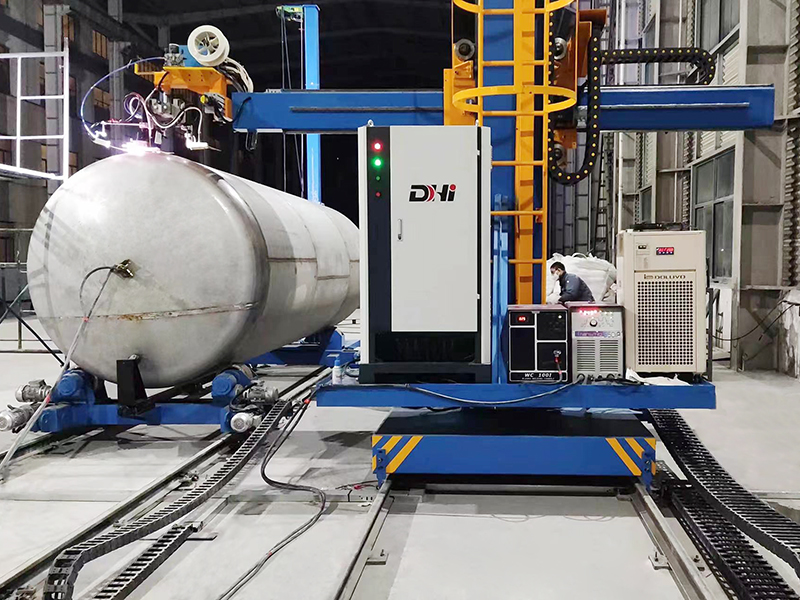
Traditional ship welding relies heavily on manual operation, especially for large curved components such as hull curved sections and stern frames, which have high labor intensity and unstable quality. The application of large-scale articulated robots and gantry-type robot systems has solved this problem.
- Technical Features: 6–8 axis heavy-duty robots with a working radius of 3–5 m and a payload of 50–150 kg, equipped with laser vision seam tracking systems (sampling frequency 1 kHz). The system can dynamically correct the welding torch position according to the actual weld seam shape, compensating for workpiece deformation and assembly errors (tolerance ±2 mm).
- Application Cases: Chinese shipyards use robot welding systems to weld container ship hull curved sections, achieving an automated welding rate of over 80%, reducing weld defect rates from 2.5% to 0.3%, and cutting labor costs by 40%.
- Development Direction: Collaborative robots (cobots) will be applied to small-batch, multi-variety ship component welding, supporting human-robot collaboration to handle complex welding positions that are inaccessible to large robots.
2.2 Digital Twin-Driven Welding Process Simulation
Digital twin technology constructs a virtual model of the ship welding process, realizing predictive simulation and optimization of welding parameters, thermal deformation, and defect formation.
- Technical Principles: The digital twin model integrates multi-physical field simulation (thermal, mechanical, metallurgical) and real-time production data (welding current, voltage, speed). Before actual welding, the model simulates the temperature field distribution of the weld seam, predicts thermal deformation and residual stress, and optimizes welding sequences and clamping schemes to minimize deformation.
- Application Value: For large LNG ship cargo tanks, digital twin simulation reduces the welding deformation of 30 m long Invar steel plates to within ±3 mm, eliminating the need for flame correction and improving production efficiency by 20%.
- Key Technology: The integration of IoT sensors and digital twin models enables real-time data interaction between physical welding processes and virtual models, realizing closed-loop optimization of welding parameters.
2.3 AI-Powered Welding Quality Real-Time Monitoring
The quality inspection of traditional ship welding is mostly post-weld testing (e.g., UT, RT), which is time-consuming and cannot prevent defect formation in real time. AI-powered real-time monitoring systems have changed this pattern.
- Technical Principles: High-speed cameras and spectral sensors capture the morphology of the weld pool, plasma arc, and molten metal flow in real time. Deep learning algorithms analyze the correlation between these features and weld defects (porosity, cracks, incomplete fusion), and automatically adjust welding parameters (current, speed, shielding gas flow) within 10 ms to eliminate defect risks.
- Application Scenarios: Critical for welding high-strength steel offshore platform legs and submarine hulls. The AI monitoring system can detect micro-cracks with a width of 0.01 mm, ensuring the structural safety of marine engineering equipment under harsh ocean conditions.
- Advantages: Real-time, non-destructive, and intelligent, reducing the cost of post-weld inspection by 50% and improving the qualified rate of welds to over 99.5%.
2.4 IoT-Based Welding Production Management System
The ship welding workshop is a complex multi-process production system, and the IoT-based management system realizes the integration of equipment, personnel, and process data.
- System Functions: Collect real-time data of welding robots, power supplies, and testing equipment, including welding parameter records, equipment operation status, and weld quality data. The system generates production reports automatically, realizes predictive maintenance of equipment, and optimizes the scheduling of welding tasks.
- Application Effect: Korean shipyards have applied IoT management systems to cruise ship welding workshops, reducing equipment downtime by 30% and improving overall production efficiency by 25%.
3. Key Application Cases of Innovative Ship Welding Technology
3.1 LNG Carrier Invar Steel Inner Tank Welding
LNG carriers require strict leak-proof performance, and the inner tank is made of 0.7–1.2 mm thick Invar steel. The combination of FSW and laser spot welding is used for welding: FSW is applied to the longitudinal and transverse seams of large plates, and laser spot welding is used for the connection of pipeline nozzles, ensuring zero leakage of the inner tank.
3.2 Offshore Wind Turbine Jacket Welding
Offshore wind turbine jackets are made of high-strength steel (EH36, EH40) with a thickness of 50–100 mm. Multi-wire SAW and LAHW are used in combination: multi-wire SAW is used for thick plate butt welding, and LAHW is used for fillet welding of node parts, improving welding efficiency by 40% and ensuring the fatigue resistance of weld joints under cyclic loads of wind and waves.
4. Challenges and Future Outlook
4.1 Current Challenges
- Material-Welding Process Matching: The wide application of high-strength steel, ultra-high-strength steel, and non-ferrous metals in ships requires the development of customized welding processes to avoid cold cracks and brittle fractures.
- Cost Control of Intelligent Systems: The high initial investment of robot welding systems and digital twin platforms limits their promotion in small and medium-sized shipyards.
- Skilled Talent Training: The operation and maintenance of intelligent welding equipment require technicians with both welding expertise and digital technology capabilities, and the talent gap is large.
4.2 Future Development Trends
- Green Welding Technology: Development of low-emission welding processes (e.g., flux-cored wire welding with low fume generation) and waste heat recovery systems to meet the environmental protection requirements of shipbuilding.
- Multi-Technology Fusion: Integration of laser welding, arc welding, and friction welding to form hybrid processes suitable for complex ship components.
- Full Lifecycle Management: Combination of welding intelligent manufacturing and ship digital twin to realize the traceability of welding quality throughout the ship's lifecycle, from design, construction to operation and maintenance.
In conclusion, the innovation of ship welding technology is moving towards the direction of "high efficiency, intelligence, and greening". With the continuous breakthrough of core technologies, it will strongly support the upgrading of the global shipbuilding industry and the development of high-end marine engineering equipment.