







Robotic MIG/MAG Welding Cells
Pulsed MIG with digital communication for structural steel, automotive frames, and heavy equipment. Payloads 6–20 kg, reaches 1,400–2,000 mm.
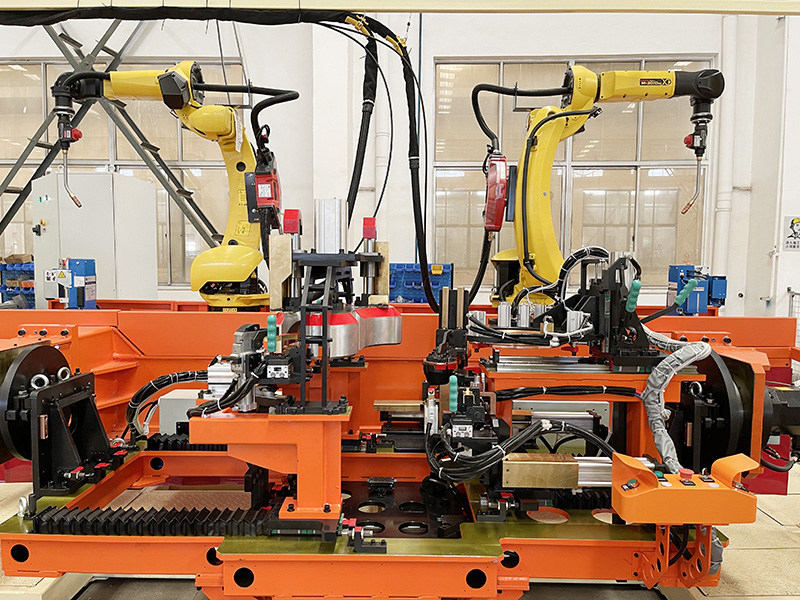
Drive axle welding production line
U-shaped Pipe Beam Automatic Welding Production Line
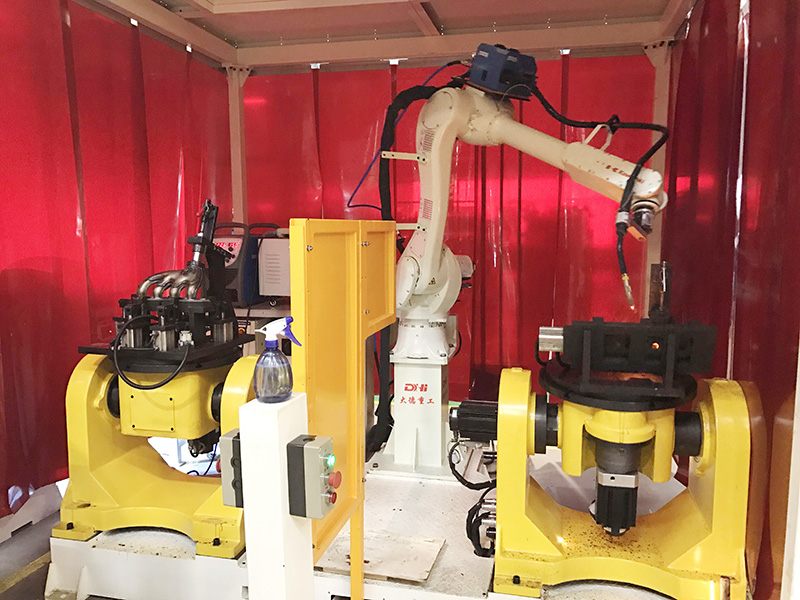
High-efficiency single-station welding system
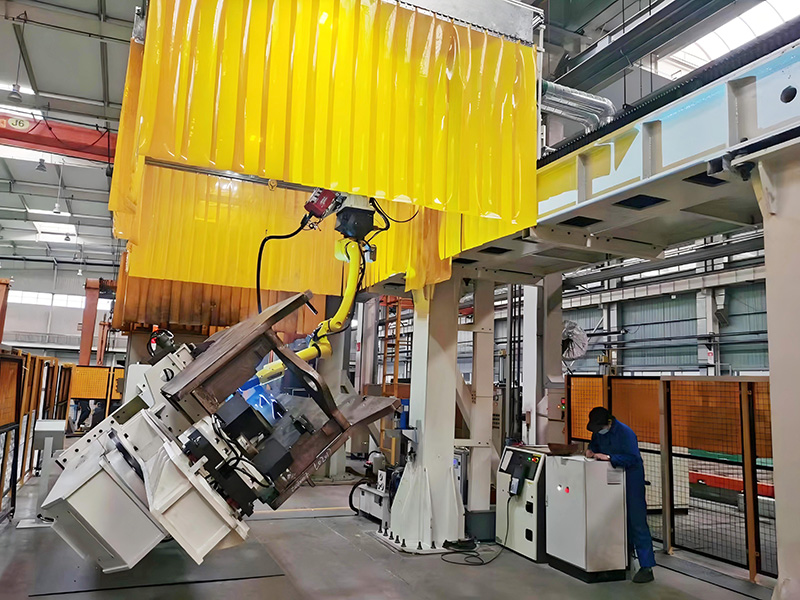
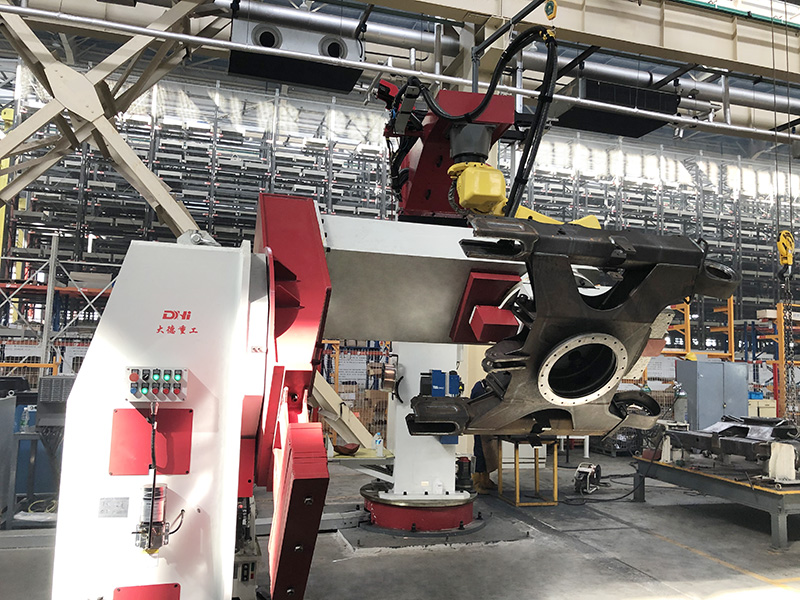
Road Roller Mainframe Welding Production Line
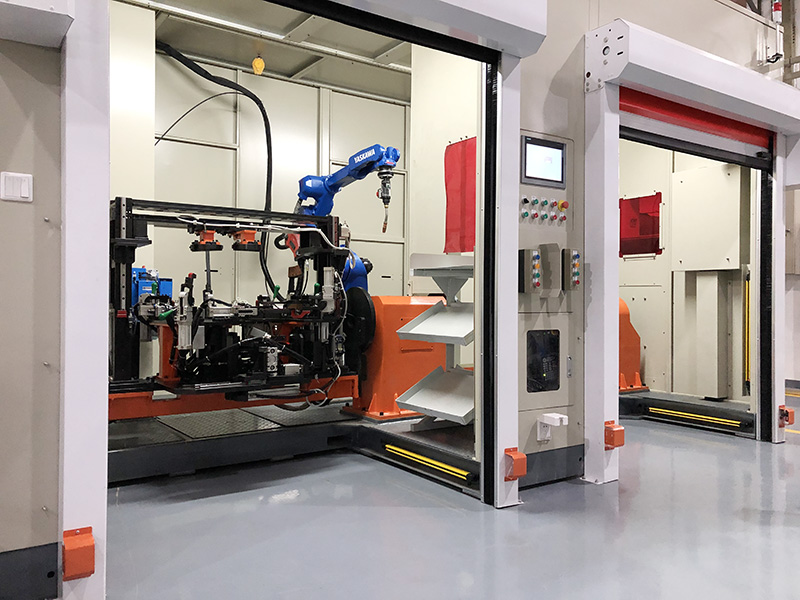
AGV-driven smart welding assembly line
Dade Heavy Industry (stock code 870547) designs and manufactures turnkey robotic welding cells for structural steel fabrication, automotive body-in-white, shipbuilding hulls, and construction machinery. We integrate Kawasaki, Fanuc, and Estun 6-axis robot arms with pulsed MIG/MAG power sources, servo-driven positioners, and ISO 10218-2 compliant safety systems. 10,000+ units delivered across 30 provinces and exported to Southeast Asia, the Middle East, Japan, Europe, and the Americas.
Kawasaki certified agent (2025) · IATF 16949 · ISO 9001 · 100,000 m² factory in Wuxi, Jiangsu
Pulsed MIG with digital communication for structural steel, automotive frames, and heavy equipment. Payloads 6–20 kg, reaches 1,400–2,000 mm.
Precision TIG for stainless steel, aluminium, and titanium in aerospace, pressure vessels, and food-grade piping. AC/DC square-wave power sources.
DN/DP pneumatic spot, DT projection, FN-II seam, and FNZ twin-roller seam welders for sheet metal assemblies and automotive components.
Fiber laser 1–12 kW with scanner heads for tailor-welded blanks, battery tabs, and dissimilar metals. Scanner-based remote welding up to 50 m/min.
Plasma arc for stainless steel and titanium; SAW for thick-plate longitudinal seams in pressure vessels and wind-tower sections.
Multi-robot cells with part transfer, fixturing, seam tracking, fume extraction, and ERP/MES integration. Commissioned in 30+ countries.
The table below summarizes typical robot, process, and positioner pairings Dade Heavy Industry supplies for common industrial applications. Exact configuration depends on workpiece geometry, material, production volume, and quality standard.
| Application | Robot Arm | Welding Process | Typical Workpiece | Positioner Type | Typical Cycle Time |
|---|---|---|---|---|---|
| Excavator boom & stick arms | 6-axis, 20 kg payload, 1,800 mm reach | Pulsed MIG / MAG | High-strength X-frame chassis, 20–50 mm plate | 2-axis headstock-tailstock (2,000 kg) | 3–6 min / joint |
| Support wheel rim (mining trucks) | 6-axis, 12 kg payload, 1,400 mm reach | Robotic MIG with pulsed arc | Wheel rim, 600–1,200 mm diameter | 2-axis headstock-tailstock (1,500 kg) | 2–4 min / rim |
| Gas-insulated transmission line (GIL) | Gantry-mounted dual 6-axis, 12 kg each | MIG with cold-metal transfer (CMT) | Aluminium alloy enclosure, 3–8 mm wall | 3-axis gantry + 2-axis positioner | 8–15 min / joint |
| Vibration exciter assembly | 6-axis, 10 kg payload | MIG with seam tracking | Exciter housing, cast steel | Single-axis rotary table (500 kg) | 4–7 min / assembly |
| Exhaust aftertreatment housing | 6-axis, 6 kg payload, hollow wrist | TIG with cold-wire feed | Stainless steel 304/316, 1.5–3 mm | 2-axis rotary-tilt (300 kg) | 1–3 min / part |
| Horizontal rotation workstation | Dual 6-axis, 12 kg each | Dual-torch MIG | Structural beams, 500–2,000 mm length | Single-axis turntable + linear track | 2–5 min / beam |
| Automotive body-in-white (BIW) | 6-axis, 8–12 kg, hollow wrist | Resistance spot + MIG hybrid | Sheet steel 0.8–2.0 mm | None (direct part transfer) | 5–15 sec / spot |
| Pressure vessel longitudinal seam | Gantry SAW, 1.6–4.0 mm wire | Submerged arc (SAW) | Carbon steel, 12–60 mm plate | Rotating roller bed (10,000 kg) | 0.3–1.2 m/min |
A well-scoped RFQ cuts quotation time from weeks to days. Follow these five steps to define your cell.
Match payload to torch + wire feeder + cable pack weight (typically 15–35 kg). Reach must cover the farthest weld joint plus 150 mm margin. Dade supplies Kawasaki (QJAR series), Fanuc (ARC Mate), and Estun (ER series) arms from 6 kg to 20 kg payload, 1,400–2,000 mm reach. For parts over 2 m, add a 7th-axis linear track (1–6 m stroke).
Pulsed MIG with digital communication (e.g., Kemppi, Fronius, Lincoln Electric, OTC) is standard for structural steel. For stainless/aluminium, specify AC/DC TIG with square-wave and pulse. For high-deposition thick plate, consider tandem MIG or SAW. Power source must support digital handshake with robot controller for real-time parameter adjustment.
Single-axis rotary (up to 2,000 kg) for simple rotation; dual-axis headstock-tailstock (up to 5,000 kg) for complex 3D joints; 3-axis gantry + rotary for large fabrications. Servo-driven with ±0.01° repeatability. Synchronize with robot via Ethernet/IP or Profinet.
Modular quick-change fixtures reduce changeover from hours to minutes. Design for clamp clearance around torch access zones. Include datum pins for repeatable part location ±0.05 mm. Consider pneumatic clamping for cycle-time reduction.
Through-arc tracking (TACT) for MIG; laser line scanner for TIG/laser; tactile touch-sensing for fit-up verification. Adds 15–25% to cell cost but eliminates rework on warped or misaligned parts. Essential for shipbuilding panels, large structural weldments, and castings with dimensional variation.
The table below shows a representative cost share for a standard MIG welding cell. Exact pricing varies by region, payload class, integration scope, and local labor rates; this is for budgetary scoping only.
| Component | Share of Cell Cost | Notes |
|---|---|---|
| Robot arm + controller | 30–40% | 6-axis arm, 20 kg payload typical for structural MIG |
| Welding power source + wire feeder | 10–15% | Pulsed MIG with digital communication |
| Welding positioner | 10–20% | Single-axis, two-axis, or three-axis depending on workpiece |
| Linear track (if specified) | 5–15% | Length-dependent; long tracks raise share |
| Fixturing + tooling | 10–20% | Custom per part family; quick-change premium |
| Safety enclosure + interlocks | 3–5% | ISO 10218-2 compliant, light curtains, e-stop |
| Seam tracking + sensors | 3–8% | Optional; laser higher than TAST |
| Integration, programming, training | 10–15% | Procedure qualification often separate line item |
Note: When Dade engineers commission a cell on site, the integration line item often expands if the customer needs welding procedure qualification (WPQ) under ISO 15614, ASME Section IX, or AWS D1.1. WPQ work runs in parallel with mechanical install and is priced separately on the basis of joint count and code.
Excavator booms, stick arms, bucket linkages, undercarriage frames. High-strength steel (Q690, Q890), thick plate, multi-pass MIG with preheat control. Typical cycle: 3–6 min/joint. Dade has delivered 200+ cells to XCMG, Sany, Zoomlion supply chains.
Body-in-white spot welding, battery tray laser welding, motor housing TIG. High-volume, takt-time critical. Dual-robot cells with servo guns, servo-driven spot welders, and real-time quality monitoring (Q-DAS integration). IATF 16949 compliant.
Hull block panel lines, stiffener welding, longitudinal seams. Gantry SAW for flat panels; robotic MIG for curved sections. Preheat/interpass temperature monitoring per AWS D1.1 / ISO 15614. Delivered to CSSC, DSIC, and Korean yard supply chains.
GIL aluminium enclosures, heat exchanger tube-to-tubesheet, reactor nozzle welds. TIG with cold-wire feed for stainless 304/316, duplex 2205, Inconel 625. Orbital TIG for tube-to-tubesheet; SAW for longitudinal seams. ISO 15614 / ASME IX WPQ support.
Wind tower flange welding, transmission tower leg-to-crossarm, substation structures. High-volume fillet and butt joints. Dual-robot tandem MIG for deposition rates up to 12 kg/h.
Bogie frames, side frames, coupler pockets. Fatigue-critical welds requiring 100% UT/MT. Robotic MIG with preheat/interpass control. Delivered to CRRC and Wabtec supply chains.
With drawings, material specification, production volume, and site constraints supplied, technical quotations are returned within 5 to 10 business days. A contract-grade commercial proposal follows within 1 to 2 weeks once the technical scope is fixed.
Yes. Kawasaki, Fanuc, and Estun robot arms can be supplied standalone with controller, teach pendant, and commissioning support. Positioner, fixturing, safety systems, and programming are added as an integrated package on request.
Standard robot arms are typically 8 to 12 weeks from order. Welding workstations with custom fixturing run 10 to 16 weeks. Fully custom lines with non-standard tooling and seam tracking run 16 to 24 weeks.
Yes. Dade supports installation, commissioning, and operator training in export markets including Southeast Asia, the Middle East, Japan, Europe, and the Americas, either as part of the turnkey project or as standalone engineering service.
Standard packages include 12 months parts warranty on the robot and welding equipment, remote controller diagnostic support, and a parts dispatch service agreement. Extended service covering scheduled preventive maintenance and faster on-site response is available on request.
We support WPQ/WPS development per ISO 15614, ASME Section IX, AWS D1.1/D1.3, EN 1090, and customer-specific codes. Procedure qualification testing (tensile, bend, macro, RT/UT) can be arranged through accredited labs.
Send drawings (PDF + STEP), material specification, production volume (parts/shift), cycle-time target, quality standard (code), site constraints, and integration scope. Technical quotations returned within 5–10 business days for complete RFQ packages.
Send Inquiry Now