Automatic Welding Equipment: An Innovative Solution To Improve Efficiency, Reduce Costs, And Enhance Quality
Release time:2026-04-20
Visits:448
In the rapid development of modern manufacturing, automation technology is playing an increasingly important role. Among them, automatic welding equipment, as a key device for welding operations through automation technology, is widely used in various industries, bringing significant efficiency improvements to enterprises. It can not only greatly improve welding efficiency, significantly reduce production costs, but also effectively enhance welding quality and fundamentally improve the working environment of workers.
Main Types of Automatic Welding Equipment
According to the degree of automation and specific application scenarios, automatic welding equipment can be mainly divided into the following categories:
Rigid automatic welding equipment (primary automation equipment): This type of equipment is an entry-level choice for automated welding. It is designed based on the open-loop control principle and can automatically complete the entire welding process according to a preset program. However, its limitation is that it cannot perform closed-loop feedback control on parameter fluctuations during welding, nor can it randomly correct possible deviations.
Adaptive control automatic welding equipment: Compared with rigid automation equipment, adaptive control automatic welding equipment is a step forward in technology. It is equipped with advanced electronic sensing circuits and sensors, which can realize automatic guidance and precise tracking of the weld trajectory, and implement closed-loop feedback control on the main parameters during the welding process to ensure that the entire welding process is completed automatically in an efficient and stable manner in strict accordance with the preset program and process parameters.
Intelligent automatic welding equipment: This represents the highest level of current automatic welding technology. Intelligent equipment integrates a variety of high-precision detection elements, such as visual sensors, touch sensors, auditory sensors, and laser scanners. With the help of a powerful computer software system, a rich database, and a professional expert system, it can perform real-time identification, intelligent judgment, accurate detection, and rapid calculation of the welding process, and can realize automatic programming. In addition, it also has advanced functions such as welding parameter storage and automatic generation of welding log files.
Basic Composition of Automatic Welding Equipment
A complete set of automatic welding equipment is usually composed of the following key components:
Welding power source: As the core power source of the equipment, its output power and welding characteristics must match the welding process method used, and it is equipped with an interface connected to the main controller to realize collaborative work.
Wire feeder and its speed control system: For occasions with high requirements for wire feeding speed control accuracy, the control circuit of the wire feeder needs to have acceleration feedback function to ensure the stability and accuracy of wire feeding.
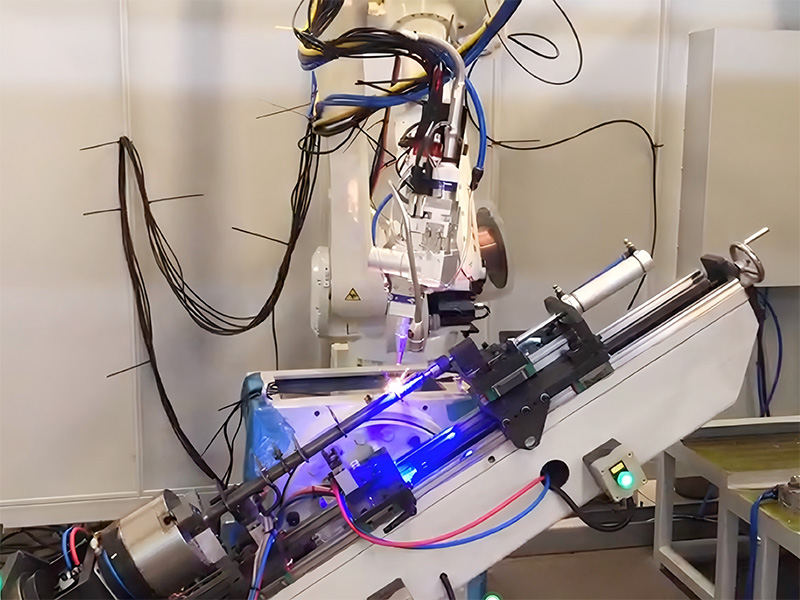
Welding head: The movement mechanism of the welding head usually consists of the welding head itself, the welding head support frame, the suspension trolley, etc. To ensure the accuracy of the welding head movement, its drive system generally uses a servo motor with an encoder.
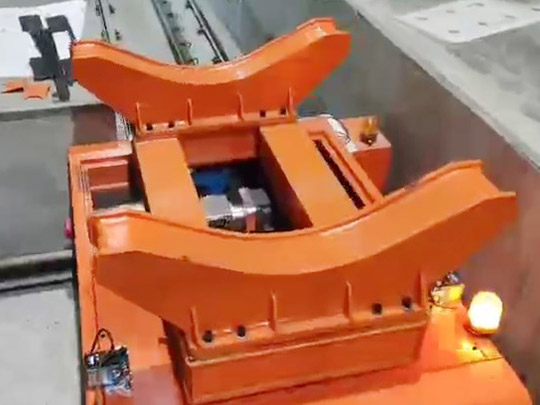
Traveling mechanism: Such as welding roller stands, head-tail stock tilters, turntables, positioners, etc. These movable traveling mechanisms are important components for realizing welding position adjustment, and are usually driven by servo motors to ensure the stability and positioning accuracy of movement.
Main controller (system controller): This is the ""brain"" of the automatic welding equipment, mainly responsible for the linkage control between components, the execution of welding programs, the setting, adjustment and display of welding parameters and extended parameters, and also has key control functions such as fault diagnosis and human-machine dialogue.
Computer software: The operation of the equipment is inseparable from the support of various software, commonly used including programming software, function software, expert systems, and special software for specific process methods.
Auxiliary devices: To ensure the smooth progress of the welding process, auxiliary devices such as wire feeding system, circulating water cooling system, flow recovery and conveying device, wire reel, drag chain and cable hose mechanism are also required.
Weld seam tracking system: This system can help the equipment accurately find the weld position and track the welding trajectory in real time, which is an important guarantee for ensuring welding accuracy.
Wide Application Fields of Automatic Welding Equipment
With its significant advantages, automatic welding equipment has been widely used in many industries such as machinery manufacturing, automobile manufacturing, steel structure, and container production. It can not only stably improve the quality of welded products, reduce errors caused by human factors, but also effectively reduce the welding costs of enterprises, including labor costs and material waste. At the same time, it liberates workers from the harsh and high-intensity welding work environment in the past, greatly improving working conditions. With the continuous advancement of technology, automatic welding equipment is developing in a more intelligent and efficient direction, injecting strong impetus into promoting the transformation and upgrading of various industries."