Multi-Joint Robots: A Comprehensive Analysis Of Principles, Applications, Advantages, And Future Development Trends
Release time:2026-05-18
Visits:494
In the era of rapid development of automation and intelligentization, multi-joint robots, with their excellent flexibility and versatility, are becoming a key driving force for transformation in various industries. They can simulate the complex movements of the human arm and accurately perform various tasks in three-dimensional space, greatly improving production efficiency and operation precision. This article will deeply explore the working principles, wide-ranging applications, core advantages and challenges, as well as future development trends of multi-joint robots.
I. Working Principles of Multi-Joint Robots
The core of
multi-joint robots lies in their flexible structure composed of multiple independent rotating joints. Each joint is usually driven by a high-precision motor, and by precisely controlling the rotation angle and speed of each joint, the robot can achieve complex motion trajectories in three-dimensional space.
Joint modules are the key components for multi-joint robots to realize motion, and their design directly affects the robot's performance. These modules are responsible for efficiently converting the energy of the motor into the required physical motion, which can be either rotational or linear. In pursuit of ease of use and energy conversion efficiency, the design of joint modules often embodies the wisdom of precision engineering, ensuring that the robot is both flexible and efficient when performing tasks.
II. Wide Application Fields of Multi-Joint Robots
The application scenarios of multi-joint robots are extremely extensive, profoundly changing the production mode of traditional industries and showing great potential in emerging fields:
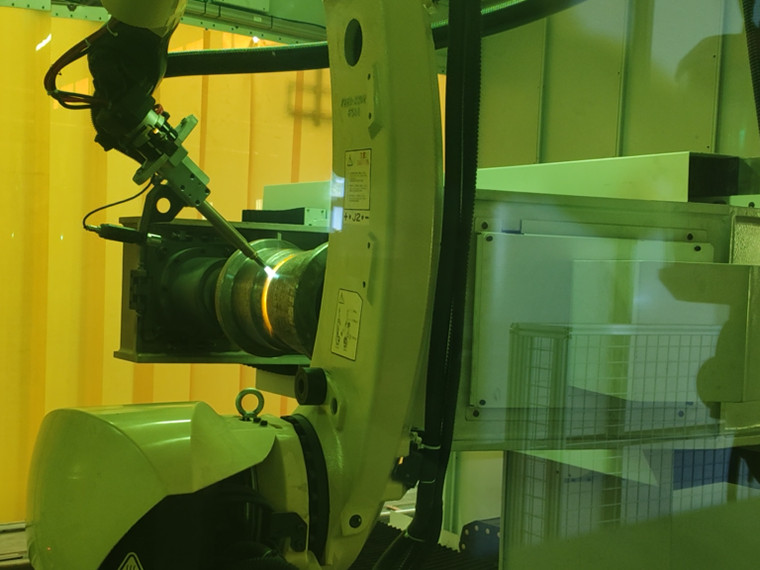
1. Industrial Automation and Manufacturing: This is the most mature and widely used field of multi-joint robots. They play an irreplaceable role in assembly lines, welding operations, precision painting, material handling and loading/unloading, etc. They not only significantly improve production efficiency and reduce human errors, but also can replace manual labor in dangerous or highly repetitive working environments to ensure production safety.
2. Healthcare Field: In the medical field, multi-joint robots provide strong technical support for minimally invasive surgery, precise radiotherapy, rehabilitation treatment, etc. Surgical robots can assist doctors in performing high-precision operations, reducing trauma and recovery time; rehabilitation robots can provide patients with personalized rehabilitation training to help them restore motor functions.
3. Other Emerging Fields: With the advancement of technology, the application boundaries of multi-joint robots are constantly expanding, gradually penetrating into semiconductor manufacturing, education and training, scientific research, military defense, aerospace and other fields, solving increasingly complex problems.
III. Core Advantages and Potential Challenges of Multi-Joint Robots
Advantages:
High Flexibility: With multiple degrees of freedom, it can easily complete various complex and delicate movements, adapting to diverse operational needs.
Excellent Precision: Adopting advanced control technology and precise mechanical structure to ensure extremely high positioning accuracy and trajectory tracking ability when repeatedly performing tasks.
Easy Programming and Control: Usually equipped with a user-friendly programming interface and teaching function, allowing operators to relatively easily program tasks and plan paths for the robot.
Good Energy Conversion Efficiency: Optimized joint design and drive system enable the robot to effectively utilize energy during operation, reducing energy consumption.
Operational Safety and Maintenance Convenience: Modern multi-joint robots generally have完善的 safety protection mechanisms and are designed with maintenance convenience in mind.
Balanced Cost-Effectiveness: With the popularization of technology and large-scale production, the overall cost of ownership is gradually becoming reasonable, which can bring long-term investment returns to enterprises.
Challenges:
Structural Complexity: The relatively complex overall structure due to more joints and precision components may require professional knowledge for maintenance and repair.
Initial Investment Cost: For some high-end models or customized solutions, the purchase cost may be high, posing a certain threshold for small enterprises.
Working Environment Requirements: Some high-precision applications have certain requirements for the working environment (such as temperature, humidity, cleanliness, space), requiring corresponding environmental configuration.
IV. Future Development Trends of Multi-Joint Robots
Looking to the future, the development of multi-joint robots will present the following important directions:
Enhanced Intelligence: By integrating technologies such as artificial intelligence, machine learning, and computer vision, robots will have stronger autonomous decision-making ability, environmental perception ability, and self-learning ability, capable of independently handling more complex dynamic tasks.
Modularization and Standardization: Modular design will become the mainstream, making robot assembly, upgrading, and maintenance more convenient. Components of different brands and models will also be more easily compatible, reducing costs and shortening development cycles.
Customization and Personalization: In response to the needs of different industries and specific application scenarios, robots will provide more flexible customized solutions to meet users' personalized needs.
Deepened Human-Robot Collaboration: Future robots will pay more attention to natural interaction and collaboration with humans, achieving efficient and harmonious coexistence of humans and robots in the same workspace through more user-friendly human-machine interfaces and safer collaboration mechanisms.
Summary
As an outstanding representative of modern automation technology, multi-joint robots, with their unique structural advantages and powerful functions, are playing an increasingly important role in promoting industrial upgrading, improving medical services, exploring unknown fields, etc. Although facing some challenges, their development prospects are broad. With the continuous evolution of trends such as intelligentization, modularization, customization, and human-robot collaboration, multi-joint robots will certainly play a more core role in future intelligent manufacturing and intelligent life, bringing more well-being and benefits to human society."