3D Robotic Fiber Laser Welding Machine: An Innovative Solution To Enhance Manufacturing Efficiency And Precision Welding
Release time:2026-07-20
Visits:421
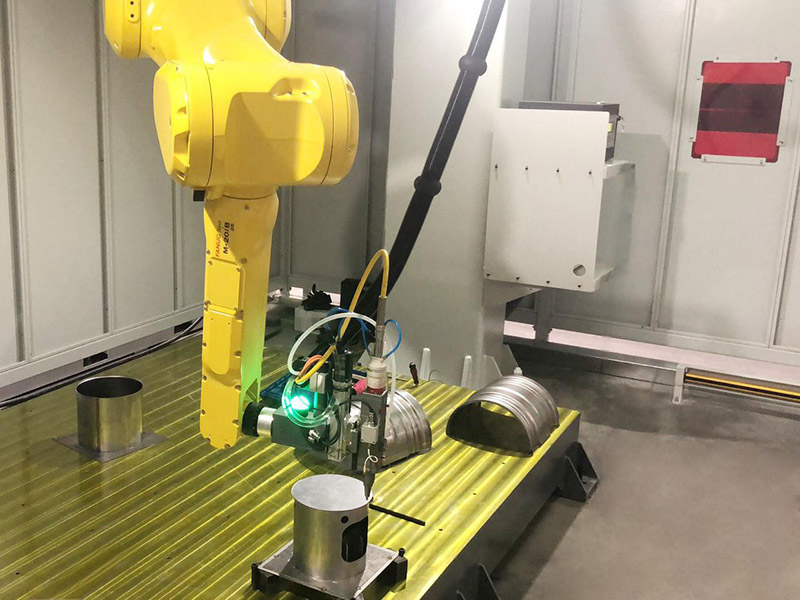
Against the backdrop of modern manufacturing's pursuit of high precision, high efficiency, and high automation, 3D robotic fiber laser welding machines are gradually becoming the ideal choice for numerous industries. This advanced equipment skillfully integrates the flexible movement of 3D robots with the precise energy of fiber laser welding, bringing a revolutionary solution for the welding of complex workpieces.
The core working mechanism of a 3D robotic fiber laser welding machine is based on the following key links:
1. Generation and Transmission of High-Energy Laser Beam: The equipment transmits a high-energy laser beam through an optical fiber, which can be precisely focused on the surface of the workpiece to be welded. Under the action of laser energy, the material in the irradiated area rapidly absorbs the energy and melts instantaneously, forming a molten pool.
2. Precise Manipulation by 3D Robot: The equipped robotic arm has the ability to move precisely in the X, Y, and Z dimensions. This enables the laser welding head to flexibly and accurately reach any welding position of the workpiece according to the preset path and trajectory, making it particularly suitable for handling workpieces with complex geometries.
3. Automated Welding Process: The entire welding process is highly automated. The robot can work continuously without fatigue, avoiding the fatigue and efficiency fluctuations that may occur with manual operation, thereby significantly improving overall production efficiency and minimizing manual intervention.
Core Advantages of 3D Robotic Fiber Laser Welding Machine
By choosing a 3D robotic fiber laser welding machine, enterprises can gain significant advantages in multiple aspects:
Excellent High Precision and High Consistency: The perfect combination of the precise motion control of the 3D robot and laser welding technology ensures the quality and dimensional accuracy of each weld. This advantage is particularly prominent for workpieces with complex shapes and strict welding requirements, effectively ensuring the uniformity of product quality.
Significant Improvement in Production Efficiency: The automated welding process greatly accelerates the welding speed, can meet the needs of mass production, thereby significantly improving the overall production efficiency and capacity of the enterprise.
Strong Versatility and Adaptability: The equipment has the ability to weld a variety of materials, including metals, plastics, and composite materials, and can flexibly adapt to welding tasks in different industries and types, providing enterprises with a wide range of application possibilities.
Effective Reduction in Labor Intensity: The automated welding process greatly reduces reliance on manual operations, not only reducing the labor intensity of workers but also improving the working environment.
Better Environmental and Safety Performance: The laser welding process itself generates relatively concentrated heat, reducing the thermal impact on non-welding areas of the workpiece and lowering the risk of workpiece deformation and thermal damage. At the same time, it produces less smoke and harmful gases, which is more in line with environmental and safety standards.
Wide Application Fields of 3D Robotic Fiber Laser Welding Machine
With its numerous advantages, 3D robotic fiber laser welding machines have been widely used in multiple industries:
Automobile Manufacturing: Play an important role in the production of auto parts, and can be used for welding engine components, body panels, chassis structures, and interior components, etc.
Aerospace: Meet the stringent requirements for welding complex parts and high-precision components in the aerospace field, ensuring the safety and reliability of aircraft.
Electronic Manufacturing: Suitable for the welding of precision components in electronic devices, such as high-precision welding of micro-components like circuit boards, connectors, and sensors.
Medical Device Manufacturing: In the production of precision medical devices such as surgical instruments, implants, and diagnostic equipment, it can provide clean and precise welding solutions.
Other Industries: In addition, it can also play a unique role in industries that require attention to details and precision, such as jewelry processing, fashion accessory production, signboard and advertisement production.
Advanced Technical Features of 3D Robotic Fiber Laser Welding Machine
To ensure the stability, reliability, and efficiency of the welding process, 3D robotic fiber laser welding machines are usually equipped with a number of advanced technical features:
Self-Protection Function: When a potential hazard is detected, the robot can automatically stop working, thereby protecting the safety of the equipment itself and the operators.
Welding Torch Oscillation Function: The welding torch can oscillate along a specific trajectory according to preset parameters, which helps to improve the molten pool formation and welding quality, especially suitable for filling some special welds.
Welding Sensing Function: Integrated with welding sensors, it can achieve precise detection of the welding starting point and real-time weld tracking during the welding process, ensuring the accuracy of the welding path.
Welding Torch Anti-Collision Function: During the welding process, if the welding torch is accidentally subjected to abnormal resistance or collision, the robot will immediately stop moving to avoid damage to the welding torch and the workpiece.
Welding Torch Calibration Function: Even if a slight collision causes the welding torch position to deviate, the welding torch姿态 can be corrected and reset through simple operations to ensure the precision of subsequent welding.
Welding Wire Adhesion Contact Function: After welding, if wire adhesion occurs, the equipment can release the adhesion by emitting light again, ensuring the smooth progress of the next welding.
Arc Break Restart Function: If an arc break occurs during the welding process, the robot can automatically identify and return to the break point, re-ignite the arc and continue welding, reducing welding defects and material waste.
Summary
In conclusion, with its characteristics of high efficiency, precision, safety, and high automation, 3D robotic fiber laser welding machines are becoming a powerful assistant in handling complex welding tasks in modern manufacturing. It can not only significantly improve product quality and production efficiency but also reduce production costs and labor intensity, injecting new vitality into the development of various industries. With the continuous innovation and development of technology, 3D robotic fiber laser welding machines will undoubtedly play a more important role in the field of intelligent manufacturing in the future, continuously promoting the progress and upgrading of the manufacturing industry."