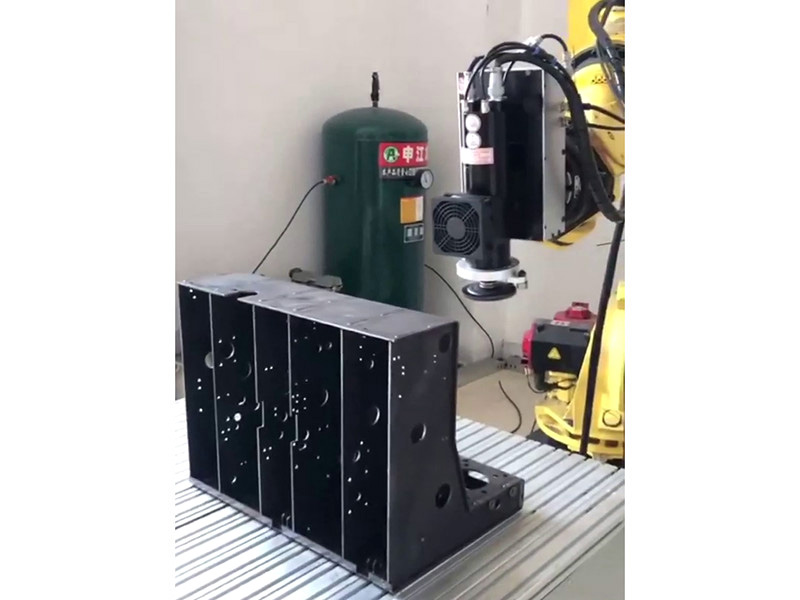
In the field of industrial manufacturing, welding, as a key process for joining materials, its quality and efficiency directly affect product performance and production efficiency. With the in-depth advancement of intelligent manufacturing, intelligent welding control system has gradually become the core of modern welding technology. By integrating advanced sensors, intelligent algorithms, and digital management, it has redefined the control logic of the welding process, bringing comprehensive optimization of efficiency, quality, and cost to the industry.
I. Intelligent Welding Control System: Redefining the Core of the Welding Process
Traditional welding relies on manual experience and manual operation, which is easily affected by factors such as environment and personnel skills, leading to quality fluctuations and efficiency bottlenecks. The intelligent welding control system, through integrating the three core capabilities of data collection, intelligent analysis, and precise control, realizes the digitization, automation, and intellectualization of the welding process. It is not only the ""brain"" of welding equipment but also a key hub connecting production data and decision-making, transforming welding from ""experience-driven"" to ""data-driven"".
II. Core Function Analysis: Full-Process Management from Data to Decision-Making
The intelligent welding control system covers the entire life cycle of welding, ensuring process controllability, data availability, and decision accuracy through multi-dimensional technical means, mainly including the following core capabilities:
1. Real-time Data Collection and Dynamic Monitoring
Through built-in sensors, key parameters in the welding process are captured in real-time, such as current, voltage, welding speed, workpiece temperature, and equipment operating status. Real-time feedback is provided through a visual interface, allowing operators to grasp welding dynamics at any time and detect abnormalities promptly.
2. Data Storage and Intelligent Analysis
It supports multi-format data storage and builds a welding process database. Combined with big data analysis and AI algorithms, in-depth mining of historical and real-time data is conducted to generate welding quality evaluation reports, parameter optimization suggestions, etc., providing data support for production decision-making.
3. Precise Parameter Optimization and Weld Seam Tracking
According to workpiece material, thickness, and welding process requirements, the system can automatically match or optimize welding parameters (such as current magnitude, arc length, etc.), reducing manual debugging time. At the same time, visual sensors are used to track the weld seam position in real-time and dynamically adjust the welding torch trajectory to ensure welding accuracy, especially suitable for welding complex workpieces.
4. Remote Monitoring and Authority Management
It supports remote access through the network, allowing managers to view welding data and equipment status from a different location, and even remotely control equipment start and stop. Combined with hierarchical authority settings, data security and operational specifications are ensured, and non-authorized personnel are prevented from interfering with core processes.
5. Fault Diagnosis and Predictive Maintenance
The system has a built-in fault diagnosis algorithm, which can monitor equipment abnormalities in real-time (such as motor failure, sensor abnormality, etc.) and automatically alarm. By analyzing equipment operation data, potential fault risks can also be predicted, and maintenance can be arranged in advance to reduce unplanned downtime.
III. Core Advantages: Why Intelligent Welding Control System Becomes an Industry Necessity?
Compared with traditional welding methods, the intelligent welding control system brings multi-dimensional value improvement through technological innovation and becomes a key tool for manufacturing enterprises to reduce costs and increase efficiency:
1. More Stable Welding Quality
Through precise parameter control and weld seam tracking, human operation errors are reduced, the consistency of each weld is ensured, and the rework rate is lowered. This advantage is particularly obvious in fields such as automotive and aerospace that have strict requirements for welding quality.
2. Significant Improvement in Production Efficiency
Real-time monitoring and parameter optimization reduce downtime for debugging, and the remote control function breaks spatial limitations, making management more efficient. Data shows that after introducing the intelligent control system, the welding efficiency of some enterprises can be increased by more than 30%.
3. Effective Reduction in Production Costs
Predictive maintenance reduces equipment maintenance costs, parameter optimization reduces consumable waste, and stable quality reduces rework losses, lowering the comprehensive production costs of enterprises in multiple dimensions.
4. More Scientific Management Decisions
Data visualization reports make the production status clear at a glance, and management can adjust production plans and optimize process schemes based on real data, realizing the transformation from ""experience management"" to ""data management"".
5. Comprehensive Upgrade of Safety
Real-time monitoring of equipment status and environmental parameters, combined with safety protection logic (such as overcurrent protection, emergency stop), reduces safety hazards in the welding process and ensures the safety of operators and equipment.
IV. Wide Application Scenarios: Covering Welding Needs of Multiple Industries
With its flexibility and reliability, the intelligent welding control system has been applied in multiple industrial fields and has become a ""standard configuration"" in key production links:
- Automobile Manufacturing: In the welding of body frames and chassis, precise parameter control ensures welding strength and improves the safety performance of the entire vehicle;
- Aerospace: For the welding of high-strength alloy materials, the system avoids welding deformation and ensures the precision of parts through real-time temperature monitoring and parameter optimization;
- Ship and Ocean Engineering: In the welding of large components, remote monitoring and weld seam tracking functions solve on-site operation problems and improve welding efficiency;
- New Energy Field: In the welding of lithium battery tabs and photovoltaic brackets, microsecond-level parameter adjustment ensures the consistency of welding quality;
- Construction Steel Structure: In the welding of complex nodes, the system realizes quality traceability through data tracing function, meeting engineering acceptance standards.
V. Future Development Trends: Innovation Directions of Intelligent Welding Control System
With the development of Industry 4.0 and AI technology, the intelligent welding control system will evolve towards being more intelligent, more integrated, and more user-friendly:
1. Higher Precision and Real-time Performance
Sensor technology and data processing capabilities will be further upgraded to achieve nanoscale parameter collection and millisecond-level response, capturing tiny changes in the welding process (such as molten pool shape, arc stability), making quality control more precise.
2. In-depth AI Integration and Autonomous Decision-Making
More advanced machine learning algorithms will be introduced, enabling the system to independently learn welding process rules based on historical data, automatically recommend optimal parameter combinations, and even realize ""unmanned intervention"" autonomous welding under complex working conditions.
3. Full-Process Digital Integration
Seamless docking with MES (Manufacturing Execution System), ERP (Enterprise Resource Planning) and other systems to realize full-process digital management from order scheduling, welding execution to quality traceability, and build an ""end-to-end"" intelligent production closed loop.
4. More User-friendly Interactive Experience
The operation interface will be more intuitive, supporting voice control, AR-assisted operation and other functions, reducing the learning cost of operators and lowering the technical threshold.
5. Data Security and Privacy Protection
Technologies such as blockchain and encrypted transmission will be adopted to ensure the security of welding data during storage and transmission and meet industrial data compliance requirements.
Conclusion: Intelligent Welding Control System, Leading the Intelligent Transformation of the Welding Industry
As the core of modern welding technology, the intelligent welding control system is breaking the efficiency and quality bottlenecks of traditional welding through data-driven and intelligent decision-making, bringing multiple values of ""improving quality, increasing efficiency, and reducing costs"" to manufacturing enterprises. From automotive to aerospace, from new energy to construction steel structures, its application is reshaping the welding production models of various industries. In the future, with the continuous iteration of technology, the intelligent welding control system will become an important pillar of industrial intelligence, promoting the welding industry to develop towards higher quality, higher efficiency, and more sustainable directions."