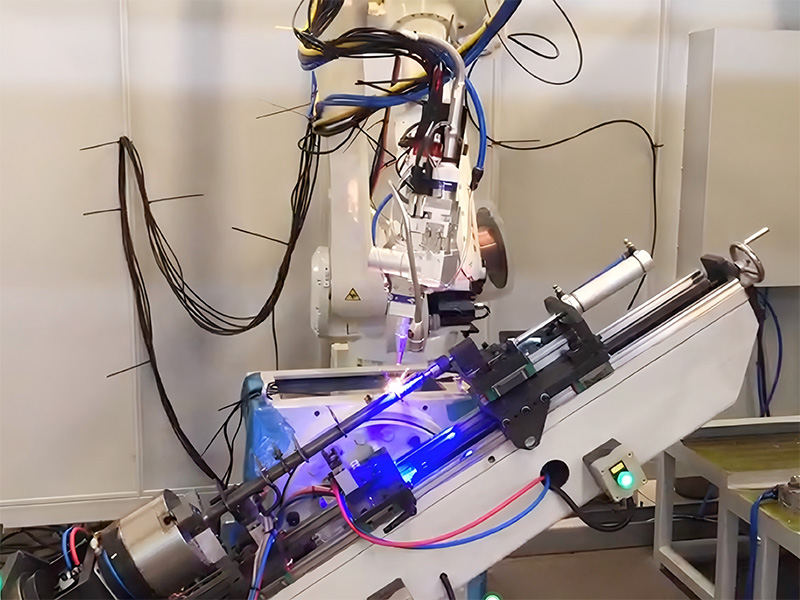
Collaborative robot (cobot) welding has emerged as a cornerstone of smart manufacturing, redefining productivity by merging human dexterity with robotic precision. Unlike traditional industrial welding robots—which require physical safety barriers and specialized programming expertise—cobots comply with ISO/TS 15066 (the global standard for human-robot collaboration, HRC) to operate safely alongside workers. This integration addresses key manufacturing pain points: repetitive strain injuries, inconsistent weld quality, and rigid production workflows. For industries ranging from automotive tier suppliers to small-batch metal fabricators, cobot welding delivers measurable efficiency gains through flexibility, automation, and cost optimization.
Cobot welding refers to the use of collaborative robots equipped with welding tools (e.g., MIG torches, TIG electrodes, spot-welding guns) to support or execute welding tasks in shared human-robot workspaces. Its technical distinction from traditional welding robots lies in three core design principles:
- Intrinsic Safety: Built-in force-torque sensors and collision detection systems limit contact force to ≤50N (per ISO/TS 15066), eliminating the need for safety cages and enabling direct human proximity.
- User-Friendly Programming: Graphical user interfaces (GUIs) and “teach-by-demonstration” functionality allow welders (not just roboticists) to program tasks in 15–30 minutes—compared to 4–8 hours for conventional robot programming.
- Modular Integration: Compact form factors (typically 15–50kg) and compatibility with standard welding power sources (e.g., Fronius, Lincoln Electric) enable seamless retrofitting into existing production lines, no facility redesign required.
Cobot welding systems also incorporate real-time process monitoring (e.g., arc voltage/current tracking, weld bead inspection via machine vision) to ensure compliance with industry standards like AWS D1.1 (structural steel) or ISO 15614 (qualification of welding procedures).
2. Core Efficiency Drivers of Cobot Welding
Cobot welding enhances production efficiency not just through “automation,” but by solving specific bottlenecks in welding workflows. Below are the four most impactful drivers, supported by industry data:
2.1 Productivity & Throughput Gains
Welding is inherently repetitive, with human welders limited by fatigue (typically 60–70% “arc-on time,” the percentage of time the torch is active). Cobots address this by:
- Maximizing Arc-On Time: Operating 24/7 with 90–95% arc-on time—boosting daily output by 25–30% compared to human-only workflows. For a fabricator producing 100 welded assemblies daily, this translates to 25–30 additional units.
- Unattended & Lights-Out Operation: Integrated load/unload systems (e.g., pneumatic fixtures, robotic part feeders) enable overnight or weekend production, adding 8–12 hours of non-labor-dependent output weekly.
- Task Paralleling: Humans handle high-value tasks (e.g., part fixturing, quality inspection) while cobots execute repetitive welds (e.g., fillet welds on brackets). This “human-machine collaboration” cuts cycle times by 15–20% versus either alone.
2.2 Quality Consistency & Defect Reduction
Weld quality directly impacts efficiency—rework for defective welds (e.g., porosity, undercutting) can consume 10–15% of production time and increase material waste by 5–8%. Cobots mitigate this through:
- Parameter Precision: Computer-controlled wire feed rates (2–20 m/min), travel speeds (50–500 mm/min), and arc length (±0.1mm) ensure uniform weld bead geometry across every part.
- In-Process Correction: Sensors detect deviations (e.g., part misalignment, thermal distortion) and adjust parameters in real time—reducing defect rates to <1% (vs. 3–5% for manual welding).
- Auditable Traceability: Most cobot systems log welding data (time, parameters, operator) to comply with quality standards (e.g., IATF 16949 for automotive), eliminating time spent on manual record-keeping.
2.3 Flexibility for High-Mix, Low-Volume (HMLV) Production
Modern manufacturing increasingly requires rapid switching between parts (e.g., custom metal fabricators handling 5–10 unique orders daily). Cobots excel here by:
- Rapid Changeovers: Reprogramming for new part geometries takes 15–30 minutes, compared to 2–4 hours for traditional robots. For a shop with 3 daily changeovers, this saves 4.5–7.5 hours weekly.
- Multiprocess Compatibility: A single cobot can switch between MIG, TIG, and spot welding via quick-change tooling—eliminating the need for multiple dedicated robots and reducing floor space usage by 30–40%.
- Small-Batch Viability: Unlike traditional automation (which requires high volumes to justify costs), cobots are cost-effective for batches as small as 50–100 units—critical for SMEs and custom manufacturers.
2.4 Cost Optimization & ROI
While cobot welding systems have an upfront cost ($30,000–$80,000, including welding tooling), they deliver rapid returns through:
- Labor Cost Reduction: One operator can oversee 2–3 cobots, cutting direct labor costs by 50–60%. For a team of 4 manual welders (average $28/hour in the U.S.), this saves ~$112,000 annually.
- Material Waste Reduction: Precision welding reduces scrap from 5–8% to <1%. For a fabricator using $50,000/month in steel, this saves $2,500–$3,500 monthly.
- Low Maintenance Costs: Cobots have an average service life of 10–15 years with minimal maintenance (annual calibration, $500–$1,000/year)—far lower than the $5,000–$10,000/year maintenance for traditional welding robots.
Industry benchmarks show most cobot welding deployments achieve ROI in 12–18 months, with some high-volume applications (e.g., automotive component welding) seeing returns in as little as 8 months.
3. Workplace Safety: A Hidden Efficiency Driver
Safety directly impacts efficiency—workplace injuries (e.g., arc flash, musculoskeletal disorders) cause unplanned downtime, worker compensation claims, and training costs for replacements. Cobot welding improves safety by:
- Reducing Hazard Exposure: Cobots handle tasks with high injury risk (e.g., overhead welding, confined-space welds), cutting arc flash incidents by 70–80% and repetitive strain injuries by 90%.
- Compliant Safety Features: Emergency stop (E-Stop) response times of <0.1 seconds and hand-guided teaching modes (no need to reach into dangerous zones) align with OSHA 1910.252 (welding safety standards).
- Lower Absenteeism: Safer work environments reduce absenteeism by 15–20%, ensuring consistent staffing and avoiding production delays.
4. Real-World Industry Applications
Cobot welding’s versatility makes it valuable across sectors, with each industry leveraging its unique efficiency benefits:
4.1 Automotive Manufacturing
Tier 1 suppliers (e.g., those producing door frames, chassis components) use cobots for high-volume, repeatable welds. For example:
- A U.S.-based automotive supplier integrated 6 cobot welding cells for SUV frame brackets, increasing arc-on time from 65% to 92% and boosting daily output by 32%.
- Cobots’ ability to work in tight spaces (e.g., between chassis rails) eliminates the need for custom fixtures, cutting setup time by 40%.
4.2 Aerospace & Defense
Aerospace manufacturers (e.g., producing turbine blades, aircraft structural parts) rely on cobots for precision and compliance:
- A European aerospace firm uses cobots for TIG welding of titanium alloy components, achieving a defect rate of 0.5% (vs. 3% manual) and meeting AS9100 quality requirements.
- In-process vision systems on cobots reduce post-weld inspection time by 50%, as data is logged automatically.
4.3 Small-to-Medium Enterprises (SMEs)
Custom metal fabricators and job shops (e.g., producing agricultural equipment, structural steel) use cobots to compete with larger firms:
- A Canadian SME specializing in custom trailers added 2 cobot welders, reducing changeover time between orders from 2 hours to 20 minutes and increasing annual revenue by 28%.
- Cobots allowed the shop to take on smaller batches (previously unprofitable with manual welding) without sacrificing efficiency.
5. How to Integrate Cobot Welding into Your Production Line
Successful integration requires a structured, data-driven approach—avoiding the common pitfall of “automating for automation’s sake.” Follow these steps:
1. Task Assessment: Identify welding tasks that are repetitive (arc-on time >50%), high-risk (e.g., overhead work), or prone to defects (rework >5%). These are the highest-priority candidates for cobots.
2. Technical Feasibility: Verify compatibility with your existing welding processes (e.g., MIG vs. TIG) and part geometries (e.g., maximum workpiece weight—most cobots handle 5–15kg).
3. Pilot Project: Start with a single high-volume, low-complexity task (e.g., welding brackets) to measure performance (arc-on time, defect rate, labor savings) before scaling.
4. Operator Training: Focus on “cobot-welder collaboration” skills (e.g., programming basics, safety protocols) rather than robotic expertise—most operators become proficient in 1–2 weeks.
5. Performance Monitoring: Use IIoT tools to track OEE (Overall Equipment Efficiency) and refine workflows (e.g., adjusting fixture design to reduce part loading time).
Partnering with a cobot provider that specializes in welding (e.g., Universal Robots with Miller Electric, Fanuc with Lincoln Electric) ensures seamless integration with your existing welding equipment.
6. The Future of Cobot Welding: Next-Level Efficiency
As technology advances, cobot welding will deliver even greater efficiency through:
- AI-Powered Process Optimization: Machine learning algorithms will analyze historical welding data to auto-adjust parameters (e.g., heat input for different material thicknesses), further reducing defects.
- Digital Twin Integration: Virtual simulations of cobot welding cells will allow pre-production testing of workflows, cutting setup time by 60–70%.
- Mobile Cobots: Autonomous mobile robots (AMRs) paired with cobot arms will enable “on-demand welding” (e.g., moving to large workpieces like structural steel beams) without fixed fixturing.