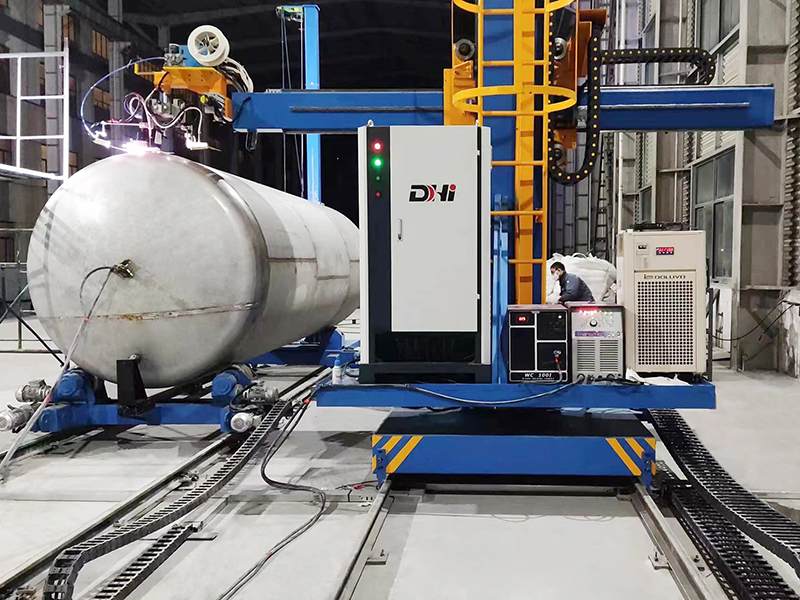
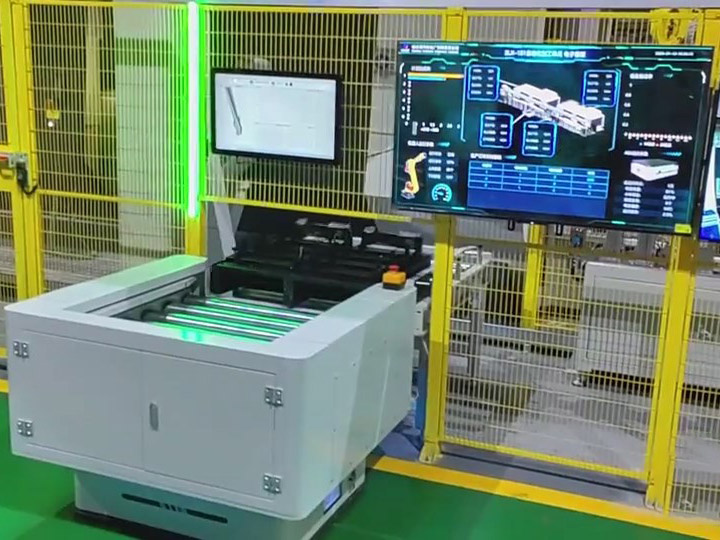
In the intelligent transformation of modern manufacturing, automatic welding robots are playing an increasingly important role. Integrating precision machinery, intelligent control, and sensing technology, they can replace manual labor to perform high-precision, high-efficiency welding operations. They not only significantly improve production efficiency and product quality but also provide strong support for enterprises to reduce costs and safety risks. This article will comprehensively analyze how automatic welding robots are reshaping modern manufacturing from the aspects of working principles, application fields, and development trends.
Working Principles of Automatic Welding Robots: Three Systems Collaborate to Drive Precise Operations
The efficient operation of
automatic welding robots relies on the close cooperation of three systems: mechanical structure, control, and sensing, which together realize the automation and precision of the welding process.
1. Mechanical Structure System: The ""Body"" for Flexible Movements
Automatic welding robots typically adopt a multi-degree-of-freedom robotic arm structure, driven by high-precision servo motors and reducers, enabling flexible rotation, movement, and other actions in three-dimensional space. This design ensures that the robot can adapt to the welding needs of different workpieces, maintaining stable motion accuracy whether for complex curved welds or operations in narrow spaces.
2. Control System: The ""Brain"" of the Welding Process
The control system is the core of the automatic welding robot, responsible for planning the welding path and adjusting welding parameters (such as current, voltage, welding speed, etc.). It supports two mainstream working modes: teach pendant programming (recording the path by manually guiding the robot, which then automatically repeats the operation) and offline programming (pre-designing the welding plan through software without occupying robot production time). The combination of these two modes can quickly adapt to the production needs of multiple varieties and small batches.
3. Sensing and Execution System: The ""Sensory"" for Real-time Detection
To ensure welding quality, automatic welding robots are equipped with ""sensory"" devices such as visual sensors and laser sensors. These sensors can real-time detect the workpiece position and weld shape, feed the data back to the control system, and dynamically adjust the welding path and parameters. For example, when there is a slight deviation in the workpiece, the sensor can quickly identify and compensate, avoiding weld defects caused by positioning errors.
Core Application Fields of Automatic Welding Robots: Production Upgrades Across Industries
With the advantages of high precision and efficiency, automatic welding robots have been deeply applied in multiple manufacturing fields, becoming a key tool to improve production levels.
Automotive Manufacturing: Quality Assurance from Body to Components
In automobile production, automatic welding robots are widely used in core links such as body welding and engine component welding. Traditional manual welding is susceptible to fatigue and skill differences, while robots can perform continuous and stable operations, not only increasing production efficiency by more than 30% but also ensuring weld strength and consistency, reducing potential quality hazards in the later stage.
Aerospace Field: Precision Welding in Extreme Environments
Aerospace products have extremely high requirements for welding quality. Structural components such as aircraft wings and rocket bodies need to withstand complex mechanical environments. Automatic welding robots can complete welding operations with millimeter-level precision through high-precision positioning and parameter control, ensuring structural stability and safety to meet the strict standards of the aerospace field.
Machinery Manufacturing and Engineering Machinery: Efficient Welding of Heavy Components
In the machinery manufacturing and engineering machinery industries, welding of large steel structures and heavy equipment components often faces challenges such as heavy workpieces and long welds. Automatic welding robots, with their heavy-load robotic arms and long working radius design, can easily handle heavy component welding, reduce manual handling and operation intensity, and increase the welding qualification rate to over 99%.
New Energy and Rail Transit: Reliable Partners for High-standard Production
New energy fields such as power batteries and energy storage equipment, as well as rail transit fields such as high-speed rail car bodies and subway components, have special requirements for welding processes (such as low spatter and no deformation). Automatic welding robots can meet these high-standard requirements through customized welding processes and sensory compensation technology, facilitating the large-scale production of new energy and rail transit industries.
Development Trends of Automatic Welding Robots: Smarter, More Flexible, More Collaborative
With the advancement of Industry 4.0 and intelligent manufacturing, automatic welding robots are rapidly developing towards the direction of ""intelligent upgrading, flexible adaptation, human-robot collaboration, and digital interconnection"".
In-depth Intelligence: AI-driven Self-learning and Adaptation
Future automatic welding robots will integrate multi-sensor data (vision, force, temperature, etc.) and combine AI algorithms to achieve ""self-learning"". For example, optimizing process parameters by analyzing historical welding data, or real-time identifying weld defects during welding and automatically adjusting strategies to further improve welding quality and efficiency.
Flexible Manufacturing Adaptation: Lightweight and Modular Design
To adapt to the production needs of small batches and multiple varieties, automatic welding robots are adopting lightweight robotic arms and modular structures. Lightweight design can reduce energy consumption and improve motion flexibility, while modularity supports quick replacement of welding torches, sensors, and other components to meet the welding needs of different workpieces and shorten production line switching time.
Deepened Human-robot Collaboration: Safe and Efficient ""Human-robot Partners""
Traditional industrial robots mostly operate in isolated environments, while the new generation of collaborative robots can work collaboratively with workers in the same space through force control technology and safety sensors. For example, workers are responsible for workpiece positioning, and robots complete precision welding, giving play to the flexibility of humans and the high precision of robots to achieve a collaborative effect of ""1+1>2"".
Digital Ecosystem: Industrial Internet and Cloud Management
Automatic welding robots will be gradually connected to industrial internet platforms to realize real-time uploading of production data and cloud management. Enterprises can monitor robot operating status, analyze welding data, predict maintenance needs, and even remotely debug welding parameters through cloud systems, improving overall production efficiency and operation and maintenance levels.
Application Case of Automatic Welding Robots: Transformation from ""Manual Dependence"" to ""Intelligent Production""
A heavy-duty auto parts factory once long faced problems of low efficiency and large quality fluctuations in the welding process: manual welding relied on skilled workers, the training cycle for newbies was long, and high-intensity operations easily led to weld defects. After introducing automatic welding robots, the enterprise achieved three major transformations:
- Efficiency Improvement: Welding cycle reduced from 15 minutes per piece to 8 minutes per piece, daily production capacity increased by 80%;
- Stable Quality: Weld qualification rate increased from 85% to 99.5%, reducing rework costs;
- Cost Reduction: Reduced labor input by 60%, saving over one million yuan in annual labor costs, while reducing the impact of welding fume on workers' health.
Common Questions About Automatic Welding Robots
1. Is the working principle of automatic welding robots complicated? Can ordinary people operate them?
The core of automatic welding robots is the collaboration of mechanical movements, parameter control, and sensory compensation, but the operation interface has been visualized and intelligentized. Ordinary people can master basic operations such as teach pendant programming and daily maintenance through short-term training (usually 1-2 weeks) without needing to deeply understand the underlying technical principles.
2. What core parameters should be paid attention to when choosing an automatic welding robot?
Key parameters include: repeat positioning accuracy (determining welding precision, usually required to be within ±0.02mm), load capacity (selected according to the weight of the welding torch and workpiece), working radius (matching the production line layout), and process compatibility (whether it supports various welding methods such as arc welding and laser welding).
3. Is the maintenance cost of automatic welding robots high?
Although regular maintenance such as robotic arm lubrication and sensor calibration is required, the overall annual maintenance cost is much lower than manual training and management costs. For a medium-sized enterprise, the annual maintenance cost of a robot is about 1/5 of the labor cost, and the risk of sudden failures can be further reduced through predictive maintenance.
4. What is the difference between collaborative robots and traditional industrial robots?
Collaborative robots focus more on safety and flexibility, with functions such as collision detection and force control feedback, and can work directly with workers; traditional industrial robots are more suitable for independent operation scenarios with high load and high speed. Enterprises can choose according to production needs or deploy both types of robots in a mixed manner.
Conclusion: Automatic Welding Robots, the ""Accelerator"" of Intelligent Transformation in Manufacturing
The emergence of automatic welding robots has not only changed the mode of traditional welding operations but also become an important support for the development of manufacturing towards intelligence and high quality. From automobiles, aerospace to new energy and rail transit, it is promoting the dual improvement of production efficiency and quality in various industries with its advantages of high efficiency, precision, and stability. With the continuous advancement of technology, future automatic welding robots will be smarter, more flexible, and more collaborative, injecting stronger impetus into the digital transformation of manufacturing."