Welding Workstation: A Comprehensive Analysis Of Enhancing Industrial Welding Efficiency And Quality
Release time:2026-07-06
Visits:392
In modern industrial production, the requirements for precision, efficiency, and quality of welding processes are becoming increasingly stringent. As the core equipment for achieving automated welding, welding workstations, by integrating advanced mechanical and intelligent control technologies, are becoming a key factor in improving production efficiency. This article will deeply explore the core components, main classifications of welding workstations, and their significant advantages for industrial production.
Core Components of Welding Workstations
An efficient welding workstation typically consists of the following key components working together to ensure the automation and precision of the welding process:
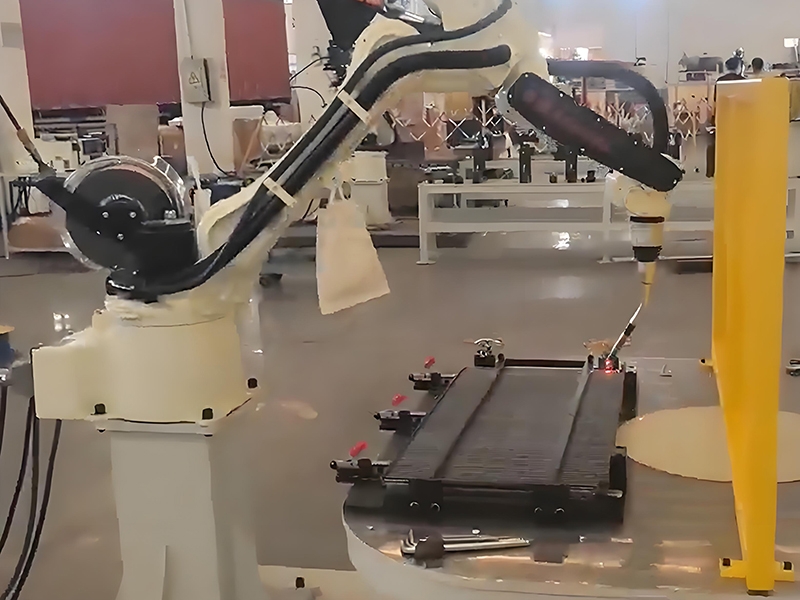
1. Welding Robot: As the core driving unit of the workstation, the
welding robot undertakes the main welding operation tasks. It usually includes the robot body, a teach pendant for programming and operation, a control cabinet responsible for logical control, as well as key components such as an active wire feeding mechanism and welding power source. Through programming, the robot can execute complex welding trajectories, ensuring the consistency and stability of welding.
2. Welding Positioner: To ensure that every critical part of the welded workpiece can be accurately welded by the robot, the welding positioner plays a crucial role. It can precisely rotate, flip, or tilt the workpiece according to preset welding process requirements, placing the weld in the optimal welding position, thereby effectively improving welding quality and efficiency.
3. Gun Cleaner: The welding slag and spatter generated during the welding process can affect the performance of the welding torch and welding quality. The gun cleaner can automatically clean the torch tip, promptly removing these debris, which not only helps maintain stable welding quality but also extends the service life of the torch and reduces downtime caused by manual cleaning.
4. Control System: This is the ""brain"" of the welding workstation, responsible for coordinating and controlling the orderly operation of all components. It integrates robot controllers, various sensors, and monitoring systems, realizing automated management of the welding process, real-time data collection and analysis, and timely response to abnormal situations, promoting welding work towards intelligence.
Common Classifications of Welding Workstations
According to different industrial application scenarios and welding requirements, welding workstations are mainly divided into the following categories:
Shaft Welding Robot Workstation: Such workstations are usually equipped with welding robots with different numbers of axes and closely cooperate with welding positioners. They are particularly suitable for welding shaft or rotating workpieces with complex weld seams. They are widely used in fields with extremely high precision requirements, such as power equipment and electrical manufacturing industries, and can provide excellent welding accuracy.
Box Welding Robot Workstation: Specifically designed for the automated welding needs of large box-type structural parts, such as safes, large containers, and mechanical equipment enclosures. It can stably handle mass production tasks and strictly ensure the dimensional accuracy and welding quality of welded parts, meeting the requirements for high output and high standards in industrial production.
Stainless Steel Welding Robot Workstation: In view of the characteristics of stainless steel materials, such workstations often adopt advanced laser welding technology to achieve higher weld strength and welding efficiency. Stainless steel is widely used in numerous fields such as food processing, medical equipment, and chemical equipment due to its excellent ductility, high strength, and corrosion resistance, and the corresponding welding workstations therefore have an important position.
Advantages of Welding Workstations for Industrial Production
Through the deep integration of automation and intelligence, welding workstations bring significant improvements to industrial production in multiple aspects:
High Efficiency: Automated operations greatly reduce manual intervention, significantly increase welding output per unit time, and shorten the production cycle.
High Precision: The precise repeated positioning of the robot and the accurate cooperation of the positioner ensure the consistency and accuracy of each weld, effectively reducing the welding defect rate.
High Quality: Stable welding parameter control and a clean welding environment ensure the reliability and aesthetics of weld quality.
Improved Working Environment: It frees operators from harsh and dangerous welding environments, reduces labor intensity, and improves operational safety.
In conclusion, with its advanced technical characteristics, welding workstations have become an indispensable key equipment in modern industrial production, providing solid technical support for the high-quality development of various industries. Choosing the appropriate type of welding workstation is directly related to the improvement of production efficiency and the guarantee of product quality."