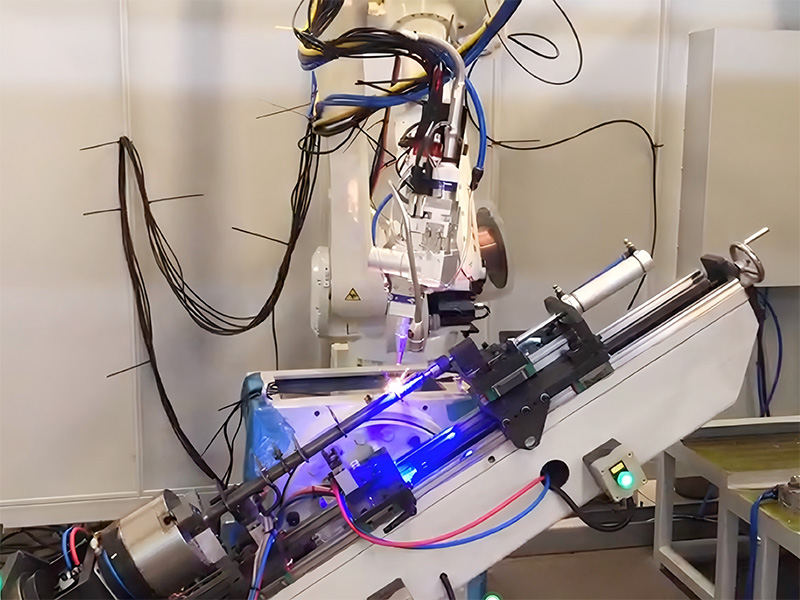
Welding robot arms are transforming the manufacturing landscape. They bring precision and consistency to welding tasks, reducing human error.
These advanced machines operate tirelessly, boosting productivity and efficiency in industrial settings. They are equipped with sensors and software for precise control.
Welding automation not only cuts labor costs but also enhances workplace safety. By handling repetitive tasks, these robots free human workers for more complex roles.
Industries like automotive, aerospace, and construction are reaping the benefits. The integration of AI and machine learning further enhances their capabilities.
As technology evolves, welding robot arms continue to offer new features. They are a key component in modern manufacturing strategies.
What Is a Welding Robot Arm?
A
welding robot arm automates the welding process with precision. It is designed to perform welding tasks with minimal human intervention.
These robots consist of an industrial robot arm fitted with a welding tool. They operate under computer control and follow pre-programmed paths.
Welding robot arms are equipped with several key components:
Robotic Arm: Provides flexibility and range of motion.
Controller: Directs the arm's movements.
Power Supply: Feeds energy to the welding tool.
Wire Feeder: Feeds welding wire continuously.
Welding Torch: The tool that performs the welding.
These components work together to ensure smooth operation. The robot arm mimics human motion but with greater speed and accuracy.
Welding robot arms can handle various welding techniques. They adapt to different materials and angles, offering versatility. This makes them indispensable in manufacturing settings that demand efficiency.
Key Benefits of Welding Automation
Welding automation brings numerous advantages to the manufacturing sector. By minimizing manual intervention, it ensures a consistent quality of welds. High precision in welding outcomes leads to fewer defects and less rework.
A significant benefit of welding automation is the reduction in labor costs. Automated systems can operate continuously without the need for rest, unlike human workers. This leads to higher productivity and faster production cycles.
Safety is greatly enhanced with welding automation. Workers are kept away from harmful fumes and high temperatures. Moreover, the risk of workplace accidents is reduced, creating a safer environment.
Automation improves manufacturing efficiency. Robotic welding arms can handle high volumes of work with steady output. They are key to meeting tight production schedules without sacrificing quality.
Additional benefits include:
Increased Flexibility: Adaptable to various welding tasks.
Enhanced Precision: Achieves exact weld paths.
Resource Efficiency: Reduces waste during production.
Cost Savings: Long-term savings offset initial investment.
Scalability: Easily adjusts to changes in production needs.
Implementing welding automation is a strategic move for manufacturers. It not only increases efficiency but also enhances competitiveness in the global market. As technology advances, these benefits will continue to grow.
How Welding Robot Arms Boost Manufacturing Efficiency
Welding robot arms revolutionize manufacturing efficiency through automation. They excel in continuous operation, unmatched by human workers. This reduces production downtime and enhances output.
The integration of robotic welding arms accelerates production cycles. Their precision minimizes errors, leading to fewer defects. This consistency reduces rework and ensures high-quality products.
These robots are equipped to handle complex welding tasks with ease. Advanced technology allows for intricate designs and custom weld paths. This capability boosts manufacturing agility and responsiveness.
Automation through robotic arms also optimizes resource management. By improving weld precision, they cut down on material waste. Cost savings are thus achieved alongside quality improvements.
Advantages of using welding robot arms include:
24/7 Operation: Uninterrupted production cycles.
Error Reduction: Decreased need for corrective actions.
Flexibility: Adaptable for various materials and weld types.
Improved Safety: Less human exposure to hazardous conditions.
Higher Throughput: Meets increased production demands efficiently.
With the deployment of welding robot arms, efficiency becomes integral to manufacturing processes. They streamline operations by reducing manual errors and accelerating production. This ultimately positions manufacturers for a competitive edge in a rapidly evolving market landscape.
Applications of Robotic Welding Arms in Industry
Robotic welding arms find widespread use across various industries. In automotive manufacturing, they handle both small and large-scale production runs. The precision and speed of robotic arms are pivotal in meeting high production standards.
In the aerospace sector, these robots perform complex welds on critical components. Their ability to weld diverse materials ensures durability and safety. This adaptability is crucial for the stringent demands of aerospace applications.
The construction industry also benefits from robotic welding arms. They excel in tasks that involve repetitive welds in harsh environments. This helps in maintaining consistent quality in construction projects.
Industries applying robotic welding arms include:
Automotive: Mass production with precision.
Aerospace: Critical component assembly.
Construction: Consistent welds in tough conditions.
Electronics: Fine, detailed welding tasks.
Shipbuilding: Heavy-duty and intricate welding applications.
These versatile applications highlight the adaptability and efficiency robotic welding arms bring to the industrial landscape. With their wide array of uses, robotic welding arms become indispensable tools in modern manufacturing practices.
Types of Welding Robot Arms and Their Capabilities
Welding robot arms come in various forms, each suited to specific tasks. Articulated robots, with multiple joints, offer flexibility for intricate welds. They are ideal for applications needing complex movements.
Gantries or Cartesian robots provide precision in linear welding tasks. They excel when consistency and accuracy are paramount. Their straightforward design makes them suitable for large-scale manufacturing operations.
Collaborative robots, or cobots, are designed to safely work alongside humans. They assist in delicate welding tasks, making them valuable in environments where space and safety are concerns. Cobots are increasingly popular in industries focusing on human-robot collaboration.
Common types include:
Articulated Robots: Flexibility and complex movements.
Cartesian Robots: Precision in linear tasks.
SCARA Robots: High-speed assembly tasks.
Collaborative Robots: Safe human interaction.
Cylindrical Robots: Rotary and linear movement.
Each type offers distinct benefits, enhancing the efficiency of welding operations. Understanding their capabilities helps industries choose the right solution for their specific welding needs. The right choice maximizes productivity and improves weld quality.
Advanced Features and Technologies in Modern Welding Robots
Modern welding robots incorporate cutting-edge technologies to enhance performance. Features like advanced sensors help detect precise weld positions, reducing errors. These sensors also enable robots to adapt to changing conditions, maintaining consistency.
Artificial intelligence (AI) plays a critical role in welding automation. AI enhances decision-making capabilities, allowing robots to adjust parameters in real time. This leads to improved weld quality and faster production times. Machine learning algorithms further optimize these processes by analyzing data and refining techniques.
Robotic welding arms now often include:
Vision Systems: Improve accuracy with defect detection.
Internet of Things (IoT) Integration: Allows for real-time monitoring.
Adaptive Control Systems: Enable on-the-fly adjustments.
Cloud Connectivity: Facilitates data analysis and storage.
Enhanced Safety Features: Protect both robots and human workers.
These technologies make welding robots more versatile and efficient. Their ability to perform complex tasks with precision contributes to their widespread adoption. Continuous innovations in robot design are driving the future of manufacturing. With advanced technologies, welding robots continue to offer significant advantages in industrial settings.
Overcoming Challenges: Implementation and Integration
Integrating welding robot arms into existing systems can pose challenges. Compatibility with current equipment is a primary concern. Ensuring the robot works seamlessly with other machines requires careful planning.
Training personnel is also crucial for successful implementation. Workers must understand how to operate and maintain these advanced systems. Without proper training, the benefits of welding automation may be limited.
To address these challenges, companies often focus on:
Assessing Current Infrastructure: Evaluate existing equipment and processes.
Providing Comprehensive Training: Equip staff with necessary skills.
Engaging with Expert Consultants: Gain insights into best practices.
Developing Clear Implementation Plans: Set timelines and objectives.
Ensuring Regular Maintenance and Support: Keep systems running smoothly.
Taking these steps can ease the integration process. Proper planning and support help maximize the benefits of robotic welding arms. This ensures they contribute effectively to improved efficiency.
Cost Considerations and Return on Investment
Investing in welding robot arms requires a substantial upfront cost. This includes the robot itself and necessary software. However, the benefits often outweigh these initial expenses over time.
Cost savings come from reduced labor and increased efficiency. These robots can work around the clock without breaks, improving productivity. Higher precision and fewer errors also mean less waste and rework.
When evaluating return on investment, consider:
Decreased Labor Costs: Less need for manual operations.
Enhanced Productivity: Faster and continuous production cycles.
Improved Quality: Consistent and precise welding results.
Lowered Waste and Rework: Minimal material loss and fewer corrections.
Understanding these factors helps companies see the potential for long-term gains. The right implementation can significantly boost overall financial performance.
Future Trends in Welding Automation
Welding automation is rapidly evolving with technology advancements. AI and machine learning are becoming integral to improving capabilities. These technologies enable robots to learn and adapt to various tasks.
The demand for smart factories is driving innovation. This trend pushes the integration of welding robots with IoT devices. Real-time monitoring and data analysis become possible, enhancing efficiency.
Key future trends include:
AI-Enhanced Learning: Robots evolving to perform complex tasks.
IoT Integration: Real-time insights for better decision-making.
Increased Collaboration: Robots working alongside humans in safer environments.
Sustainability Focus: Reducing environmental impacts through optimized processes.
These trends indicate a future with smarter, more efficient welding operations. Companies staying ahead will gain a significant market advantage.
Conclusion: The Competitive Edge of Welding Robot Arms
Welding robot arms provide a significant boost in manufacturing efficiency. They enhance precision and reduce errors, resulting in superior product quality. By automating tasks, they allow human workers to focus on more complex processes.
These robots offer a competitive edge in today's fast-paced market. Implementing welding automation can lead to cost savings and improved safety. Companies adopting this technology will likely outperform competitors. As industries move towards automation, welding robots position businesses at the forefront of innovation and productivity. The future of manufacturing is increasingly tied to robotic solutions.