3D Laser Welding Equipment For Joints That Do Not Lie Flat
Release time:2026-11-16
Visits:9
Flat-bed laser welding is a solved problem: clamp the sheet, run the head in X and Y, keep the focus 0.5 mm below the surface. The moment the seam climbs a wall, turns a corner into a bracket, or follows the crown of a formed part, that model collapses. The head has to stay normal to a surface that keeps changing angle, the gas has to reach a joint that is sometimes overhead, and the fixture has to hold a shape that wants to spring back.
That is the territory of 3D laser welding equipment. The engineering questions change from "how much power" to "how does the machine know where the surface is, and how does it keep the beam perpendicular while the part moves underneath it".
What Makes a Weld Truly 3D
Normal orientation and why it matters
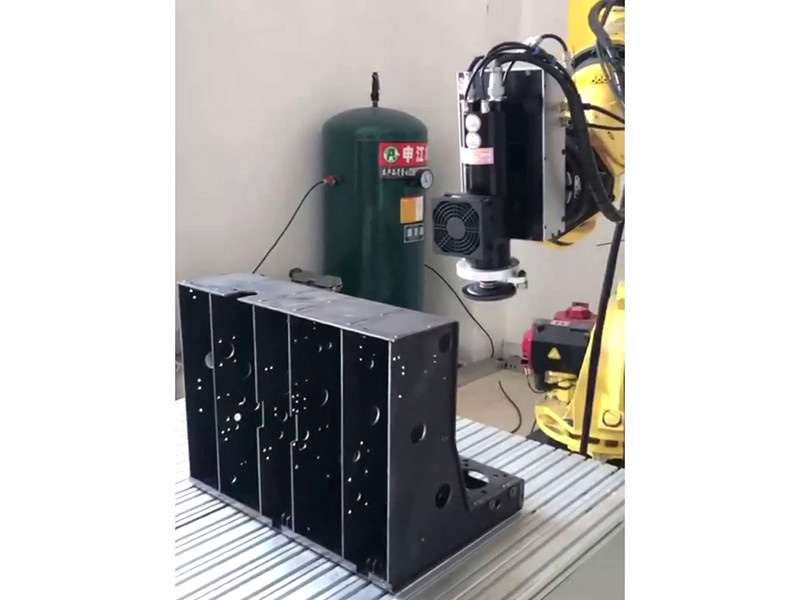
Industrial 3D Robot Fiber Laser Metal Cutting Machine
A
laser weld is directional. Tilt the head 15° off normal and the keyhole starts to lean; the weld face becomes asymmetric, penetration drops on one side, and spatter increases. On a flat seam the machine holds normal by default. On a curved or angled seam, normal has to be computed for every point along the path, and the wrist has to reach that orientation without hitting the fixture.
The four geometries that force 3D
• A formed or stamped shell with a flange that curves in two planes
• A box corner where three seams meet at different angles
• A tubular or cylindrical joint with a radial weld
• A casting with a machined boss standing off a curved wall
If your part matches any of these, a flat-bed machine with a tilting head will fight you. A true 3D system will not.
Choosing Kinematics
|
Configuration |
Strength |
Limitation |
Best fit |
|
6-axis robot |
Large envelope, flexible path, lower cost per m³ |
Deflection at full reach |
Parts up to roughly 2 m, high mix |
|
5-axis gantry |
Stiffness, long straight seams, heavy parts |
Larger footprint, higher price |
Large panels, high volume |
|
Robot on linear track |
Envelope extension without losing reach |
Track alignment and maintenance |
Long parts, multiple stations |
|
Robot plus positioner |
Part rotates under a stationary head |
Positioner accuracy adds to the chain |
Radial and circumferential seams |
The decision usually comes down to part size and annual volume. Under 30,000 parts a year with frequent changeovers, a robot wins. Above that, with one family of large parts, a gantry's stiffness pays for itself in first-pass yield.
The Calibration Chain in 3D Laser Welding Equipment
Tool center point
The TCP is the point where the beam focuses. Every 3D system depends on knowing exactly where that point sits relative to the robot flange, in all orientations. A 0.2 mm TCP error becomes a 0.2 mm seam offset on a flat plate and a much larger error on an angled surface, because the offset projects along the surface normal.
Calibrate the TCP at the start of each shift with a calibration pin, and store the result with a timestamp. If your cell drifts after a collision or a torch change, the TCP log tells you within a minute whether the geometry moved.
Offline programming and real part deviation
CAD-to-path programming is standard, and it is also where 3D projects go wrong. Stamped and cast parts deviate from CAD by 0.5 to 2 mm, which is far more than a laser weld tolerates. Three responses work:
• Probe the part at defined datum points, then transform the path to the measured position
• Use a laser seam tracker that reads the actual joint and corrects in real time
• Design the fixture so the part is forced onto a known datum, and accept that the fixture is the accuracy reference
Most production cells combine the first and third. Tracking alone struggles on short, interrupted 3D seams.
Fixture Design for Spatial Joints
Clamping sequence and access
A 3D fixture must hold the part without blocking the head. That constraint drives clamp placement: retractable clamps, swing-away arms, and clamps that grip from inside the part rather than across the seam. Sequence matters too — clamp the datum first, then push the seam closed, then lock. Clamping in the wrong order preloads the part and the seam opens as the weld cools.
Distortion control
Spatial assemblies distort in three directions, not one. Two practical controls: weld in a balanced sequence that alternates sides of the part, and use copper or aluminium heat sinks at thin-wall intersections. On long curved seams, a stitch pattern with a defined pitch often beats a continuous weld for flatness, at a small cost in strength.
Gas Coverage When the Torch Is Not Pointing Down
Overhead and vertical-up positions lose shielding gas quickly. Coaxial nozzles work up to about 20° off vertical; beyond that, add a secondary side nozzle or a trailing shield that follows the seam. On stainless, the trailing shield also controls heat tint, which is a corrosion issue rather than a cosmetic one.
Inspecting a 3D Weld
|
Method |
Detects |
Practical use |
|
Visual and dye penetrant |
Surface cracks, undercut, incomplete fusion at the toe |
Every part, first article and sampling |
|
Cross-section |
Penetration, weld width, porosity |
First article, parameter changes |
|
X-ray or CT |
Internal porosity, lack of fusion |
Aerospace, pressure-tight parts |
|
Leak test |
Through-thickness defects |
Enclosures, battery trays, vessels |
|
3D scan of weld bead |
Bead profile, distortion |
Dimensional sign-off |
For a production cell, visual plus leak test on every part, with sectioning on the first article each shift, catches the failures that actually occur.
The Circuit Breaker Case: 3D Welding in a High-Mix Shop
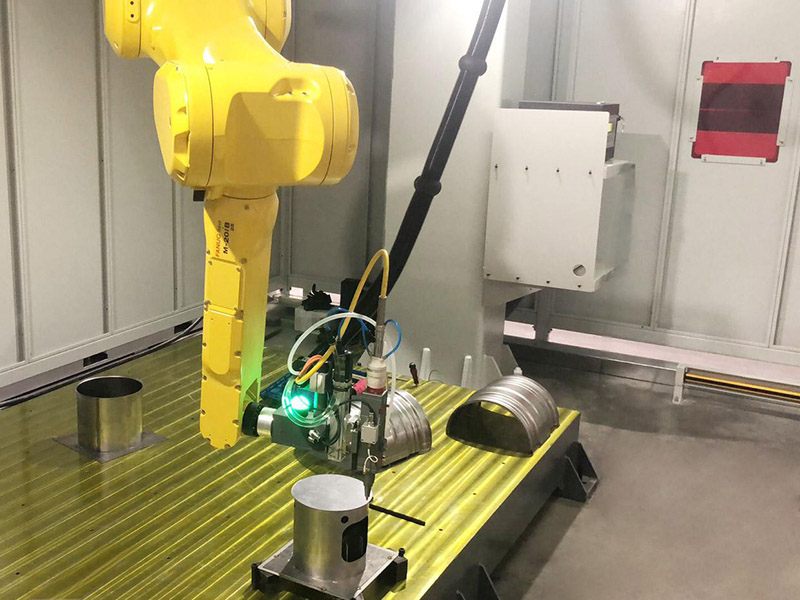
Dade Heavy Industry built a
3D laser welding workstation for circuit breaker switches around three constraints that appear in most high-mix electrical assembly: fume, access and consistency. The cell is fully enclosed with dust extraction ports and integrated safety protection, which improved the working environment and reduced operator exposure at the same time as it raised output.
The control architecture is a PLC bus that simplifies wiring between the control cabinet and the robot arm. Parameter sets are recalled per product rather than dialled in by hand, which is the difference between a changeover that takes five minutes and one that takes forty. Dade's engineers designed the workstation specifically for 3D axis-based welding in the circuit breaker industry, where a switch family can contain dozens of variants on a similar body.
That is the pattern worth copying: a 3D cell earns its cost through changeover speed, not through peak speed. If your variants share a body and differ in detail, 3D laser welding equipment with parameter recall will out-produce a faster single-purpose machine across a year.
Commissioning Checklist
• TCP verified in at least six orientations, logged
• Path verified on a nominal part and on a part at the upper and lower tolerance limits
• Gas flow measured at the nozzle in the worst welding position
• Extraction airflow measured with the door closed and the cycle running
• Interlock test: door, light curtain, chiller alarm, gas low, source fault
• Thirty-part run with cycle time and first-pass yield recorded
• Changeover timed between the two most different part numbers
Working With Dade
Dade Heavy Industry (stock code 870547) has been building robot-based welding and cutting systems since before
3D laser work became common in Chinese manufacturing. From a 100,000 m² site in Wuxi with roughly 600 employees, the company covers digital robot workstations, industrial welding robots and complete robot application systems, with a portfolio of 50 series and 200 specifications and installations in 30 provinces plus exports to Southeast Asia, the Middle East, Japan, Europe and the Americas.
For a 3D welding project, the useful first conversation is about the part drawing and the joint access, not the machine model. Dade's pre-purchase analysis step takes customer drawings and samples and returns a weldability assessment, a fixture concept and a cycle-time estimate — the three documents that tell you whether 3D laser welding equipment is the right answer before you commit capital.