Pipe Welding: Processes, Equipment And Quality Control
Release time:2026-10-02
Visits:2
Pipe welding is among the most demanding jobs in fabrication. The welder works in tight spaces, around curves, and often in vertical or overhead positions, while the weld has to be sound enough to hold pressure for years. This article compares the main pipe welding processes, the equipment that supports them, and the quality controls that keep pipe joints reliable.
Why Pipe Welding Is Difficult
Pipe joints punish mistakes. The weld root is often welded from one side only, so full fusion at the root depends entirely on technique. Contamination from oil, rust, moisture or the wrong shielding gas shows up quickly as porosity or inclusions. And because pipe comes in every diameter and wall thickness, there is no single process that suits all work.
Add the position problem. Fixed pipe forces all-position welding: flat at the bottom, vertical up the sides, overhead at the top. That is why pipe welding has its own qualifications and why skilled pipe welders are paid accordingly.
Main Pipe Welding Processes
TIG welding (GTAW). The standard for root passes on carbon, stainless and alloy pipe. It gives a clean, fully fused root that inspection can trust. Slow, but the filler passes can go faster with other processes.
MIG/MAG welding (GMAW). Good for filler and cap passes once the root is in. Faster than TIG, but the gun needs access, which limits small-diameter work.
Flux-cored arc welding (FCAW). High deposition for thicker wall and outdoor work. Self-shielded types tolerate wind better than solid wire with gas.
Submerged arc welding (SAW). Used for long seams and rotating pipe. Very high deposition, deep penetration, clean welds, and no arc flash. The pipe rotates under a fixed head, or the head travels along the seam.
Orbital welding. A mechanized TIG head clamps around the tube and rotates the electrode around the joint under automatic parameter control. It is the standard for tube-to-tube and tube-to-tubesheet joints in clean plants, where weld repeatability matters more than speed.
Equipment That Makes Pipe Welding Easier
Pipe rotators and turning rolls. Rotate the pipe at a controlled speed so the weld is made downhand. Essential for SAW and for long seam welding.
Pipe positioners and welding manipulators. A column-boom manipulator holds the torch while the pipe turns, keeping angle and travel speed steady across the whole seam.
Orbital welding heads. Clamp around the tube, guide the electrode, and control current, rotation speed and wire feed automatically. They remove the welder's hand from the equation entirely.
Welding carriages. Motorized units that travel along a seam or climb a fixed pipe, carrying the torch or the welder's equipment.
Standards and Qualification
Pipe welding runs on codes. ASME B31.1 covers power piping and B31.3 process piping. ASME Section IX defines how procedures and welders are qualified, through WPS, PQR and WPQ documents. API 1104 governs cross-country pipelines. ISO 3834 covers welding quality management for fabricators. Each project usually names its code in the contract, and the welding procedure has to match it before production starts.
Common Defects and Inspection
The defects that show up in pipe welds are familiar to every inspector: porosity from contaminated gas or surfaces, lack of fusion at the root or side walls, lack of penetration on the root pass, slag inclusion in multipass welds, and cracks, which are the only defect that always gets rejected.
Inspection follows the code. Visual examination of every weld, then NDT on a defined percentage: radiographic testing (RT) or ultrasonic testing (UT) for internal soundness, magnetic particle (MT) or dye penetrant (PT) for surface cracks, and a hydrostatic test of the completed line. The NDT percentage is usually higher on pipe than on structural work, because a pressure failure is more than a cosmetic problem.
Automation Trends
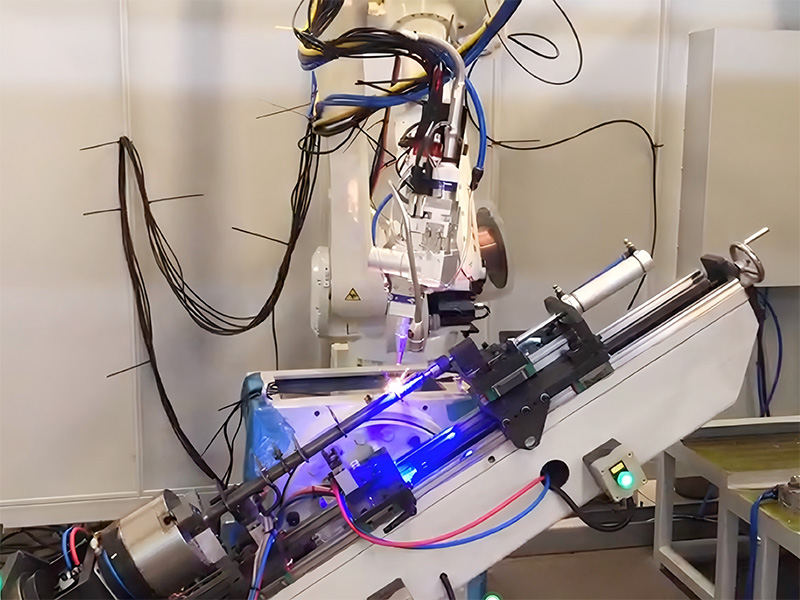
Orbital TIG dominates clean piping and tube systems because it is repeatable and its data can be logged per weld. Robotic welding of pipe spools is growing: a shop welds the spool on a positioner while a robot or manipulator handles the seams, which suits the repetitive geometry of prefabricated spools. Seam tracking and laser sensing are also appearing, letting automated heads follow joints that were previously welded by hand.
Bottom Line
Pick the process by the joint and the code, not by habit. TIG for roots and critical alloys, SAW for rotating pipe and long seams, orbital where repeatability must be proven on paper. The equipment that holds the pipe and moves the torch decides how much of that quality is actually achieved. Dade Heavy Industry supplies pipe welding equipment including manipulators, positioners and automated pipe welding lines for pressure vessels, boilers and process plants.