Welding Workstation Design: The Cell Around The Robot
Release time:2026-12-07
Visits:6
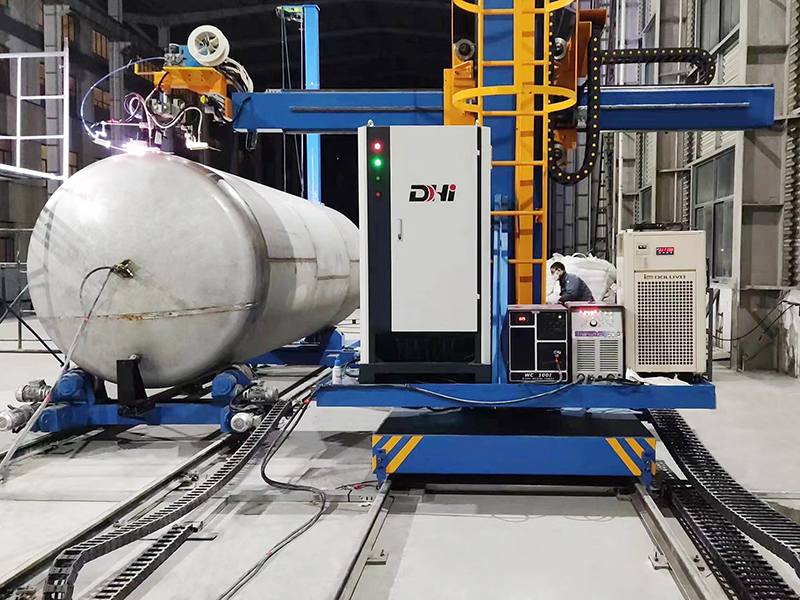
The robot gets the attention. The workstation decides whether the robot can work. A welding workstation is the physical arrangement that turns an arm and a torch into a production process: the table that holds the part, the positioner that turns it, the extraction that keeps the air breathable, the enclosure that keeps the arc and the fume where they belong, and the utilities that everything depends on.
Get the workstation right and a mid-range robot outperforms a premium one. Get it wrong and the best robot on the market produces welds that have to be ground back, at a rate nobody forecast.
What Belongs in a Welding Workstation
Positioner and table
The positioner is the workstation's most under-specified component. It has to carry the part's mass, hold it rigidly against welding force, and index to the angle the joint needs. A rotary table driven by a servo motor with slewing bearing support gives smooth rotation under load; a chain-driven table gives backlash that shows up as arc wander.
Load capacity, rotation range and positioning accuracy are the three numbers to fix. A 300 kg capacity table that rotates 0° to 180° with servo control covers most medium fabrications; a part that needs continuous 360° rotation at welding speed needs a different drive arrangement.
Fume extraction
Robotic welding runs long arc-on times, which means a high volume of fume in a small space. Extraction at the arc is far more effective than extraction at the ceiling: capture efficiency at the torch is typically several times higher for the same fan power. The purifier welding room Dade Heavy Industry builds exists precisely because robotic cells concentrate fume — it is a fully enclosed room with dust extraction ports and integrated safety protection, and it also carries an automatic nozzle cleaning system, a gas supply monitoring window and a workpiece counter on the touchscreen.
Safety and enclosure
Three layers, each doing a different job: the physical guard keeps people out of the arc, the interlock stops the cycle when the guard opens, and the light curtain or safety door handles the loading moment. Automatic doors that lower at cycle start, as used in the enclosed room design, remove the operator's temptation to reach in during a cycle.
Utilities and monitoring
Gas flow, air pressure, cooling water, and power. Each needs a sensor, not an assumption. A gas monitoring window on the panel is a small feature with a large effect: it turns a slow quality drift into an alarm.
A Reference Specification: Horizontal Rotation Station
Dade's
horizontal rotation welding workstation is a useful benchmark because the specification is unusually complete.
|
Parameter |
Value |
|
Configuration |
6-axis robotic gas-shielded welding system |
|
Arm |
2.0 m rotating arm with built-in welding torch |
|
Power source |
350 A low-spatter source |
|
Current range |
30–350 A |
|
Repeat positioning accuracy |
±0.08 mm |
|
Working range |
±165° |
|
Welding speed |
0.3–1.0 m/min |
|
Material |
Q195, Q235 carbon steel plate, 1.2–5.0 mm |
|
Workpiece tolerance |
≤0.5 mm |
|
Table size |
2000 × 2000 mm |
|
Table heights |
700 mm or 400 mm |
|
Table drive |
Servo motor with slewing bearing support |
|
Table load |
300 kg |
|
Rotation |
0°–180° forward and reverse, robot controlled |
Read that list as a design template. The 2.0 m arm sets the working radius; the ±165° range sets how much of a part can be welded without reclamping; the 0.3–1.0 m/min speed range sets the achievable cycle time; the 300 kg table load sets the part size ceiling; and the 0.5 mm workpiece tolerance is the honest statement of what the fixture and the process can absorb. That last number is the one buyers should interrogate, because it determines whether the workstation suits their upstream quality.
A Second Reference: Enclosed Room Type
|
Parameter |
Value |
|
Model |
WFHCQ001 |
|
Total power consumption |
40 kW |
|
Voltage and frequency |
380 V ±10%, 50 Hz ±5% |
|
Total weight |
approximately 4.5 t |
|
Dimensions (L×W×H) |
5000 × 3100 × 2800 mm |
|
Required air pressure |
as published for the model |
|
Operation mode |
fully automatic, dual station |
The dual-station arrangement is the point. While the robot welds at one station behind a closed door, the operator loads the other. That single design decision often doubles output compared with a single-station cell, without changing the robot or the welding parameters.
Ergonomics: Designing the Operator In
Loading height
A table at 700 mm suits a part loaded from a trolley; a table at 400 mm suits a heavy part lifted with a hoist. The same station is often offered in both heights for exactly that reason. Choose by how the part arrives, not by what looks comfortable in a drawing.
Access and door design
The door has to be wide enough for the part plus the fixture plus the hoist sling. A door that clears the part by 20 mm will be struck within a month. Allow 150 mm on each side.
Light and visibility
LED lighting inside the enclosure, positioned so the operator can see the seam during first-article checks. Laser-safe or arc-safe viewing panels where the process requires it.
Utility Requirements
Three-phase supply, typically 380 V ±10 percent at 50 Hz, with a dedicated circuit for the source
• Compressed air at 0.5 to 0.7 MPa, dry, for clamps and nozzle cleaning
• Cooling water for a water-cooled torch, with flow and temperature alarms wired into the stop circuit
• Extraction ducting sized for the fume volume at the arc, not the room volume
• Floor loading adequate for the station's mass plus the part
The vibration exciter line Dade built specifies compressed air at 0.5 to 0.7 MPa and ambient conditions from −20 °C to 45 °C with humidity of 50 to 90 percent — a reminder that workstations are specified against the plant, not the laboratory.
Choosing the Right Type
|
Type |
Strength |
Limitation |
Best for |
|
Open station with rotary table |
Low cost, easy access, fast load |
Fume escapes, needs room ventilation |
Low-volume, large parts |
|
Enclosed room |
Fume control, safety, dual station |
Higher cost, larger footprint |
High arc-on time, coated metals |
|
In-line station |
Integrated with conveyor and takt |
Less flexible, layout-bound |
Multi-station production lines |
An open station is often the correct first purchase for a job shop. An enclosed room becomes necessary when arc-on time exceeds roughly half the shift, because that is when fume accumulation outpaces general ventilation.
Commissioning and Maintenance
Commission in this order: mechanical alignment, utilities verification, extraction airflow measurement with the door closed, interlock test on every safety device, dry cycle, first article, then a shift at target rate.
Then put the maintenance on a calendar:
• Daily: nozzle clean, gas flow check, spatter tray, door interlock function
• Weekly: torch tip and liner inspection, table rotation backlash check, extraction filter differential pressure
• Monthly: positioner repeatability check with a dial indicator, safety device full test, chiller water quality
• Quarterly: fixture datum verification, program backup, cable dress inspection
Most workstation failures are maintenance failures. The station is mechanically simple, which makes neglect the dominant risk.
Working With Dade Heavy Industry
Dade Heavy Industry (stock code 870547) builds
welding workstations as part of a broader robot application business, from horizontal rotation stations with servo-driven 2000 × 2000 mm tables to fully enclosed welding rooms with dust extraction and dual-station operation. The company operates a 100,000 m² plant in Wuxi, Jiangsu with roughly 600 employees, holds IATF and ISO management system certifications, and has delivered close to 10,000 sets across 50 series and 200 specifications to customers in 30 Chinese provinces and export markets including Southeast Asia, the Middle East, Japan, Europe and the Americas.
Its published after-sales terms are worth reading before you compare quotations: one-year warranty excluding wear parts, lifetime technical support, and a two-hour response commitment, with tooling and workpiece problems explicitly excluded. A supplier who states exclusions clearly is usually a supplier who has been in the field long enough to know where the arguments happen.
For a workstation project, bring the part, the loading method and the fume requirement. Those three inputs fix the table, the door and the extraction, and the rest of the specification follows.