







© 2025 JiangSu Dade Heavy Industry Co.Ltd. All Rights Reserved.Web Design by Wangke

Release time:2025-08-06 Visits:990
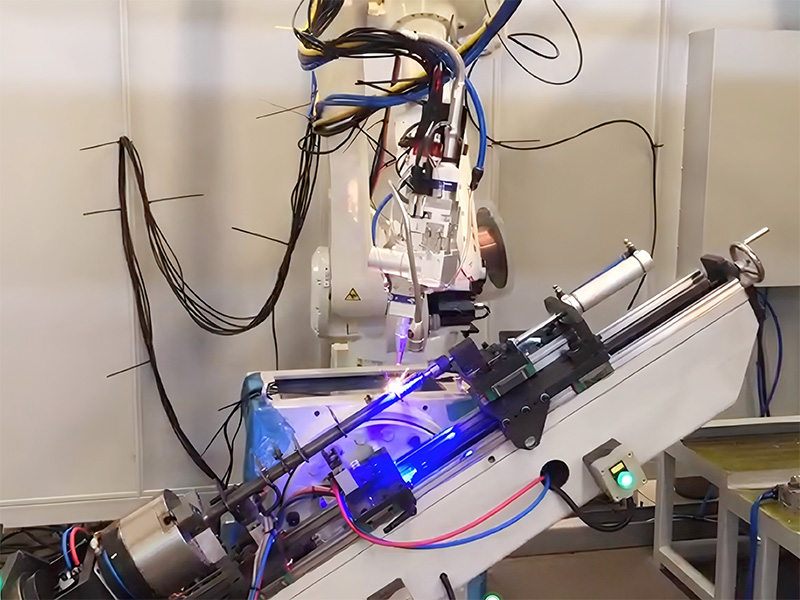
Plasma welding, with its high - temperature plasma arc and precise control ability, has become a representative of high - efficiency and high - precision welding technologies in modern industry. By generating a concentrated energy beam through a specially constructed plasma welding torch and using shielding gas to isolate oxidation, this technology can achieve low - deformation and high - strength metal fusion, and plays an irreplaceable role especially in key fields such as aerospace, automobile manufacturing, and energy equipment.
The core of plasma welding lies in its high energy density (up to 10⁶ W/cm2) and extremely high arc column temperature (about 24,000-50,000K), far exceeding that of traditional arc welding. Its features include:
| 1. Fast welding speed | High energy input shortens the melting time and enhances efficiency. |
|---|---|
| 2. Good deformation control | The small heat - affected zone reduces internal stress in the material. |
| 3. Excellent weld quality | The keyhole effect enables one - side welding with two - side formation, free of porosity and slag inclusions. |
| 4. Strong adaptability | It can weld foils as thin as 0.1mm and handle deep - penetration welding of thick plates. |
Key components such as turbine blades and combustion chambers of aircraft engines need to withstand extreme high temperatures and mechanical loads. Plasma welding precisely controls the penetration depth through the keyhole - type arc to ensure defect - free welds, meeting the strict standards for material heat resistance and fatigue resistance. For example, after welding nickel - based alloy blades, the fine - grained structure can be maintained, significantly improving the service life.
In automobile body manufacturing, the welding of high - strength steel and aluminum alloy is extremely sensitive to heat input. With its low - heat - input characteristic, plasma welding avoids the problem of material softening. For instance, after welding the aluminum alloy door frame, the joint strength can reach over 90% of that of the base material. Meanwhile, when this technology is used for welding engine blocks and gearboxes, it can reduce subsequent processing costs and improve airtightness.
Oil and gas pipelines and pressure vessels in nuclear power plants need to meet the requirements of high strength and leakage prevention. Plasma welding achieves single - pass full penetration of pipelines over 30mm thick through the full - penetration process, and the impact toughness of the weld is better than that of traditional multi - layer welding. When overlay welding the inner wall of a nuclear reactor, the combined arc technology can precisely control the molten pool to avoid radioactive material contamination.
Micro - plasma arc welding (with a current as low as 0.1A) is often used for electronic components such as micro - relays and sensors. After welding wires with a diameter of less than 0.2mm, the electrical conductivity does not decay and the heat - affected zone is less than 50um, avoiding the deterioration of component performance. Pulse plasma welding is used for copper foil windings of transformers, which can complete the fusion within milliseconds, with an efficiency 40% higher than that of laser welding.
Medical devices such as surgical scalpels and implanted titanium alloy bone plates need to avoid surface contamination. The splash - free characteristic of plasma welding ensures a smooth and burr - free weld, reducing the risk of bacterial attachment. When welding the stainless - steel sleeve of an endoscope, the arc length automatic adjustment system can control the deformation within +/-0.05mm, meeting the assembly accuracy requirements of complex cavity structures.
Although plasma welding has significant advantages, its high - energy characteristic also brings risks of harmful gases such as ozone and nitrogen oxides, and a dedicated exhaust system is required. In addition, it is crucial to select the process type according to the material thickness:
| Keyhole welding | Suitable for single - pass welding of thick plates from 3 to 8mm. |
|---|---|
| Full - penetration welding | Used for thin plates or surface overlay welding. |
| Micro - beam welding | Specialized in ultra - thin parts and precision components. |
In summary, through continuous innovation, plasma welding technology has penetrated from high - end fields such as aerospace into civilian industries and has become a core process for improving product performance and optimizing manufacturing costs. In the future, with the upgrade of automation and intelligence, this technology will open up broader application spaces in fields such as new - energy vehicle battery welding and 3D printing repair.
The core of plasma welding lies in its high energy density (up to 10⁶ W/cm2) and extremely high arc column temperature (about 24,000-50,000K), far exceeding that of traditional arc welding. Its features include:
Key components such as turbine blades and combustion chambers of aircraft engines need to withstand extreme high temperatures and mechanical loads. Plasma welding precisely controls the penetration depth through the keyhole - type arc to ensure defect - free welds, meeting the strict standards for material heat resistance and fatigue resistance.
In automobile body manufacturing, the welding of high - strength steel and aluminum alloy is extremely sensitive to heat input. With its low - heat - input characteristic, plasma welding avoids the problem of material softening. For instance, after welding the aluminum alloy door frame, the joint strength can reach over 90% of that of the base material.
Oil and gas pipelines and pressure vessels in nuclear power plants need to meet the requirements of high strength and leakage prevention. Plasma welding achieves single - pass full penetration of pipelines over 30mm thick through the full - penetration process, and the impact toughness of the weld is better than that of traditional multi - layer welding.
Micro - plasma arc welding (with a current as low as 0.1A) is often used for electronic components such as micro - relays and sensors. After welding wires with a diameter of less than 0.2mm, the electrical conductivity does not decay and the heat - affected zone is less than 50um, avoiding the deterioration of component performance.
Explore our full range of plasma welding equipment.