Robot Laser Welding Equipment: Designing The Cell Around The Seam
Release time:2026-11-13
Visits:9
A robot does not make laser welding easier. It makes it flexible, which is a different thing. The beam still demands a tight gap, clean edges and a stable focal position. What the arm adds is the ability to carry that beam along a path that changes every model year, in a work envelope that a gantry cannot reach without a much larger footprint.
That trade — flexibility for stiffness — is the whole design problem behind
robot laser welding equipment. Get it right and you have a cell that switches part numbers in twenty minutes. Get it wrong and you have a six-axis machine that vibrates at the end of its reach and welds a seam that moves 0.3 mm depending on which way the arm is leaning.
Why a Robot Instead of a Gantry
Reach, payload and the fiber path
A 6-axis arm with 1.8 to 2.0 m reach covers a work envelope that would need a gantry three times its footprint. The fiber runs either externally in a cable dress pack or internally through the arm, and the internal route protects the fiber but limits wrist articulation. For a head with wobble optics and a cross-jet, the dress pack usually wins because it lets you service the head without pulling the arm apart.
Where the robot loses
Arms deflect. A 20 kg payload at full extension can move 0.2 mm under acceleration, and a laser weld on 1 mm sheet notices. Two fixes exist: keep the working path inside 70 percent of maximum reach, and program the seam with the wrist oriented so gravity loads the arm consistently. Gantries hold position better on long straight seams; robots hold it better on curved, interrupted seams.
The Four Interfaces That Decide Success
Robot to laser: timing, not wiring
The controller must switch the source on within a defined window and modulate power in step with path speed. If the robot decelerates into a corner and the laser keeps full power, the seam burns through. Most modern cells solve this by linking program velocity override to the source's analogue or bus command, so power follows speed. Ask for that link explicitly — it is not always in the base package.
Robot to fixture: sensing the part is there
A clamp that closes on air is not confirmation. Part-present sensing, clamp-position feedback and a permissive signal into the program prevent the classic failure of welding an empty fixture. On hydraulic fixtures, add pressure confirmation; on pneumatic, add a pressure switch rather than relying on the valve.
Robot to fume extraction and safety
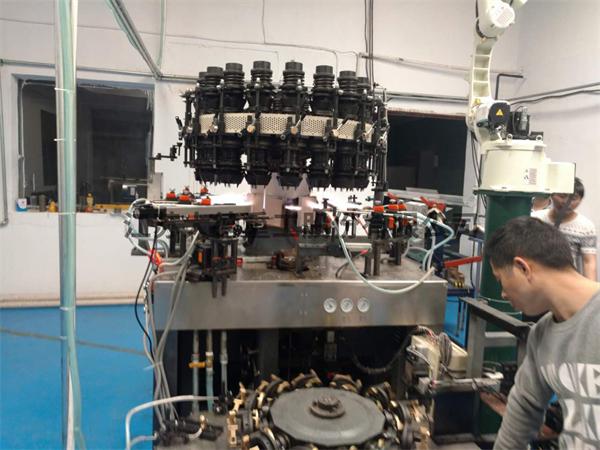
Efficient Glass Tubes Glazing Install Lifting Handling Robot Cell
Laser welding produces fine metal fume and, on coated steels, metal oxide particulate. Extraction at the seam, inside the enclosure, with the door interlock tied to the extraction running status, is the arrangement that passes an audit. Safety doors that lower automatically at cycle start, as used in Dade's purifier-industry welding room design, remove the temptation to reach in during a cycle.
Robot to PLC and MES
A PLC bus control architecture simplifies the wiring between the control cabinet and the arm, and it is what allows parameter sets to be recalled by part number instead of edited by hand. If your plant runs MES, confirm the cell can export weld parameters, cycle counts and alarm history over a standard interface.
Specifying the Arm
|
Parameter |
What to check |
Practical note |
|
Payload |
Head + dress pack + bracket weight, with margin |
Add 30 percent for cable stiffness |
|
Reach |
Longest seam plus fixture clearance |
Stay inside 70 percent of maximum |
|
Repeatability |
Stated as ±mm at the tool flange |
Needs to be smaller than gap tolerance |
|
Wrist articulation |
Can it orient the head normal to the seam? |
Check the worst corner, not the average |
|
Mounting |
Floor, wall or inverted |
Inverted saves floor space on tall parts |
A common mistake is buying the arm for payload and then discovering the wrist cannot rotate the head to the angle the joint needs. Draw the worst seam in three dimensions, place the arm, and check the wrist angles before the order.
Seam Finding Without a Perfect Jig
Wire touch sensing
The cheapest robust method: touch the part with the wire or a sensing nozzle at three to five points, calculate the offset, shift the program. It costs a few seconds per part and removes the need for fixture accuracy better than 0.3 mm. Dade's platform welding system for mini excavator frames uses wire touch sensing for seam positioning before fill welding, with hydraulic clamping to hold the part once located.
Laser seam tracking
A camera or laser triangulation sensor reads the joint ahead of the beam and steers the path in real time. It handles long seams with thermal distortion well. On thin sheet with tight gaps, tracking can chase the gap and make the path wander — set a dead band.
Vision and 3D scanning
For parts presented in random orientation, a 3D scan locates the part and generates the path. It adds cost and programming complexity, and it pays back when fixture cost per variant would otherwise dominate.
Cycle Time Arithmetic
Run the numbers before the quotation is finalised. Take a 320 mm fillet on 1.5 mm stainless at 2.5 m/min: 7.7 seconds of arc-on time. Add approach, gas pre-flow, and retract: 11 seconds. Add door open, load, clamp, door close: 25 seconds on a single-station cell. That is 36 seconds per part, of which the laser is working for 21 percent of the time.
The fix is not a faster laser. It is a second station, a shuttle, or a rotary positioner that lets loading happen while welding continues. Two stations on an index table turn that 36 seconds into roughly 20, and the laser utilisation climbs past 50 percent. Every robot laser welding cell should be reviewed against this arithmetic before the layout is frozen.
Enclosure and Environment
The circuit breaker switch cell that Dade Heavy Industry built shows what a production-grade enclosure looks like: a fully enclosed structure with dust extraction ports and integrated safety protection, designed for a workshop where the previous manual process exposed operators to fume and inconsistent quality. The enclosure does three jobs at once — it keeps the beam inside, it keeps the fume away from the operator, and it stabilises the air around the optics so the lens stays clean for a full shift.
Add a positive-pressure optical compartment if the plant is dusty. Add a chiller alarm into the cell's stop circuit. Add a spatter tray under the fixture, because cleaning a spatter tray takes ten minutes and replacing a damaged fixture takes two days.
Acceptance and Ramp-Up
Write the acceptance run around production conditions. Thirty consecutive parts, mixed across at least two part numbers, with the fixture changed between them. Measure penetration on sectioned samples, porosity by X-ray, spatter by particle count, and cycle time by stopwatch including handling. Then run the cell for one shift at target rate before sign-off.
Ramp-up is usually a fixture problem, not a robot problem. Budget the first two weeks for clamp refinement, seam-finding offsets and program cleanup. A supplier who plans for that will hand over a cell that runs; one who promises a plug-and-play install will hand over a list of excuses.
Working With Dade Heavy Industry
Dade Heavy Industry (stock code 870547) integrates
robot laser welding equipment around Kawasaki and FANUC arms and Raycus fiber sources from its Wuxi base, where roughly 600 employees work across a 100,000 m² site. The company's scope starts before the hardware: drawings and samples are analysed to confirm the joint is weldable by laser, the fixture concept is designed against the part, and the plant layout is checked for handling and extraction routes. With nearly 10,000 sets of equipment delivered across 50 series and exports to Southeast Asia, the Middle East, Japan, Europe and the Americas, the reference list covers both high-mix job shops and dedicated lines.
If you are comparing quotations for robot laser welding equipment, ask each supplier to sketch the cell layout, state the seam-finding method, and calculate laser utilisation for your part. The answers separate integrators from resellers faster than any specification sheet.