Laser Welding Equipment: What Decides Whether A Line Holds Quality
Release time:2026-11-09
Visits:6
Most buyers compare laser welding equipment on one number: kilowatts. That number tells you very little on its own. Two systems rated at the same power can behave like different machines once you put a real joint under them — one produces a clean keyhole with a narrow heat-affected zone, the other spits, blows holes in thin sections, and needs a grinder after every cycle. The difference is rarely the laser source. It sits in the optics, the gas delivery, the fixture, and how well the motion system holds position while the seam moves under the beam.
This page walks through what a laser welding equipment package really consists of, which variables actually move weld quality, and how to write acceptance tests that protect you after the invoice is paid.
What a Laser Welding Equipment Package Actually Contains
A working system is six subsystems, not one box.
The source, the fiber and the head
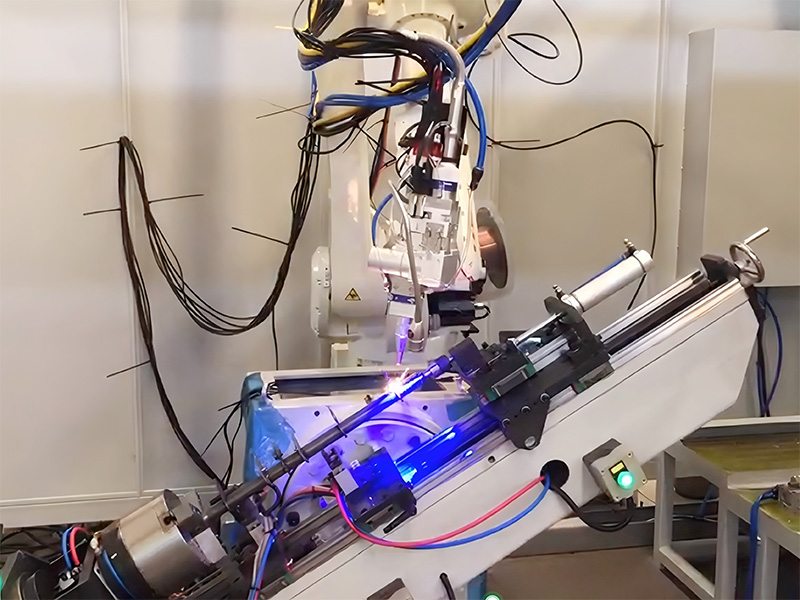
3D Robot Laser Welding Cells for Circuit Breakers
The source sets the ceiling on capability: power, beam quality, and modulation speed.
Fiber laser welding machines in the 1 kW to 4 kW band cover most sheet-metal and thin-plate production work; thicker sections or high-speed seam welding push toward 6 kW and above. Beam quality (measured as BPP) matters as much as power, because a tighter beam reaches a smaller spot at a longer working distance, which keeps the head clear of fixtures.
The weld head is where many projects quietly fail. A fixed-optic head is fine for a flat, well-supported seam. The moment the joint is three-dimensional or the gap varies, you need a head with adjustable focus, cross-jet air protection, and preferably beam oscillation (wobble) so the energy is spread across the gap instead of drilled into one line.
The parts buyers forget
Chillers, shielding gas panels, and fixtures decide uptime. A chiller sized to the source's duty cycle at 45 °C ambient is not the same as one sized for a lab. Gas delivery with a dedicated solenoid, flow meter and pre-flow delay prevents the first 20 mm of every seam from oxidizing — a defect that shows up only after pickling or leak testing.
Matching Power to Joint Geometry
Power should follow the thickness and the joint type, not the brochure.
|
Joint type |
Typical thickness |
Practical power band |
What limits it |
|
Lap fillet, sheet |
0.5–2.0 mm |
1–2 kW |
Gap tolerance, not power |
|
Butt, square edge |
1.0–3.0 mm |
2–4 kW |
Edge squareness and fit-up |
|
Butt with oscillation |
3.0–6.0 mm |
4–8 kW |
Gas coverage, spatter control |
|
Deep penetration |
6.0 mm and up |
8 kW+ |
Fixture stiffness, distortion |
A 4 kW source on a 1 mm lap joint is not "safer". Excess power narrows the process window: the seam goes from conduction to keyhole mode, the weld becomes more sensitive to gap, and the risk of burn-through rises with every 0.1 mm of mismatch. Size for the worst joint in the family, then confirm the best joint still runs.
The Five Variables That Move Weld Quality
Gap tolerance and fit-up
Laser welding tolerates roughly 10 percent of the material thickness in gap before the seam needs filler or oscillation. On 1.5 mm stainless that is 0.15 mm. If your press brake or laser cut cannot hold that, the answer is not more power — it is a clamping fixture that pushes the edges together, or a wobble pattern that bridges the gap.
Shielding gas and plasma suppression
Argon gives the calmest weld pool but the poorest penetration; helium and nitrogen raise penetration and speed but widen the plume. On stainless, a trailing shield behind the head keeps the hot seam under gas for the second or two it stays above 400 °C, which is what prevents heat tint. On aluminium, cross-jet air across the optics protects the lens from spatter and fume.
Focus position and spot size
Focus sits at or slightly below the surface for keyhole welding and slightly above for thin conduction-mode joints. Moving focus 1 mm can change penetration by 20 to 30 percent. Record the setting for each part number and lock it into the program.
Surface condition
Mill scale, oil, and zinc coating all change coupling. Galvanised steel needs a gap between sheets so zinc vapour escapes, or porosity follows. Pickled stainless welds more predictably than black-hot-rolled.
Clamping and heat sinking
Copper or aluminium backing bars pull heat out of the seam and reduce distortion on thin sheet. On long seams, a copper chill bar behind the joint often does more for flatness than any parameter change.
Where Laser Welding Beats Arc Welding — and Where It Does Not
|
Criterion |
Laser |
MIG / TIG |
|
Heat input |
Low, narrow HAZ |
High, wide HAZ |
|
Speed on thin sheet |
3–10× faster |
Baseline |
|
Gap tolerance |
Poor without filler |
Forgiving |
|
Thick section, single pass |
Needs high power |
Multi-pass is normal |
|
Distortion on 1 mm sheet |
Minimal |
Visible, needs straightening |
|
Operator skill demand |
Programming skill |
Torch skill |
Laser wins on thin, fit-up-controlled, high-volume joints: enclosures, battery trays, motor housings, instrument panels. Arc processes still win on thick structural work, rough fit-up, and low-volume jobs where fixture cost cannot be amortised.
Integrating Laser Welding Equipment Into a Running Line
Cycle time and handling
The laser is rarely the bottleneck. Handling usually is. A 400 mm seam at 3 m/min takes 8 seconds; the operator opening a door, loading a fixture and closing it takes 20 to 40 seconds. Design the cell so loading happens while the beam is cutting somewhere else — dual station, shuttle table, or a rotary positioner.
Safety, enclosure and fume
Class 1 enclosure with interlocked doors, laser-safe viewing windows, and extraction at the seam. Welding fume from coated steel and aluminium carries fine particulate; extraction at the torch, not at the ceiling, is what keeps the cell compliant and the optics clean.
What to Ask a Laser Welding Equipment Supplier
Ask for a weld on your part, not a coupon. Bring three condition levels: nominal fit-up, worst-case gap, and worst-case surface. A supplier who only demonstrates perfect coupons has not shown you a process, only a machine.
Acceptance tests to write into the contract
• Penetration and weld width on a cross-section, measured at three points per sample
• Porosity limit stated as a percentage of cross-sectional area, checked by X-ray or sectioning
• Spatter count per part, defined as attached particles above a stated diameter
• Cycle time measured over 30 consecutive parts, including handling
• Repeatability: reposition the fixture and re-run, confirming the seam still meets specification
Where Dade Heavy Industry Fits
Dade Heavy Industry (stock code 870547) builds robot-based laser welding and cutting systems from its 100,000 m² plant in Wuxi, Jiangsu, with roughly 600 employees and a product range spanning 50 series and 200 specifications. The company's work in this field is application-led: a fully enclosed 3D laser welding workstation for circuit breaker switches, built around PLC bus control with dust extraction ports and integrated safety protection, came out of a customer requirement for consistent welds in a dirty, high-mix environment rather than a catalogue template.
That background matters when you specify laser welding equipment. A supplier who has already integrated Kawasaki and FANUC arms with Raycus sources, designed the fixture, and handed over a running cell will ask about your gap tolerance and your handling time before quoting a power rating. Dade's pre-purchase analysis step works from customer drawings and samples, and the one-stop scope covers cycle-time analysis, fixture design, plant layout and a free sample trial — the four things that usually decide whether a laser cell reaches its rated output.
A Short Checklist Before You Sign
Confirm the joint family and the worst-case gap. Confirm which thicknesses must run in keyhole mode and which in conduction mode. Confirm the handling concept and the target cycle time. Confirm gas supply, chiller capacity and floor space. Then require a run on your own parts, at your own fit-up quality, before the purchase order is released.
Laser welding equipment rewards the buyer who defines the joint before the machine. It punishes the buyer who defines the machine first and then discovers the joint will not fit it. That sequence is the one Dade Heavy Industry follows on every project.