How Does Resistance Welding Work?
Resistance welding generates heat at the joint through electrical resistance while electrodes apply controlled force. The simplified heat relationship is often expressed as:
Heat ∝ Current² × Resistance × Time
This equation explains why current is such a powerful variable, but real welding also depends on force, contact area, material properties, coating, electrode condition, cooling, current waveform, and heat loss.
A typical cycle includes squeeze time, weld current, hold time, and electrode release. The force must establish stable contact before current starts and continue long enough for the molten nugget to solidify under pressure. Poor timing can cause expulsion, small nuggets, surface indentation, or inconsistent strength.
What Is Resistance Spot Welding?
Resistance spot welding makes a localized weld nugget between opposing electrodes that clamp a lap joint. It is widely used for sheet-metal assemblies because the cycle is fast and can be automated with fixed machines, welding guns, or robots.
Spot welding is a strong choice when:
Two or more sheets overlap.
Both sides of the joint are accessible.
Discrete welds meet structural and sealing requirements.
High production rate is important.
Electrode marks are acceptable or can be controlled.
The process must manage sheet stack thickness, coating, material strength, shunting from nearby welds, and electrode wear. Weld spacing and edge distance affect current flow and joint performance. A parameter schedule qualified for two uncoated sheets should not be assumed valid for a coated, mixed-thickness, or multi-layer stack.
What Is Projection Welding?
Projection welding concentrates current and force at one or more designed projections, embossments, rings, or small contact features. As current flows, the projection heats, collapses, and forms the weld.
Projection welding is commonly used for nuts, studs, brackets, cross-wire products, and parts requiring several welds in one press cycle. It offers accurate weld location because the part geometry defines the current concentration.
Advantages can include simultaneous multiple welds, lower surface marking on the opposite sheet, controlled current location, and efficient joining of hardware. Challenges include projection consistency, part orientation, tooling alignment, force distribution, and current balance across multiple projections.
A poorly formed projection can collapse before sufficient heat develops or carry unequal current. Incoming-part geometry is therefore a critical process variable.
What Is Resistance Seam Welding?
Resistance seam welding uses rotating wheel electrodes to produce a series of overlapping or spaced weld nuggets along a path. When the nuggets overlap sufficiently, the joint can form a continuous leak-resistant seam.
Seam welding is used for tanks, drums, filters, radiators, exhaust components, strip joining, and other products requiring a long repeatable joint. Operating modes include continuous current, intermittent current, and roll-spot welding.
Key variables include wheel speed, current pulse and interval, electrode force, wheel profile, cooling, overlap, and tracking. Heat accumulation can grow along a long seam, so the end of the weld may behave differently from the beginning. Process development should evaluate start, steady-state, corners, and stop conditions.
How Do the Three Processes Compare?
Spot, projection, and seam welding use the same resistance-heating principle but control current location through different joint and electrode geometries.
|
Selection Factor |
Spot Welding |
Projection Welding |
Seam Welding |
|
Weld form |
Discrete nugget |
Nugget at designed feature |
Overlapping or spaced nugget line |
|
Typical joint |
Sheet lap |
Fastener, embossment, ring, cross wire |
Lap seam or strip joint |
|
Electrode type |
Opposing caps or shaped electrodes |
Platens or shaped tools |
Rotating wheels |
|
Leak-tight potential |
Limited without special design |
Good for ring projections |
High with correct overlap |
|
Part-geometry dependence |
Moderate |
High |
Moderate |
|
Automation |
Fixed or robotic |
Press-style or automated feed |
Dedicated machine or line |
|
Main wear item |
Electrode caps |
Electrodes and projection tooling |
Wheel profile and bearings |
Choose from the functional joint requirement first. Equipment selection follows the required force, current, throat depth, access, duty cycle, and automation method.
Which Variables Control Weld Quality?
The core variables are current, time, force, electrode geometry, and contact resistance. They interact strongly.
Current too low may produce an undersized nugget or no fusion.
Current too high may cause expulsion, excessive indentation, electrode sticking, or rapid wear.
Time too short may not form the required nugget.
Time too long increases heat spread and cycle time.
Force too low can create arcing and expulsion.
Force too high can reduce interface resistance or produce excessive indentation depending on the stack.
Worn electrodes change contact area, current density, heat balance, and part marking.
Use a qualified process window rather than one nominal schedule. Include low and high line voltage, material thickness, coating, cooling-water temperature, and electrode life conditions where relevant.
How Do Material and Coating Affect the Schedule?
Material resistivity, thermal conductivity, strength, thickness, and coating change how heat is generated and removed. High-strength steels may need different force and current strategies than mild steel. Aluminum’s high conductivity and rapid electrode degradation create a different process window from steel.
Zinc and other coatings affect contact resistance, electrode pickup, and wear. Adhesive in a weld-bonded joint affects current paths and gas generation. Mixed-material stacks require careful compatibility review; not every combination is practical with conventional resistance welding.
Material certificates and coating specifications should be part of process qualification. Visual similarity does not guarantee equivalent weld behavior.
Why Are Electrode Cooling and Dressing Important?
Electrode condition controls current density and heat balance, so cooling and dressing are process controls rather than maintenance details. Inadequate water flow raises electrode temperature, accelerates softening and pickup, and changes nugget formation.
Define minimum water flow, inlet temperature range, pressure, filtration, and alarm response. Verify actual flow through the electrode circuit, not just pump operation.
Electrode dressing restores geometry and removes deposits. Dressing intervals can be set by weld count and then optimized using nugget tests, cap diameter, process-monitoring trends, and surface quality. Excessive dressing wastes electrode material; delayed dressing allows drift.
How Is Resistance-Weld Quality Verified?
Quality verification combines destructive tests, nondestructive or in-process monitoring, dimensional checks, and controlled equipment verification. No single signal proves every weld property.
Common methods include peel or chisel tests, tensile-shear testing, cross-sections, ultrasonic inspection where suitable, leak testing for seams, and monitoring of current, voltage, resistance, force, displacement, or electrode movement.
Dynamic resistance and displacement curves can indicate process changes, but limits must be correlated with physical weld results. ISO 17657 addresses measurement of welding current in resistance welding, while product-specific standards and customer requirements define acceptance.
Maintain traceability between part, machine recipe, electrode life, alarms, and inspection records for critical applications.
What Information Is Needed to Specify a Machine?
A resistance welding machine should be specified from the joint and production duty, not only from a headline current rating. Provide:
Material grades, coatings, and thickness stack.
Joint drawings and access limits.
Required nugget, strength, sealing, and appearance criteria.
Part size, weight, and loading method.
Production rate and welds per part.
Required force and current window from trials where available.
Throat depth, platen size, or wheel geometry.
Cooling-water and electrical supply conditions.
Automation, feeding, traceability, and safety requirements.
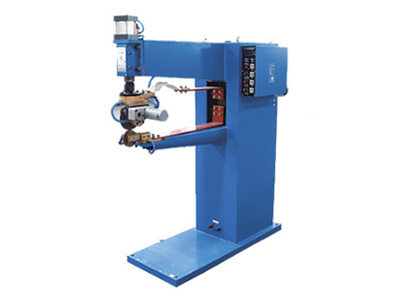
JiangSu Dade Heavy Industry offers spot, projection, and seam resistance welding equipment, including pneumatic machines and dedicated seam-welding configurations. Representative part trials are the most reliable basis for final equipment and process selection.
Frequently Asked Questions
Is projection welding stronger than spot welding?
Not inherently. Joint strength depends on material, weld size, number and location of welds, loading direction, and process quality. Projection welding offers geometric current concentration, not automatic superiority.
Can seam welding make a pressure-tight joint?
Yes, when nugget overlap, material, wheel tracking, start/stop conditions, and inspection are designed for the required leak rate. Qualification is essential.
Why do spot welds become weaker as production continues?
Electrode wear, coating pickup, cooling changes, force drift, cable heating, or material variation may shift the process. Monitor weld count and process signals, then verify physically.
Can a robot carry a resistance welding gun?
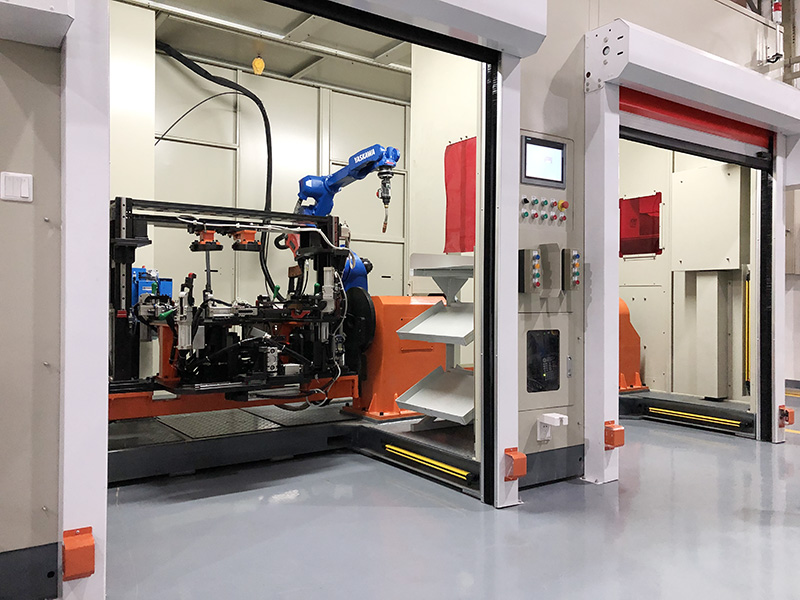
Yes, if robot payload, inertia, reach, cable routing, transformer arrangement, utilities, and force reaction are engineered for the gun and part.
Is resistance welding suitable for visible surfaces?
It can be, but indentation, electrode marks, distortion, and coating damage must be included in the cosmetic requirement and tooling design.
Conclusion
Resistance spot, projection, and seam welding are complementary processes. Spot welding serves discrete sheet joints, projection welding focuses current through designed features, and seam welding creates repeated joints along a path. Correct selection comes from the part function, stack, access, quality criteria, production rate, and verified process window. Machine current alone never defines a capable solution.