Laser Welding Machine: Working Principle, Types & Buying Guide
Release time:2026-08-31
Visits:220
Jiangsu Dade Heavy Industry Co., Ltd. (stock code: 870547) is a high-tech manufacturer of industrial robot and laser equipment, supplying robot 3D laser welding workstations, handheld laser welders, automatic laser welding systems and digital inverter welding machines from its 100,000 m² production base in Wuxi, Jiangsu, China.
Laser welding has become one of the most widely adopted joining technologies in modern manufacturing. Compared with traditional arc welding, it delivers higher speed, deeper penetration, lower heat input and far better repeatability — which is why industries from automotive and shipbuilding to petrochemical and engineering machinery are switching to laser welding machines. This guide explains how a laser welding machine works, what types are available, and how to select the right one for your production line.
What Is a Laser Welding Machine and How Does It Work?
A laser welding machine is a piece of equipment that uses a highly concentrated, high-energy laser beam to melt and fuse metal workpieces together. The working principle can be summarized in four steps:
1. Beam generation — A laser source (most commonly a fiber laser) generates a coherent, high-power light beam.
2. Beam delivery — The beam travels through optical fibers or mirror systems to the welding head, with minimal energy loss.
3. Focusing — A focusing lens concentrates the beam into a tiny spot, creating an extremely high power density on the workpiece surface.
4. Melting and fusion — The concentrated energy melts the base metal instantly, forming a weld pool that solidifies into a strong, deep weld joint when the beam moves away.
Core Components of a Laser Welding Machine
- Laser source (fiber laser generator) — the heart of the machine; power typically ranges from 1000 W to 3000 W and beyond.
- Beam delivery system — optical fiber and collimating/focusing optics.
- Welding head — handheld gun or robot-mounted head, often equipped with wobble/oscillation function for wider joints.
- Cooling system — chiller that keeps the laser source stable during continuous operation.
- CNC / robot control system — controls motion path, speed and welding parameters.
- Workstation and fixtures — rotary tables, positioners and clamping devices that hold workpieces precisely.
Main Types of Laser Welding Machines
1. Handheld Laser Welding Machine
Portable and flexible, suitable for on-site welding, large structures and low-volume production. Operators can weld stainless steel, carbon steel, aluminum and other metals with a lightweight gun.
2. Robot 3D Laser Welding Workstation
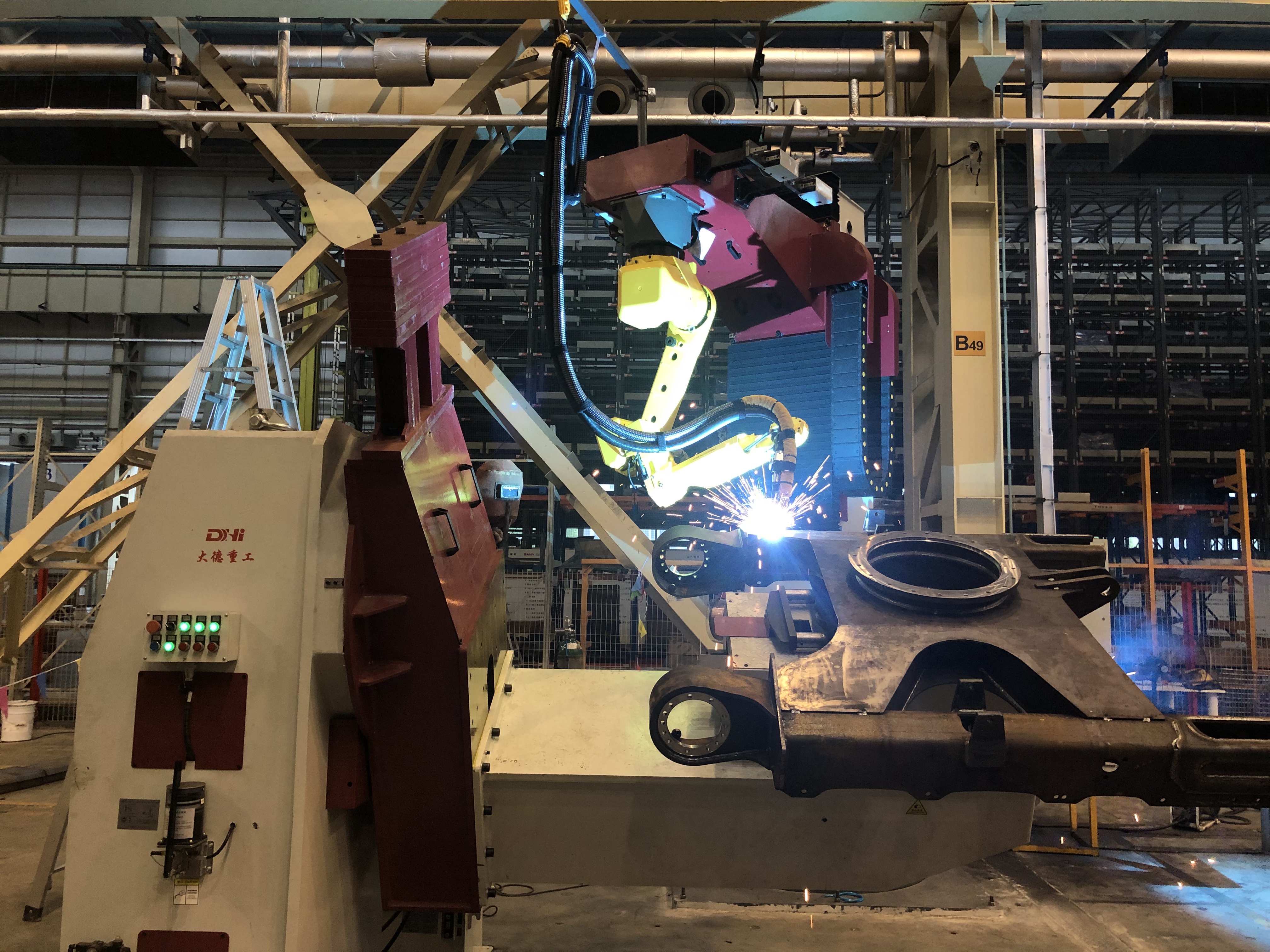
A 6-axis (or more) industrial robot carries the laser welding head, enabling complex 3D seam paths with high accuracy and repeatability. This is the mainstream choice for mass production. Dade Heavy Industry is a leading supplier of robot 3D laser welding equipment used across the automotive and engineering sectors.Dade Heavy Industry
3. Automatic / Gantry Laser Welding Machine
A stationary gantry or moving-column machine welds long straight or contour seams automatically, ideal for large panels, pipes and structural components.
4. Laser Spot & Seam Welding Systems
Used for precise spot or continuous seam welding of small parts, common in battery, electronics and medical device manufacturing.
Key Advantages of Laser Welding
- High speed and efficiency — up to several times faster than TIG or MIG welding.
- Deep penetration, narrow heat-affected zone (HAZ) — minimal distortion and reduced post-weld grinding.
- High precision and repeatability — ideal for automated mass production.
- Low operating cost — no filler wire, electrodes or shielding gas consumption in many applications.
- Wide material compatibility — welds carbon steel, stainless steel, aluminum, copper, titanium and dissimilar metal combinations.
- Easy automation integration — fully compatible with robots, sensors and production lines.
Laser Welding Applications Across Industries
- Automotive — body panels, chassis components, battery housings.
- Shipbuilding & locomotive — hull structures, frames and piping.
- Petrochemical & metallurgy — pressure vessels, tanks, pipelines.
- Construction & engineering machinery — booms, buckets, frames and heavy structural parts.
- Medical devices & electronics — hermetic sealing of precision components.
Dade Heavy Industry's
laser welding products serve all of the above sectors and are exported to Southeast Asia, the Middle East, Japan, Europe and America.
How to Choose the Right Laser Welding Machine
1. Laser power — choose 1000–1500 W for thin sheets and fine work; 2000–3000 W for thicker or high-production applications.
2. Material type and thickness — reflective metals like aluminum and copper need higher power and appropriate wavelength handling.
3. Production volume and automation level — high volume demands a robot workstation; flexible small-batch work suits handheld or semi-automatic machines.
4. Joint design and part size — determine working area, robot reach and whether a rotary positioner is required.
5. After-sales support — verify spare parts availability, training and local service from the manufacturer.
Why Choose Dade Heavy Industry
Jiangsu Dade Heavy Industry Co., Ltd. is a high-tech enterprise integrating R&D, manufacturing, sales and service, with nearly 600 employees and products spanning 50 series and 200 specifications. Its robot and laser technology teams have delivered close to 10,000 sets of equipment, supported by more than 20 provincial and municipal science and technology projects.
Whether you need a single handheld laser welder or a complete robot laser welding cell, Dade Heavy Industry can configure a turnkey solution and provide full training, installation and after-sales service. Contact us today for a free evaluation and quotation.