Industrial Robot Welding Equipment: Engineering The Line
Release time:2026-11-30
Visits:9
A single welding cell is a machine. A welding line is a factory inside a factory, and the rules change. Cycle time stops being the robot's business and becomes the conveyor's business. Quality stops being a parameter setting and becomes a traceability system. Uptime stops being the integrator's promise and becomes the maintenance department's daily reality.
That gap is where most
industrial robot welding equipment projects go wrong. The robot arrives as specified, the welds pass inspection, and the line still misses its target because the loading interval was calculated for one part family and the plant runs three, or because the fixture change takes 40 minutes when the plan assumed 10.
From Cell to Line: What Changes
Three things scale badly if they are not designed at the start.
Buffering. A cell can wait for an operator. A line cannot. Every station needs either a buffer, a dual station, or an operator whose task is timed to the takt.
Changeover. A single-part cell never changes over. A line that runs 66 variants, as the exhaust aftertreatment line Dade Heavy Industry built does, lives or dies on changeover time — which is why that line was designed for single-station die change in 30 minutes or less.
Traceability. Once parts move automatically, a defect found at the end of the line has to be traced back to a weld, a program and a wire lot. Data collection is not an add-on; it is part of the specification.
The Architecture of a Line
Robots and positioners
The robot moves the torch; the positioner moves the work. Getting the split right determines the layout. A positioner with a 360° rotating and tilting table lets a single robot reach all sides of a heavy part without a second robot. A fixed fixture forces either a bigger robot or a second station.
For a part like a wheel rim, the positioner holds the assembly, rotates it through the weld sequence, and presents each joint at a comfortable angle. For a long structural part, a linear track under the robot is often cheaper than a very large positioner.
Power sources and torches
The source and the torch are chosen together, and both are chosen against duty cycle. A 500 A class power source paired with a water-cooled torch runs continuously at 350 A without overheating; an air-cooled torch at the same current will not survive a three-shift week. Water cooling adds a chiller and hoses, and it removes the most common cause of mid-shift stoppage on a welding line.
PLC, safety and data
A line controller sequences stations, interlocks safety devices, and logs production data. Siemens S7-1500 class PLCs with an MES interface are the common choice in Chinese automotive supply chains, and they are what allow a line to report per-station output, alarm history and weld parameters without a separate historian.
|
Line type |
Typical robot |
Source class |
Control |
Note |
|
Single-station cell |
6-axis, 1.4–1.8 m reach |
350–500 A MIG |
PLC plus robot controller |
Lowest cost per station |
|
Multi-station line |
6-axis plus track |
400–500 A MIG |
Line PLC plus MES |
Balance takt across stations |
|
Heavy part line |
6-axis, 20 kg payload |
500 A water-cooled |
PLC plus safety PLC |
Positioner carries the mass |
|
High-mix line |
6-axis with quick-change torch |
400–500 A, multi-program |
PLC with recipe recall |
Changeover time is the KPI |
Robot Selection for Line Duty
Payload and duty cycle
Payload is torch plus wire feeder plus bracket, with margin for cable stiffness. On a line, duty cycle matters as much as payload: a robot running 85 percent of the time at high acceleration wears gearboxes faster than the datasheet suggests. Derate by one frame size if the duty is above 80 percent continuous.
Reach and station layout
Draw the reach envelope on the floor plan before committing to the building. A robot that reaches the fixture at full extension will deflect, and the weld will drift at the far corner. Keep the working path inside 70 percent of maximum reach and let the positioner bring the part closer.
Repeatability is not accuracy
Repeatability of ±0.05 mm means the robot returns to the same point. Accuracy means the point is where the CAD says. On a line, the second matters when you swap a robot or reload a program. Most production lines solve this with touch sensing or arc tracking rather than by buying a more accurate robot — a wire touch on three points costs three seconds and removes the need for a perfectly accurate cell.
Power Source and Torch Matching
What the source has to do
Three capabilities separate a production source from a basic one: waveform control for spatter reduction, synergic programs for one-knob setting, and a fieldbus interface so the robot can select a job by number. On a line running multiple variants, the last is not optional — hand-editing parameters at changeover guarantees inconsistency.
Wire, gas and the details that age
Wire feed length, liner condition, and gas flow at the torch are the three things that quietly degrade over a month. Specify a flow meter at the torch, not at the regulator, and put wire feed force on the daily check sheet.
Station Layout and Material Flow
The loading interval is a design input
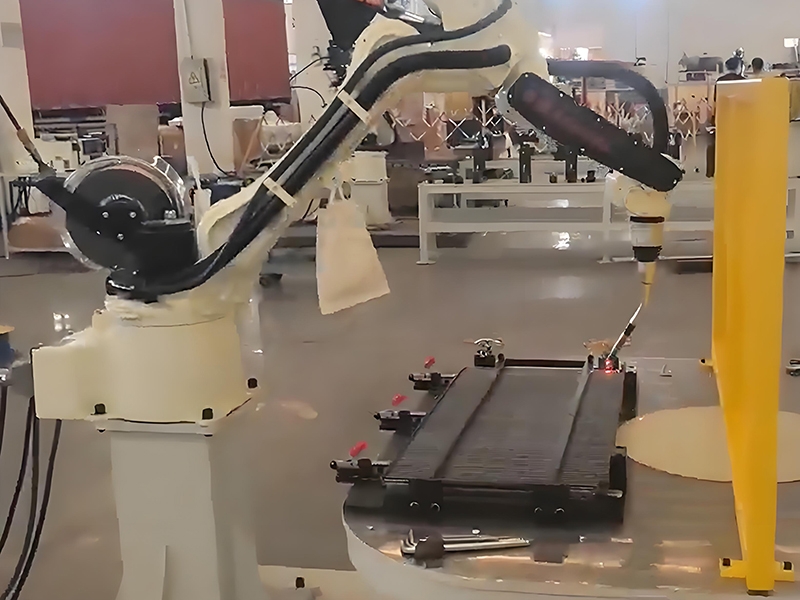
The high-horsepower support wheel line illustrates the principle. It runs a FANUC M-20iD/25 robot with a Fronius TPS500i source, a TBI water-cooled torch and Siemens PLC control. The design calls for manual loading and unloading roughly every 1.5 hours, with a loading conveyor of 15 to 20 m; everything between loadings — welding, positioning, transfer — runs automatically.
That number, 1.5 hours, is not an accident. It is the buffer capacity divided by the consumption rate, and it sets how many operators the line needs. If you cannot state your loading interval, you cannot state your headcount.
Footprint and services
The same line occupies a project space of 27 m × 9.3 m. That footprint includes the conveyor, the robot, the positioner and the safety fencing, but not the raw material store or the finished goods area. Add 20 to 30 percent for access and maintenance when you check the building.
Site Conditions That Get Forgotten
The support wheel line specification lists them plainly, and they are worth copying into any tender:
• Operating voltage AC 380 V ±10 percent, 50 Hz, three-phase five-wire
• Ambient temperature −10 °C to 45 °C, indoor
• Relative humidity below 90 percent, indoor
• Concrete floor approximately 20 cm thick, load-bearing
• Compressed air at 0.4 MPa minimum, dry enough for the air cylinders
• Water, power and gas brought to the line by the customer
Most line delays trace back to one of these five. A 0.3 MPa air supply will make a pneumatic clamp hesitate, and a hesitating clamp produces a weld in the wrong place.
Commissioning a Line
Sequence the commissioning in this order, and do not compress it:
1. Mechanical installation and alignment, including conveyor level
2. Services verification: power, air, water, gas, extraction
3. Safety validation: interlocks, light curtains, door switches, e-stops
4. Dry cycling of the material flow with no welding
5. First-article welding on each variant
6. Takt verification over a full shift at target rate
7. Traceability check: pull a finished part and retrieve its weld data
Dade Heavy Industry on Line Projects
Horizontal Rotary Welding Tables & Workstation
Dade Heavy Industry (stock code 870547) builds
industrial robot welding equipment as complete lines rather than standalone cells. The company's references include a gas-insulated transmission line welding line using FANUC M-20iD/25 robots with Binzel laser tracking and Fronius TPS500i/MW5000 sources, achieving 100 percent weld inspection with first-pass acceptance of 99 percent or better against NB/T47013.5-2015; a vibration exciter assembly and welding line handling workpieces up to 161 kg with 360° positioners; and an exhaust aftertreatment line covering 66 variants with full traceability of weld parameters, leak test data and 3D dimensional measurements.
From a 100,000 m² plant in Wuxi, Jiangsu with roughly 600 employees, the company covers design, manufacture, installation, commissioning and operator training, and holds IATF and ISO management system certifications. For buyers comparing industrial robot welding equipment, the useful question is not which robot brand appears in the quotation but which station sets the takt, and how the line behaves when the third variant of the day arrives. Dade's engineers will walk a layout with you before a quotation is issued.