







© 2025 JiangSu Dade Heavy Industry Co.Ltd. All Rights Reserved.Web Design by Wangke
Release time:2025-06-12 Visits:1019
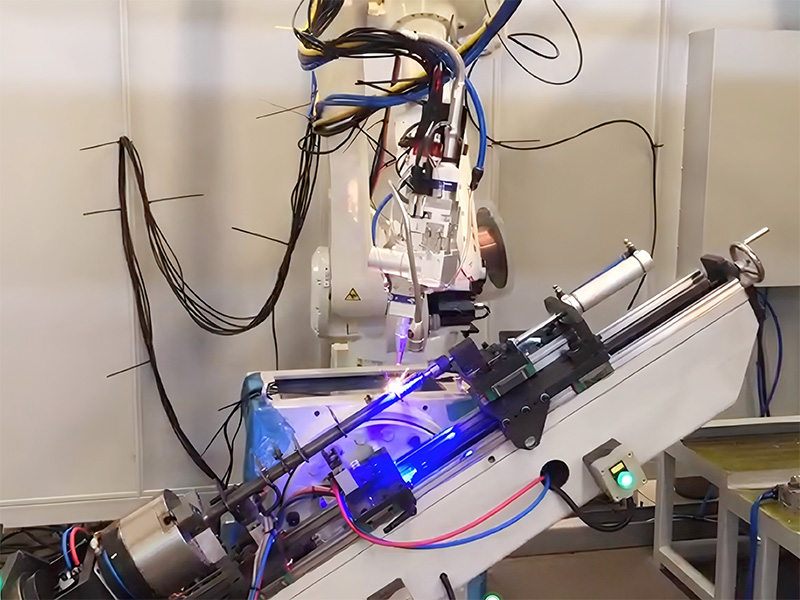
A welding manipulator is a professional welding device specifically designed for the welding of internal and external longitudinal and circumferential seams of cylindrical workpieces (such as pressure vessels, petrochemical containers, boiler drums, etc.). Through precise mechanized control, it significantly improves welding efficiency and quality, and has become an indispensable automated tool in modern industrial manufacturing.
The welding manipulator is mainly composed of modules such as columns, cross - beams, slewing mechanisms, and trolleys. Its core function is to precisely position the welding head or welding torch at the welding position and maintain a stable motion trajectory. During the welding process, the equipment can work in coordination with positioners, enabling multi - angle synchronous welding of workpieces after a single clamping, reducing repeated positioning errors and improving processing consistency.
| 1. Cross - arm Manipulators | There are two types: cantilever and telescopic arm. The telescopic - arm type, with its high flexibility and wide coverage, is the preferred choice for high - precision and complex welding. |
|---|---|
| 2. Platform Manipulators | Divided into single - rail and double - rail trolley types, they are suitable for basic welding requirements in fixed scenarios but have lower flexibility than telescopic - arm manipulators. |
| 3. Gantry Manipulators | They adopt the structure of lifting platforms or moving carriages, supporting multi - directional welding of large workpieces, especially suitable for mass production of heavy - duty tanks and pipelines. |
Modern welding manipulators achieve multi - dimensional upgrades through the integration of automation technologies:
| Precise Control | Equipped with electric slide plates and internal telescopic arms, it can adapt to workpieces of different sizes and support stable welding of materials with a thickness of 0.1 - 3.5mm. |
|---|---|
| Intelligent Collaboration | Paired with arc oscillation, weld tracking, and real - time monitoring systems, it can automatically adjust parameters to adapt to the welding of dissimilar materials (such as stainless steel, carbon steel, aluminum alloy, etc.), reducing thermal deformation and ensuring weld uniformity. |
| High - efficiency and Energy - saving | The new laser welding technology reduces the power consumption of the equipment to only 1/8 of that of traditional argon arc welding, and no consumables need maintenance. Its service life can reach 100,000 hours. |
| 1. Petrochemical and Energy Fields | Used for the circumferential seam welding of pressure vessels and pipeline systems, the man - machine cooperation mode shortens the production cycle by more than 50%. |
|---|---|
| 2. Automobile Manufacturing | In the welding of components such as chassis and exhaust pipes, robots replace manual labor in high - risk operations, increasing the qualified product rate by 30%. |
| 3. Customized Production | It supports rapid program modification and module expansion, meeting the needs of small - batch and multi - batch orders and reducing equipment iteration costs. |
The welding manipulator is mainly composed of modules such as columns, cross - beams, slewing mechanisms, and trolleys. Its core function is to precisely position the welding head or welding torch at the welding position and maintain a stable motion trajectory.
1. Cross - arm Manipulators: There are two types: cantilever and telescopic arm. The telescopic - arm type, with its high flexibility and wide coverage, is the preferred choice for high - precision and complex welding.
Modern [[LINK:https://www.dadehi.com/horizontal-rotation-welding-workstation.html|welding manipulators]] achieve multi - dimensional upgrades through the integration of automation technologies:
1. Petrochemical and Energy Fields: Used for the circumferential seam welding of pressure vessels and pipeline systems, the man - machine cooperation mode shortens the production cycle by more than 50%.
Explore our full range of robotic MIG welding systems.
Full specifications sit in the complete range of welding and cutting equipment.