Low-Spatter Welding Machine: Where Spatter Actually Comes From
Release time:2026-12-11
Visits:9
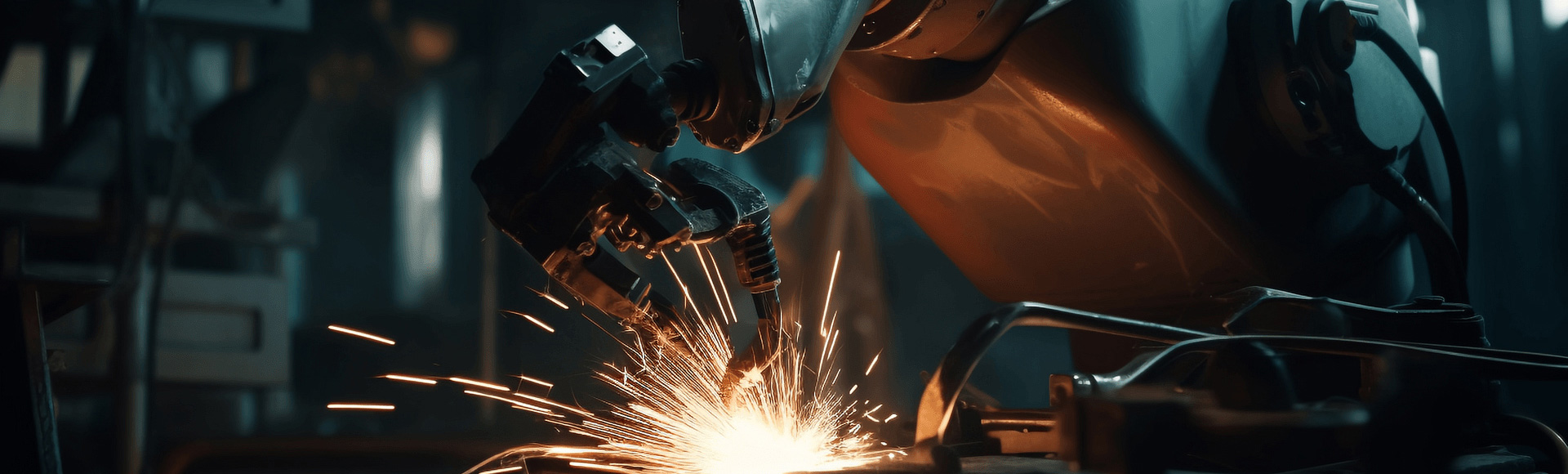
Spatter is not a cosmetic problem. It is metal that left the weld and landed somewhere else, and every particle costs money three times: once as wire, once as cleaning labour, and once as a rework risk when a particle welds itself to a machined face or a sealing surface.
A
low-spatter welding machine does not eliminate spatter. It narrows the conditions under which spatter forms, which is a more useful promise. Understanding where the particles come from tells you whether a machine can fix your problem or whether the problem is upstream.
The Four Sources of Spatter
Short-circuit transfer and pinch dynamics
In short-circuit MIG welding, the wire touches the pool, current spikes, the bridge necks down and explodes, and droplets transfer. If the current rises faster than the bridge can neck smoothly, the bridge bursts and throws metal. That burst is the dominant spatter mechanism in the 1.0 to 5.0 mm carbon steel range, which is exactly where most fabrication sits.
Gas and contamination
CO₂-rich mixes give deeper penetration and more spatter. Argon-rich mixes give a smoother arc and less spatter, at the cost of penetration and wetting. Oil, mill scale, paint and moisture on the plate all produce gas that blows metal out of the pool.
Wire and contact tip condition
A worn contact tip lets the wire wander, the arc wanders with it, and spatter rises before anyone notices why. Liner friction produces wire feed fluctuation that shows up as current fluctuation.
Torch angle and stick-out
Pushing more than about 15° tilts the arc and throws spatter forward. Long stick-out raises resistance, drops current, and destabilises transfer. Both are operator habits, and both are correctable with a fixture and a checklist.
How a Low-Spatter Welding Machine Controls It
Waveform and current ramp
The source controls the current profile in the milliseconds around each short circuit. A controlled ramp reduces the current spike at re-arc, lets the bridge neck smoothly, and re-establishes the arc with less energy. This is the single largest lever a modern source has, and it is why two 350 A machines with identical nameplate ratings behave differently on the same joint.
Inductance and pinch control
Inductance settings shape how fast current rises. Too little inductance gives a harsh, spattery arc; too much gives a soft arc that wets poorly and stubs into the pool. Synergic programs bundle inductance, voltage and wire speed into one adjustment so the operator cannot set a combination that fights itself.
Synergic programs for one-knob setting
On a production line, the operator should choose material, thickness and wire, and turn one knob. Every additional parameter is an opportunity for the previous shift to have left it wrong.
A Reference Specification
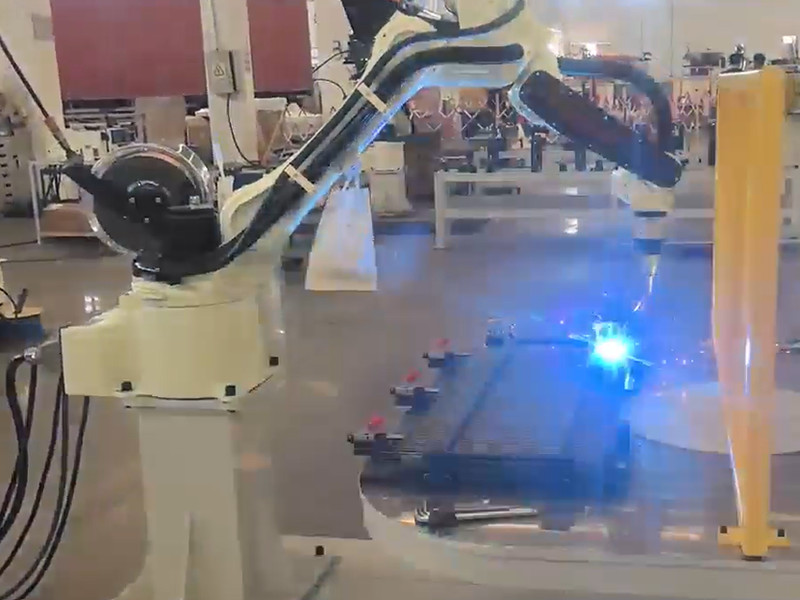
Dade Heavy Industry's horizontal rotation welding workstation is built around a 350 A low-spatter power source, and its published parameters show what that class of machine is asked to do.
|
Parameter |
Value |
|
Source |
350 A low-spatter power source |
|
Current range |
30–350 A |
|
Welding speed |
0.3–1.0 m/min |
|
Material |
Q195, Q235 carbon steel plate |
|
Thickness |
1.2–5.0 mm |
|
Stated characteristics |
low spatter, minimal slag, arc re-ignition capability |
|
Workpiece tolerance |
≤0.5 mm |
The 1.2 mm lower limit matters. Thin carbon steel is where spatter and burn-through compete: the settings that reduce spatter often reduce penetration, and the settings that guarantee fusion often blow through. A source with a stable low-current range and a controlled re-arc is what makes 1.2 mm production repeatable.
Gas Mix and Wire Choice
|
Mix |
Spatter |
Penetration |
Appearance |
Typical use |
|
80% Ar / 20% CO₂ |
Low |
Good |
Smooth, light scale |
General fabrication, robotics |
|
92% Ar / 8% CO₂ |
Very low |
Moderate |
Very smooth |
Thin sheet, visible welds |
|
100% CO₂ |
High |
Deep |
Rougher, more cleaning |
Heavy structural, cost-driven |
|
98% Ar / 2% O₂ |
Low |
Moderate |
Bright |
Stainless, some carbon steel |
The vibration exciter line Dade built runs 80% Ar / 20% CO₂ with 1.2 mm solid wire, a 22 mm wire extension and oscillation width up to 30 mm. That is a mainstream low-spatter recipe: enough CO₂ for penetration, enough argon to calm the transfer, and oscillation to spread the bead in a fillet.
Wire quality is the forgotten variable. Copper-coated wire with inconsistent coating thickness feeds unevenly and spatters more. A cheaper spool can cost more per metre than a premium one once cleaning is counted.
What Spatter Costs
|
Item |
Per part |
Per 200 parts/day |
Per year (300 days) |
|
Cleaning labour |
0.8 min |
160 min |
800 hours |
|
Consumable discs and tools |
1.2 CNY |
240 CNY |
72,000 CNY |
|
Rework from embedded spatter |
0.5% of parts |
1 part |
300 parts |
|
Anti-spatter chemical |
0.4 CNY |
80 CNY |
24,000 CNY |
At a fully loaded labour rate of 60 CNY per hour, the cleaning alone is worth roughly 48,000 CNY a year, before the consumables and the rework. That is the budget a
low-spatter welding machine is competing against, and it explains why the payback case usually rests on labour rather than on wire savings.
Horizontal Rotary Welding Tables & Workstation
Settings That Keep Spatter Low in Production
• Set wire feed and voltage from the synergic program for the actual thickness, not from the last job
• Keep stick-out at 12 to 15 mm; use a fixture or a nozzle standoff gauge to enforce it
• Hold torch angle within 10° of perpendicular for fillets, 5° push maximum for butt welds
• Replace contact tips on a count, not on failure: every 8 to 12 hours of arc time
• Blow out the liner weekly and check wire feed force
• Verify gas flow at the torch with a flow meter, not at the regulator
• Clean the nozzle every shift; a loaded nozzle disturbs gas flow and creates spatter
Verifying the Claim on Your Parts
A supplier demonstration on clean, perfectly fitted coupons proves little. Ask for a run on your material at your fit-up. Then count:
• Particles larger than 0.5 mm attached to the part, per part
• Particles on the fixture and the floor per cycle
• Time to clean one part with the plant's actual method
• Porosity on a sectioned sample, since low-spatter settings can trade penetration for calm transfer
Run the same test on the incumbent machine. The difference in cleaning time, multiplied by the annual volume, is the honest payback figure.
Where Low Spatter Matters Most
Three applications justify the premium. Visible welds on painted or powder-coated parts, where every particle becomes a grinding operation before finishing. Sealing surfaces, where an embedded particle causes a leak that only shows at test. And high-arc-on robotic cells, where spatter accumulates on nozzles, fixtures and light curtains, and the maintenance burden grows faster than the labour saving.
Dade Heavy Industry builds low-spatter stations for carbon steel plate work in exactly those settings, including the horizontal rotation workstation described above, where a 350 A low-spatter source is combined with a servo-driven 2000 × 2000 mm table and ±0.08 mm repeat positioning so the arc starts in the same place every cycle. Consistency of starting position is itself a spatter control: a torch that starts 1 mm off the joint spatters regardless of the waveform.
Working With Dade
Dade Heavy Industry (stock code 870547) has been building
welding equipment since long before waveform control became a marketing term. From a 100,000 m² plant in Wuxi, Jiangsu, with roughly 600 employees and a range of 50 series and 200 specifications, the company supplies digital inverter welding machines, robot workstations and complete welding lines, with close to 10,000 sets delivered in China and exports to Southeast Asia, the Middle East, Japan, Europe and the Americas.
If spatter is your cost driver, the productive first step is to measure it: cleaning minutes per part, particles per part, rework rate. Bring those three numbers to a supplier conversation and a low-spatter welding machine becomes an engineering decision rather than a claim.