







© 2025 JiangSu Dade Heavy Industry Co.Ltd. All Rights Reserved.Web Design by Wangke
Release time:2025-08-15 Visits:707
Joining aluminium to steel has become a critical enabler of lightweight, high-performance designs. Laser welding has emerged as the leading solution because it can concentrate heat precisely enough to limit the brittle intermetallic layer that otherwise ruins the joint.
The two metals diverge sharply in thermal and metallurgical behaviour. Aluminium has a much lower melting point, around 660 degrees C against 1538 degrees C for steel, higher thermal conductivity, and a strong tendency to form brittle intermetallic compounds at the interface. Without tight control of heat input, the joint fails in service rather than during welding.
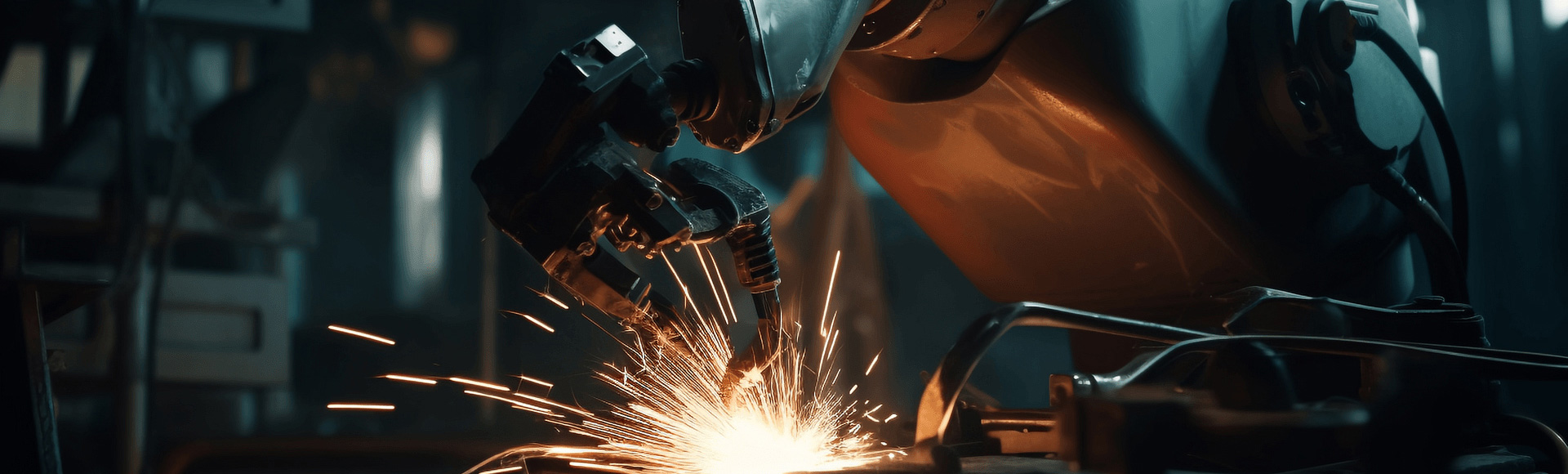
Laser welding addresses these issues through localised, high-energy heat input. A focused beam, typically 10 to 100 micrometres in diameter, delivers intense energy to the weld zone while minimising thermal exposure to the base materials. Because the heat is confined, the growth of the brittle intermetallic layer can be held within acceptable limits.
| Precision metallurgical control | Advanced systems integrate real-time monitoring such as optical emission spectroscopy to adjust laser power, pulse duration and beam oscillation dynamically, allowing the operator to optimise the intermetallic layer. |
|---|---|
| Minimal heat-affected zone | Concentrated energy restricts the heat-affected zone to under 100 micrometres in both materials, preventing grain coarsening in steel and softening in heat-treatable aluminium alloys such as the 6000 series. |
| Adaptability to production | The systems integrate with robotic cells and automated workstations for high-volume production, with vision-guided alignment to about 0.01 mm accuracy. |
| Reduced post-processing | Clean, spatter-free welds eliminate extensive grinding or deburring, cutting production cycle times by 20 to 30 percent compared with conventional methods. |
Adoption of aluminium-steel laser welding is transformative in automotive engineering, where the shift to electric vehicles drives demand for mixed-material bodies that are light where possible and strong where necessary. The same logic applies to other transport structures where weight reduction and structural integrity must both be met.
Aluminium and steel differ sharply in melting point, around 660 degrees C against 1538 degrees C, in thermal conductivity, and in their tendency to form brittle intermetallic compounds at the interface. Unless heat input is tightly controlled, the joint fails in service.
A focused laser beam typically 10 to 100 micrometres in diameter delivers intense energy to the weld zone while minimising thermal exposure to the base materials. Because heat is confined, growth of the brittle intermetallic layer can be held within acceptable limits.
Concentrated laser energy restricts the heat-affected zone to under 100 micrometres in both materials. That prevents grain coarsening in steel and softening in heat-treatable aluminium alloys such as the 6000 series.
Clean, spatter-free welds eliminate extensive grinding or deburring, cutting production cycle times by 20 to 30 percent compared with conventional methods.
Explore our full range of laser welding robot workstations.