Why Is Aluminum Difficult to Laser Weld?
Aluminum is difficult to laser weld because its physical and metallurgical properties amplify small variations in surface condition and energy coupling. It conducts heat rapidly, reflects a significant portion of incident near-infrared energy before a stable melt pool forms, and is covered by an oxide film with a much higher melting temperature than the underlying metal.
Several aluminum alloys also have solidification ranges that make them susceptible to hot cracking. Hydrogen dissolves readily in liquid aluminum but has much lower solubility in solid aluminum, so absorbed hydrogen can form pores as the weld solidifies.
These challenges do not make laser welding unsuitable. They mean the process must be engineered as a controlled system rather than treated as a simple transfer of steel parameters.
Which Aluminum Alloys Are Most Weldable?
Laser weldability depends on alloy family, temper, filler choice, joint design, and required properties. General tendencies are useful, but production decisions should follow material certificates and qualified trials.
1xxx series commercially pure aluminum is generally weldable but has high thermal conductivity.
3xxx series aluminum-manganese alloys are commonly weldable.
5xxx series aluminum-magnesium alloys often provide good weldability, though composition and service temperature must be considered.
6xxx series aluminum-magnesium-silicon alloys are widely used but can be sensitive to solidification cracking and strength loss in the heat-affected zone.
2xxx and 7xxx series high-strength alloys can be more crack-sensitive, depending on grade and heat treatment.
The welded joint may not retain the parent material’s temper strength. Design calculations should use qualified joint properties, not only base-metal catalogue values.
How Does the Oxide Layer Affect Welding?
The aluminum oxide layer can disrupt wetting, trap contamination, and interfere with stable energy absorption. Because the oxide melts at a much higher temperature than aluminum, simply heating the surface does not guarantee that the film integrates cleanly into the melt pool.
A controlled preparation sequence may include degreasing with a compatible solvent, mechanical or chemical oxide removal where specified, clean handling, and prompt welding before the surface is recontaminated. Dedicated stainless-steel brushes are often used for aluminum and should not be shared with carbon steel.
Avoid introducing moisture through cleaning fluids, compressed air, gloves, storage, or condensation. Parts moved from a cold warehouse into a warm humid shop may collect invisible moisture. Cleaning must be documented by method and maximum allowed time before welding.
What Causes Porosity in Aluminum Laser Welds?
Porosity usually comes from hydrogen, trapped surface contamination, unstable keyhole collapse, or shielding conditions that allow atmospheric interaction. The pore shape and location can help distinguish causes.
Hydrogen-Related Porosity
Hydrogen sources include moisture, hydrocarbons, lubricants, dirty filler wire, hydrated oxide, and contaminated shielding-gas lines. Control requires dry storage, clean handling, verified gas quality, and disciplined surface preparation.
Keyhole Porosity
In deep-penetration welding, vapor pressure creates a narrow keyhole. If the keyhole fluctuates or collapses irregularly, gas can be trapped before it escapes. Beam focus, power density, travel speed, joint gap, and beam oscillation influence stability.
Shielding-Related Porosity
Turbulent or insufficient gas flow can entrain air. Excessive flow is not always better; it can draw atmosphere into the shield. Nozzle angle, standoff, cross-drafts, plume interaction, and trailing coverage should be tested on the real cell.
How Can Hot Cracking Be Reduced?
Hot cracking is reduced by controlling weld-metal composition, solidification shape, strain, heat input, and joint restraint. The crack risk is highest when the alloy passes through a vulnerable solidification range while tensile strain is applied.
Useful measures include:
Select an appropriate filler alloy when autogenous welding is crack-sensitive.
Avoid joint geometries that create a deep, narrow weld with unfavorable solidification direction.
Optimize beam shape or oscillation to modify pool geometry.
Control gap and edge alignment.
Reduce excessive restraint in the fixture.
Balance the weld sequence to limit accumulated strain.
Avoid abrupt starts and stops; use qualified ramp and crater strategies.
Confirm whether preheating is beneficial or harmful for the specific alloy and production objective.
Filler selection can improve crack resistance but may change strength, corrosion behavior, anodizing appearance, and electrical conductivity. Treat it as a design decision, not just a welding parameter.
Which Shielding Gas Should Be Used?
Argon is the common starting gas for aluminum laser welding, while helium or mixtures may be evaluated when penetration, plume behavior, or thermal coupling requires adjustment. The optimum gas depends on laser type, power, joint, thickness, and optics.
Shielding design should define:
|
Variable |
Engineering Question |
|
Gas composition |
Does it support stable penetration and required surface quality? |
|
Flow rate |
Is coverage laminar and resistant to local drafts? |
|
Nozzle position |
Does it shield the molten pool without interfering with optics or sensor? |
|
Trailing shield |
Is additional coverage needed while hot metal solidifies? |
|
Root protection |
Can oxygen or moisture reach the underside of a full-penetration joint? |
|
Gas purity |
Is the specified purity maintained through regulators, hoses, and fittings? |
A flow meter at the supply does not prove effective coverage at the weld. Verify the complete gas path and nozzle condition.
How Tight Must Joint Fit-Up Be?
Laser welding generally requires tighter and more repeatable fit-up than conventional arc welding because the focused energy and filler volume may be small. The allowable gap depends on spot size, beam shape, oscillation, filler addition, thickness, and required penetration.
Gap, mismatch, edge condition, and flange width should be included in the process qualification. A nominal zero-gap drawing is not enough if production parts arrive with burrs, spring-back, coating buildup, or variable edge angle.
Fixtures should locate from functional datums and hold the joint without deforming thin material. Laser seam tracking can correct path location, but it cannot close a large gap. Wobble welding can improve gap-bridging capacity within limits, but it also changes melt-pool width and heat distribution.
Conduction Mode or Keyhole Mode?
Conduction-mode welding produces a wider, shallower weld, while keyhole-mode welding produces deeper penetration through concentrated power density. The choice depends on joint thickness, required penetration, speed, distortion, and defect sensitivity.
Conduction mode is useful for surface joining, thin material, and applications prioritizing smooth appearance. Keyhole mode supports high aspect-ratio penetration but is more sensitive to keyhole stability and can increase porosity risk when parameters fluctuate.
Between these extremes lies a transition region that may be unstable. Process development should map a window, not just identify one parameter set. Test power, speed, focus position, beam size, oscillation, gas, and gap across realistic tolerances.
How Should Laser-Welding Parameters Be Qualified?
Qualification should demonstrate repeatable performance at the boundaries of normal production variation. Record laser power at the workpiece where practical, travel speed, focus position, beam delivery, oscillation pattern, wire feed, gas, joint condition, and clamping.
Evaluate cross-sections for penetration and fusion shape, inspect for surface defects, and use radiography, computed tomography, ultrasonic testing, leak testing, or mechanical testing as required by product risk. Acceptance must follow the drawing, contract, and applicable code.
DOE-style trials are more informative than changing one parameter at a time because power, speed, focus, and gap interact. After selecting a window, lock recipes and define alarms for power, gas, cooling, focus protection, and sensor confidence.
What Must a Robotic Laser Cell Control?
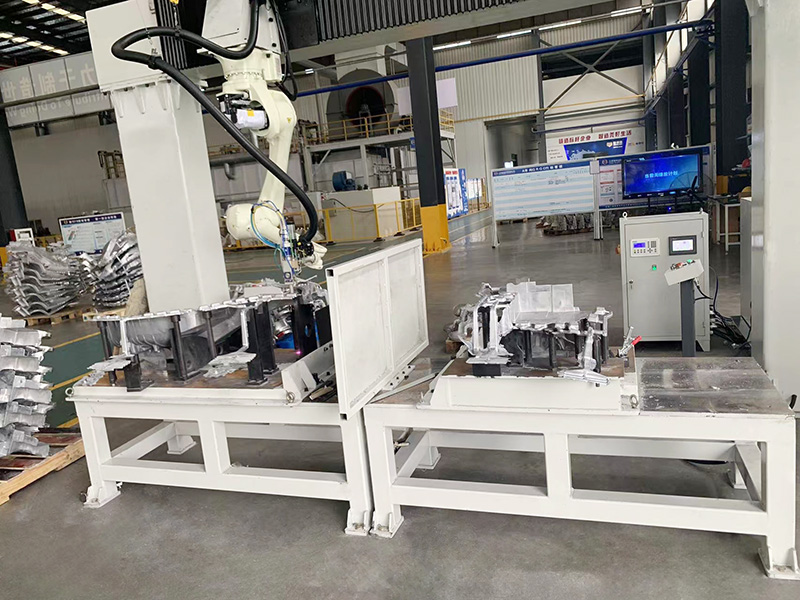
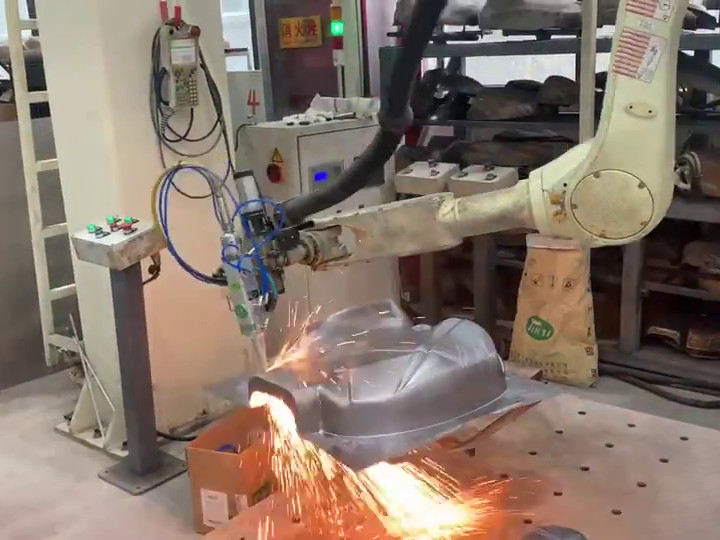
A production cell must control more than the laser source. It must manage part identity, fixture state, seam location, focus condition, shielding, cooling, optics cleanliness, robot motion, extraction, and safety interlocks.
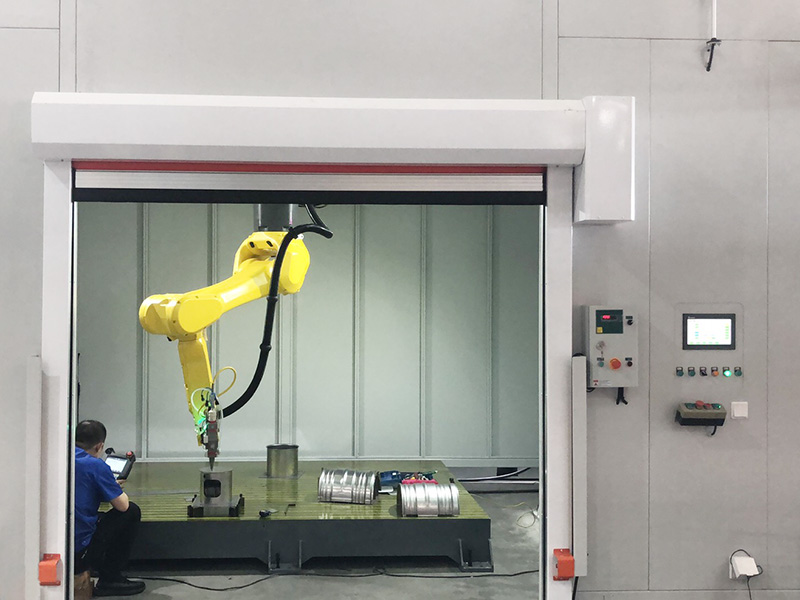
JiangSu Dade Heavy Industry provides robot laser welding systems and workstations. For an aluminum application, representative alloy certificates, coatings, part tolerances, cleanliness conditions, joint drawings, required properties, and inspection criteria should be supplied before process trials.
Laser-system safety should be engineered according to the applicable regulations and standards, which may include IEC 60825-1 and ISO 11553-1. The completed cell requires a documented risk assessment and validation; protective eyewear alone is not a substitute for an engineered enclosure and interlocking strategy.
Frequently Asked Questions
Can aluminum be laser welded without filler wire?
Yes, many joints are welded autogenously. Filler may be needed to improve crack resistance, bridge a controlled gap, or achieve a required weld composition.
Why do pores remain after increasing shielding gas flow?
The source may be hydrogen or keyhole instability rather than insufficient gas. Excessive turbulent flow can also worsen atmospheric entrainment.
Does preheating always improve aluminum laser welding?
No. It may influence thermal gradients and energy demand, but it can also affect cycle time, temper, distortion, and contamination. Validate it for the specific alloy and joint.
Can a standard steel-cleaning process be used for aluminum?
Not automatically. Aluminum needs contamination control that avoids embedded steel particles, moisture, incompatible chemicals, and rapid recontamination.
Is a beautiful top bead proof of a sound weld?
No. A smooth surface can hide lack of fusion, internal porosity, or cracking. Use cross-sections and the inspection methods required by the product.
Conclusion
Laser welding aluminum becomes predictable when alloy behavior, oxide and moisture control, joint fit-up, energy coupling, keyhole stability, shielding, and inspection are managed together. The qualified output is not a single “best” setting. It is a documented process window that remains capable across real material, fixture, and environmental variation.