Light Alloy Welding Machine: Aluminium And Magnesium Without Porosity
Release time:2026-12-18
Visits:6
Aluminium is the material that makes experienced welders cautious. It conducts heat five times faster than steel, so the pool runs away from the torch. It carries an oxide film with a melting point above 2,000 °C, so the surface does not behave like the metal underneath. It dissolves hydrogen in the liquid state and rejects it on solidification, which produces porosity that no amount of cosmetic skill can hide.
A
light alloy welding machine is therefore judged on three things: whether it can break the oxide, whether it can deliver heat fast enough to stay ahead of conduction, and whether it can keep hydrogen out of the pool. Everything else — interface, brand, colour — is secondary.
Why Aluminium Fights Back
Oxide and reflectivity
The oxide layer must be removed mechanically or broken electrically before the arc will wet the metal. AC TIG uses the positive half-cycle for cleaning; MIG relies on cathode cleaning and correct polarity. For laser welding, the same oxide and the metal's reflectivity at 1,070 nm mean that a 1 kW source couples poorly on a cold, bright surface until the keyhole opens — which is why aluminium laser welding benefits from a power margin and a controlled start.
Thermal conductivity and distortion
Heat spreads away from the weld almost immediately, so the machine has to put energy in quickly. Once the part is hot, the same settings over-penetrate. On long seams, this thermal runaway is the main cause of variable penetration, and it is managed with travel speed ramps, pulse shaping and heat sinks.
Hydrogen porosity
Hydrogen comes from moisture: in the gas, on the wire, on the plate, in the air. The cure is a chain of small controls rather than one big one: gas purity of 99.999 percent, dry air supply, wire stored sealed and used within its shelf life, plate cleaned and dried immediately before welding, and a stable arc that does not aspirate air.
Process Choice
|
Process |
Thickness |
Strength |
Limitation |
|
AC TIG |
0.8–6 mm |
Cleaning action, appearance, control |
Slow, needs skill |
|
Pulsed MIG |
2–12 mm |
Speed, penetration, robotic use |
Wire feed and porosity sensitivity |
|
Laser |
0.5–4 mm |
Very low heat input, speed |
Reflectivity, gap tolerance |
|
Plasma |
2–8 mm |
Concentrated arc, keyhole on thicker |
Process window is narrow |
For structural aluminium in the 3 to 10 mm range, pulsed MIG is the production answer. For thin cosmetic work, AC TIG or laser. For pressure-tight aluminium shells, pulsed MIG with laser tracking and full inspection, which is the configuration used in the reference case below.
The GIL Reference: Aluminium Shells at 220 kV and 500 kV
Gas-insulated transmission lines carry high voltage inside an aluminium alloy enclosure. The shell and conductor welds are pressure-tight and must pass radiographic and leak acceptance, so the welding system is a useful benchmark for what a
light alloy welding machine has to deliver in a demanding application.
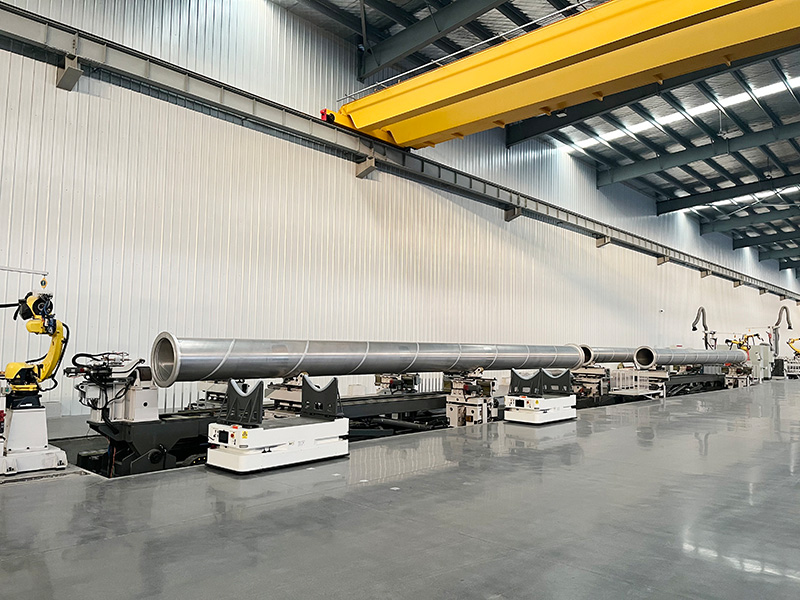
GIL(Gas-Insulated Transmission Lines) Industry Welding Line
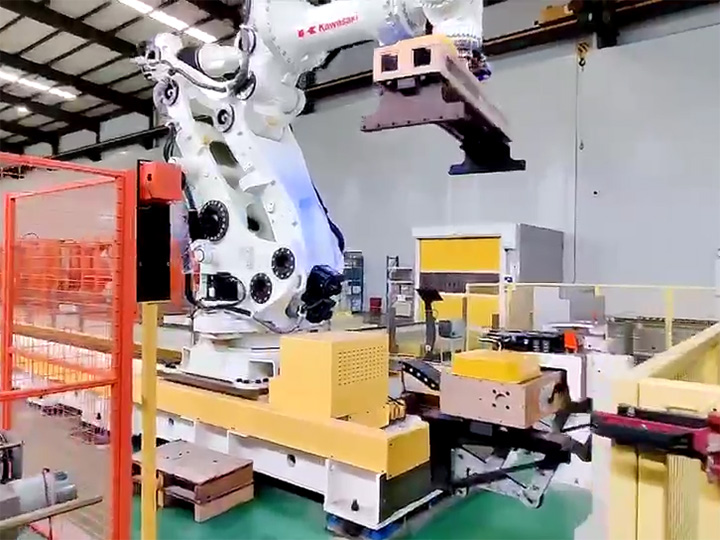
Dade Heavy Industry built the shell and conductor welding production line for this industry. The process chain runs assembly, spot welding, internal seam welding and external seam welding, and it covers single-phase and three-phase common-tank shells and conductors for 220 kV and 500 kV equipment, including nuclear power and rail transportation applications.
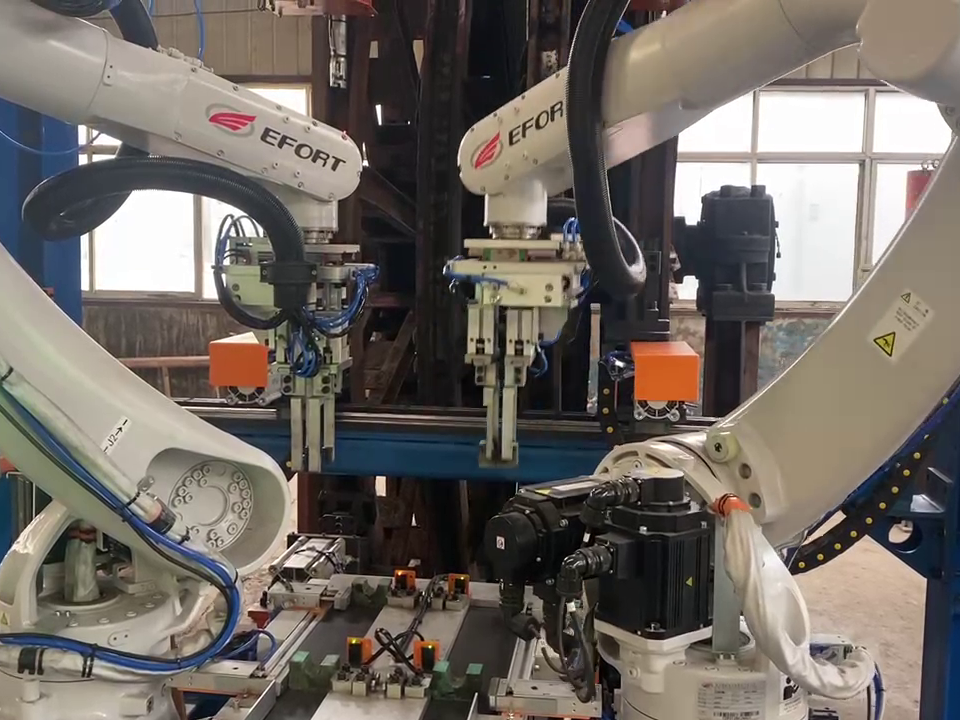
The equipment list is specific: a German Binzel laser tracking system for seam following, Fronius TPS500i and MW5000 welding systems, FANUC M-20iD/25 robots with arc tracking and automatic torch changing, and Siemens S7-1500 PLC control interfaced with MES for real-time production monitoring. Quality is verified by 100 percent weld inspection with a first-pass acceptance rate of 99 percent or better, against the NB/T47013.5-2015 standard, with seams free of cracks, pores and lack of fusion.
Read that as a specification lesson. Aluminium does not tolerate a wandering seam, so the system tracks it. Aluminium does not tolerate a cold start, so the source is a 500 A class machine with synergic control. Aluminium does not tolerate inconsistency, so every weld is inspected rather than sampled.
Wire Feed and Torch Setup
Push-pull and spool guns
Aluminium wire is soft and has low column strength. A 3 m push-only torch run will birdnest at the drive rolls. Push-pull torches, where a second drive set sits in the torch body, are the standard solution for robotic aluminium welding; spool guns are the manual equivalent for short runs.
Contact tip and burn-back
Aluminium expands more than steel, so the contact tip bore must be sized generously — typically 0.2 mm over the wire diameter. Burn-back settings need attention because the wire end oxidises between welds; a ball on the wire end causes arc instability at restart.
Liner and conduit
Teflon or nylon liners, replaced on a schedule rather than on failure. A contaminated liner deposits debris in the arc and produces the intermittent porosity that is hardest to diagnose.
Gas and Cleaning
Argon is the base gas for aluminium MIG. Adding helium raises heat input and improves wetting on thicker sections; a 70/30 argon-helium mix is common above 8 mm. Flow rates of 15 to 20 litres per minute at the torch, verified with a flow meter at the nozzle.
Cleaning is a process step, not preparation. Stainless brushes used only on aluminium, acetone or an approved solvent, and welding within a defined window after cleaning. Oxide that regrows overnight will change the arc behaviour in the morning.
Magnesium: The Harder Case
Magnesium alloys weld with similar equipment but tighter constraints: higher thermal conductivity per unit strength, greater oxidation tendency, and a fire risk if chips accumulate. Filler wire selection matters more, and interpass temperature control is stricter. For most fabricators, magnesium work is a specialist subset rather than a daily process, and it is worth confirming with the machine supplier that the synergic programs cover the specific alloy rather than only the generic magnesium line.
Verification
• Radiography or ultrasonic testing on pressure-tight seams, per the applicable standard
• Porosity acceptance stated as a percentage of cross-sectional area, agreed before production
• Leak test where the part is a containment boundary
• Tensile and bend tests on procedure qualification coupons
• Visual standard for cleaning and spatter, photographed at first article
Working With Dade Heavy Industry
Dade Heavy Industry (stock code 870547) supplies
light alloy welding systems and the lines around them, including the gas-insulated transmission line welding line described above. The company works from a 100,000 m² facility in Wuxi, Jiangsu with roughly 600 employees, holds IATF and ISO management system certifications, and has delivered close to 10,000 sets across 50 series and 200 specifications to customers in 30 Chinese provinces and export markets including Southeast Asia, the Middle East, Japan, Europe and the Americas.
Dade's engineering scope covers the full chain for aluminium work: assembly fixtures, spot welding, internal and external seam welding, seam tracking, torch changing, MES integration and safety devices including light curtains and dust removal. For a buyer, that matters because aluminium problems rarely sit in one machine — they sit at the interfaces between the fixture, the feed, the arc and the inspection.
If you are specifying a light alloy welding machine, bring the alloy designation, the thickness range, the joint type and the acceptance standard. Those four inputs determine whether you need AC TIG, pulsed MIG or a laser, and they determine the inspection method that will decide whether the project succeeds.