







© 2025 JiangSu Dade Heavy Industry Co.Ltd. All Rights Reserved.Web Design by Wangke

Release time:2025-09-17 Visits:951
Analysis of Laser Cutting Technology: Core Principles, Application Scenarios, and Guidelines for Standardized Operations
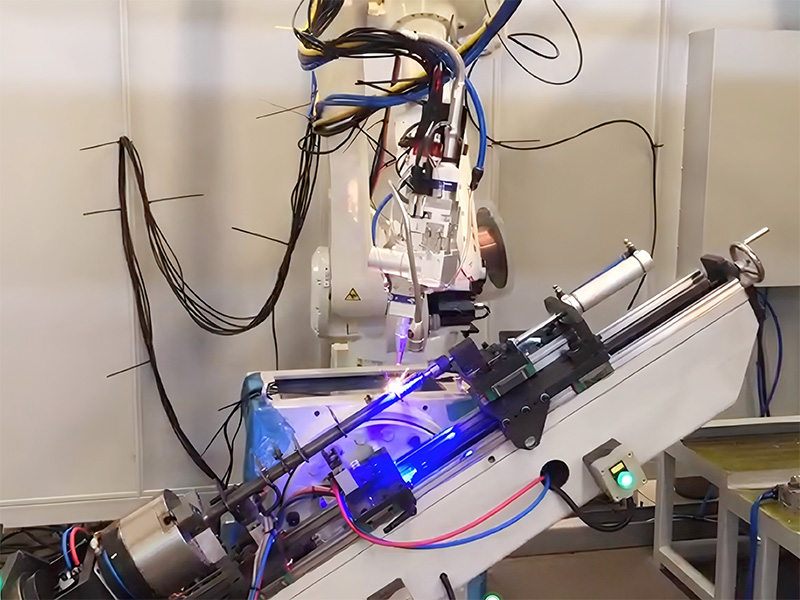
Laser cutting technology, with its high precision, high efficiency, and adaptability to diverse materials, has become one of the core processes in modern manufacturing. It achieves rapid melting or vaporization of materials through a high - energy - density laser beam and, in conjunction with a numerical control system, accomplishes precise cutting of complex patterns. This article will systematically analyze its technical principles, application fields, and key points of standardized operations to help users comprehensively master this advanced processing method.
The laser, as the core power source, generates a highly stable light beam through an excitation medium. Mainstream generators such as carbon dioxide and fiber lasers can meet different scenario requirements. Fiber - type equipment is more suitable for industrial production due to its energy - consumption ratio advantage.
A dedicated optical lens group focuses the original beam to a micron - level light spot. After the energy density is increased by a hundred times, it can reach the evaporation temperature of the material. Combined with auxiliary gas to blow away the molten slag, the quality of the cutting surface is guaranteed.
The CNC control system converts design files into coordinate instructions, driving the cutting head to achieve a repetitive positioning accuracy of +/-0.1mm. It is particularly suitable for high - end processing scenarios such as automobile molds and precision electronic components.
In the automotive industry, this technology is used to process automobile body panels and power system components, ensuring component lightweight while maintaining structural strength. In the aerospace field, special laser processes are used to process strategic materials such as titanium alloys and composite materials.
The medical industry uses ultra - fine cutting to manufacture orthopedic implants and minimally invasive surgical instruments. The electronics industry uses it for the mass production of semiconductor packaging frames and precision sensor housings.
The processing efficiency of curtain wall decorative panels and steel structure connectors is 3 - 5 times higher than that of traditional processes, and the construction error of complex hollow shapes can be controlled within 0.5mm.
| Matching of processing thickness | Equipment at the 30W level is suitable for cutting acrylic below 5mm, and a 6kW fiber laser machine can process carbon steel up to 25mm thick. |
|---|---|
| Evaluation of production efficiency | A 1500W device can cut 1mm stainless steel at a speed of up to 35m/min, with a production capacity 40% higher than that of a 1000W machine. |
| Consideration of maintenance costs | A closed optical path system can reduce the contamination rate of lenses, reducing the annual maintenance cost by about 30%. |
With the integration of artificial intelligence algorithms, new - generation equipment can adjust cutting parameters in real - time to compensate for thermal deformation errors. The dual - beam collaborative cutting technology will break through the processing bottleneck of 40mm aluminum alloy. Operators need to continuously monitor the equipment iteration trends and regularly participate in safety training courses to maintain a technological leading edge.
By thoroughly understanding the internal mechanism and standardized operation requirements of laser cutting technology, users can fully unleash the potential of the equipment and effectively control production costs while ensuring processing quality. It is recommended that enterprises establish equipment health records and an evaluation system for cutting quality in accordance with ISO 9013 standards to continuously improve the manufacturing process level.
The laser, as the core power source, generates a highly stable light beam through an excitation medium. Mainstream generators such as carbon dioxide and fiber lasers can meet different scenario requirements. Fiber - type equipment is more suitable for industrial production due to its energy - consumption ratio advantage.
A dedicated optical lens group focuses the original beam to a micron - level light spot. After the energy density is increased by a hundred times, it can reach the evaporation temperature of the material. Combined with auxiliary gas to blow away the molten slag, the quality of the cutting surface is guaranteed.
The CNC control system converts design files into coordinate instructions, driving the cutting head to achieve a repetitive positioning accuracy of +/-0.1mm. It is particularly suitable for high - end processing scenarios such as automobile molds and precision electronic components.
In the automotive industry, this technology is used to process automobile body panels and power system components, ensuring component lightweight while maintaining structural strength. In the aerospace field, special laser processes are used to process strategic materials such as titanium alloys and composite materials.
The medical industry uses ultra - fine cutting to manufacture orthopedic implants and minimally invasive surgical instruments. The electronics industry uses it for the mass production of semiconductor packaging frames and precision sensor housings.
Explore our full range of automated laser cutting cells.




