







© 2025 JiangSu Dade Heavy Industry Co.Ltd. All Rights Reserved.Web Design by Wangke

Release time:2025-06-12 Visits:965
Brazing is a welding process that connects workpieces by using molten filler metal (brazing filler metal) at a temperature lower than the melting point of the base metal. Different from fusion welding, in the brazing process, the workpieces do not melt, and a strong bond is formed only through the capillary action and atomic diffusion between the liquid brazing filler metal and the solid base metal. This low - temperature processing characteristic makes it an ideal welding solution for precision components, dissimilar metals, and heat - sensitive materials.
In brazing, by precisely controlling the heating temperature, the brazing filler metal and the workpieces are heated to a range slightly higher than the melting point of the brazing filler metal but lower than the melting point of the base metal. At this time, the liquid brazing filler metal penetrates into the joints of the workpieces through capillary action and then undergoes a metallurgical bond with the surface of the base metal. Since there is no need to melt the base material, brazing can effectively avoid deformation, oxidation, or deterioration of the organizational properties caused by high temperatures.
According to the working environment and strength requirements, brazing filler metals can be divided into two categories: hard brazing and soft brazing.
Brazed joints are usually designed in the form of lap joints or socket joints to increase the contact area, and a gap of 0.05 - 0.2 mm is used to optimize the capillary flow. In the pre - treatment process, the oxide layer and oil on the surface of the workpieces must be strictly removed, and brazing fluxes (such as borax and rosin solution) are used to improve the wettability and oxidation resistance.
Brazing can connect dissimilar metals (such as aluminum - copper, steel - ceramic) and non - metallic composite structures. At the same time, it supports the welding of workpieces with significantly different thicknesses, and has significant advantages in the processing of complex components such as automobile radiators and electronic circuit boards.
Through processes such as resistance heating, induction heating, or flame heating, simultaneous welding of multiple joints can be achieved, which is especially suitable for scenarios requiring high - density connections such as honeycomb structures and thin - plate interlayers, significantly improving the production line efficiency.
The joint surface is smooth without burrs, and the deformation of the workpiece is extremely small (usually less than 0.1 mm). Therefore, it is particularly suitable for fields with strict requirements for form and position tolerances such as precision instruments and aerospace components.
| Strength Limitation | The dynamic load capacity of the joint is lower than that of fusion welding, and it is generally not suitable for heavy - load structural parts. |
|---|---|
| Cost Factor | The cost of precious - metal brazing filler metals (such as silver - based alloys) is relatively high, and the single - point usage needs to be reduced through process optimization. |
| Process Complexity | The requirements for joint cleanliness and assembly accuracy are strict, and automated equipment needs to be used to ensure the yield. |
In scenarios such as the connection of aluminum - copper alloys in body panels and the welding of power battery modules , brazing has replaced traditional spot welding with its low - heat - input characteristic and has become the core technology for lightweight design.
The welding of copper - silver wires in photovoltaic modules and the packaging of IGBT modules rely on brazing to achieve high - conductivity and high - reliability connections, and can work in a harsh environment with a temperature range from - 50degC to 300degC.
The composite process of vacuum brazing and diffusion welding has been successfully applied to the repair of aero - engine blades, breaking through the welding bottleneck of nickel - based superalloys in traditional processes and increasing the service life of components by more than 30%.
| 1. Management of Gap Consistency | Ensure that the joint gap tolerance is <=0.1 mm through tooling fixtures. |
|---|---|
| 2. Optimization of Thermal Cycles | Adopt a gradient heating strategy to reduce the adverse effects of intermetallic compounds at the interface. |
| 3. Non - Destructive Testing Technology | Apply X - ray imaging and ultrasonic scanning to detect micro - holes or incomplete fusion defects. |
In brazing, by precisely controlling the heating temperature, the brazing filler metal and the workpieces are heated to a range slightly higher than the melting point of the brazing filler metal but lower than the melting point of the base metal.
According to the working environment and strength requirements, brazing filler metals can be divided into two categories: hard brazing and soft brazing.
Brazed joints are usually designed in the form of lap joints or socket joints to increase the contact area, and a gap of 0.05 - 0.2 mm is used to optimize the capillary flow. In the pre - treatment process, the oxide layer and oil on the surface of the workpieces must be strictly removed, and brazing fluxes (such as borax and rosin solution) are used to improve the wettability and oxidation resistance.
Brazing can connect dissimilar metals (such as aluminum - copper, steel - ceramic) and non - metallic composite structures. At the same time, it supports the welding of workpieces with significantly different thicknesses, and has significant advantages in the processing of complex components such as automobile radiators and electronic circuit boards.
Through processes such as resistance heating, induction heating, or flame heating, simultaneous welding of multiple joints can be achieved, which is especially suitable for scenarios requiring high - density connections such as honeycomb structures and thin - plate interlayers, significantly improving the production line efficiency.
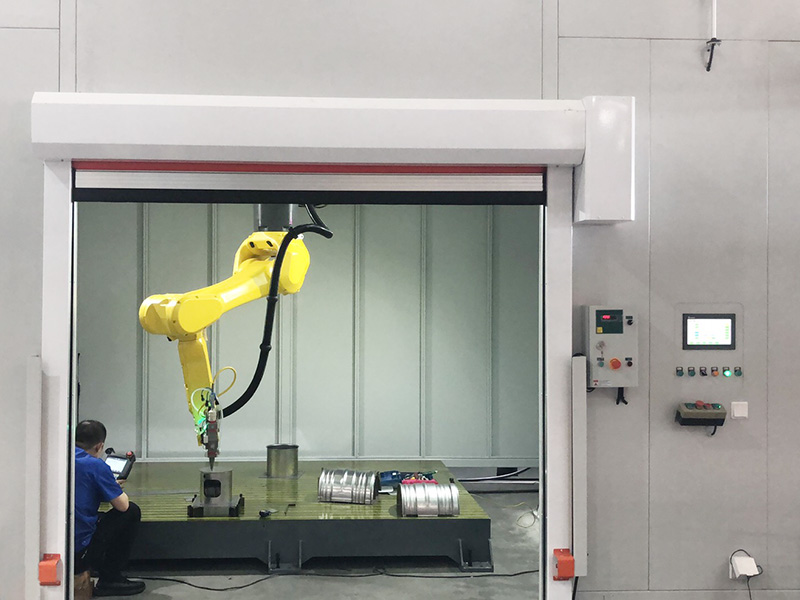
Explore our full range of robot welding workstations.




