







© 2025 JiangSu Dade Heavy Industry Co.Ltd. All Rights Reserved.Web Design by Wangke

Release time:2025-05-21 Visits:1146
Welding robots are classified by function, application scenario and operating method. Each type has distinct characteristics that determine which production problems it solves best.
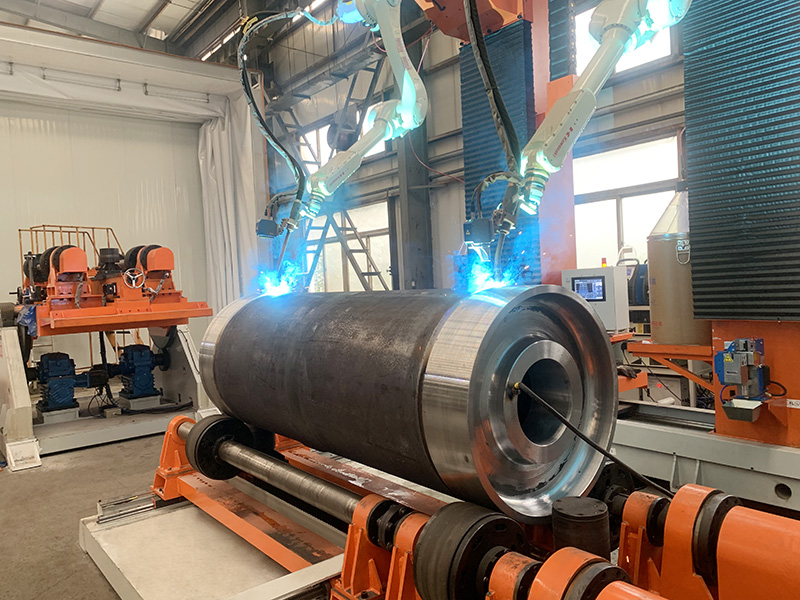
Arc welding robots are the most common type in industrial welding and are used mainly for connecting metal parts. Within arc welding they divide further by arc type.
| Gas shielded welding robots | Use inert gas as shielding to keep the weld area away from air and prevent oxidation. Suited to large-scale production in the automotive and shipbuilding industries. |
|---|---|
| Manual arc welding robots | Flexible in operation and able to weld a wide range of metals and thicknesses. Commonly used for small-scale production or maintenance work. |
| TIG welding robots | Use a non-consumable tungsten electrode. Suited to high-precision requirements such as the aerospace and nuclear industries. |
Spot welding robots join two or more metal sheets at multiple points through heating and pressure, forming a strong connection. They are essential equipment in automotive manufacturing.
Beyond arc and spot welding, several specialised types serve narrower applications.
| Laser welding robots | Use a high-energy laser beam for welding. Suited to precision machining and demanding welding applications where heat input must stay low. |
|---|---|
| Friction welding robots | Generate frictional heat between workpieces with a high-speed rotating tool, causing plastic deformation and bonding. Requires no filler material or shielding gas, making the process environmentally friendly and energy-saving. |
| Filling welding robots | Add filler material during the weld, used where joint gap or thickness requires additional deposited metal. |
Welding robots divide into arc welding robots (gas shielded, manual arc and TIG variants), spot welding robots (fixed and mobile), and specialised types including laser welding robots, friction welding robots and filling welding robots.
Fixed spot welding robots are designed for large-volume production of a single workpiece type and stay in one position. Mobile spot welding robots can move between different workstations, adapting to a range of welding tasks.
TIG welding robots, which use a non-consumable tungsten electrode, are suited to high-precision requirements in the aerospace and nuclear industries. Laser welding robots are the other option when precision and low heat input are the priority.
Friction welding robots generate heat through a high-speed rotating tool, causing plastic deformation and bonding without filler material or shielding gas. The process is therefore environmentally friendly and energy-saving.
Explore our full range of spot and seam welding machines.