







© 2025 JiangSu Dade Heavy Industry Co.Ltd. All Rights Reserved.Web Design by Wangke

Release time:2025-11-30 Visits:928
The 3D laser welding system delivers efficient, precise processing in three-dimensional space through the combined operation of fibre laser technology and robotics. This article breaks down its core functions, application scenarios, technical advantages and the direction of future iteration.
Four capabilities define what a 3D laser welding system can do.
| Millimetre-level welding precision | A six-axis linkage robotic arm with a vision positioning system reaches plus or minus 0.05 mm welding precision. In automotive cylinder block welding this can raise the yield rate by more than 20 percent. |
|---|---|
| Efficient non-contact processing | The high energy density of the laser beam raises welding speed by 3 to 5 times. Because the process is non-contact, it also reduces workpiece deformation and the subsequent correction work. |
| Adaptability to complex structures | Supports spot welding, seal welding and curved surface welding, meeting the needs of special-shaped components such as aerospace engine blades. |
| Intelligent process optimisation | Some systems integrate an AI parameter adaptive module that recognises the weld appearance and dynamically adjusts power and path, lowering the operating threshold. |
| Automotive manufacturing | Has extended from traditional body welding to new energy vehicle battery modules. Laser technology welds high-strength aluminium alloy frames and also cuts battery tabs precisely. |
|---|---|
| Aerospace | Used for aircraft fuselage skin welding and rocket engine pipeline sealing. The heat-affected zone is under 0.1 mm, which protects reliability of key components in extreme environments. |
| Precision electronics | Micron-level welding of phone middle frames and circuit board components, with surface oxide removal that improves product yield. |
| Medical devices | Seamless welding of titanium alloy bone nails and precise processing of endoscope micro-components, meeting biocompatibility requirements. |
Compared with conventional methods, the 3D laser welding system achieves breakthroughs in three areas.
The industry is pushing innovation along three lines.
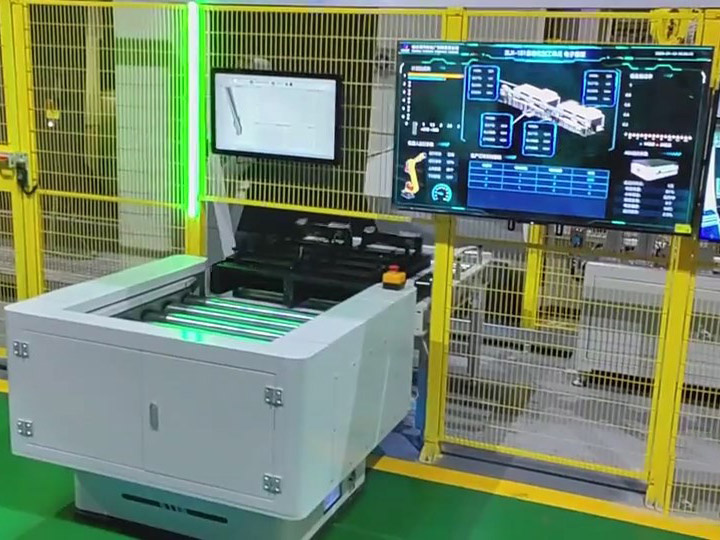
As global manufacturing moves toward intelligence, the 3D laser welding system is evolving from a single piece of processing equipment into a core node of the smart factory. Beyond improving processing precision, data interaction with MES systems makes the welding cell part of production planning and traceability rather than an isolated machine.
It is a system that combines fibre laser technology with a six-axis robot to weld in three-dimensional space. The robotic arm with vision positioning reaches plus or minus 0.05 mm welding precision, and the process supports spot welding, seal welding and curved surface welding.
With a six-axis linkage robotic arm and vision positioning, welding precision reaches plus or minus 0.05 mm. In automotive cylinder block welding this can raise the yield rate by more than 20 percent, and the heat-affected zone stays under 0.1 mm.
The high energy density of the laser beam increases welding speed by 3 to 5 times. Because the process is non-contact it also reduces workpiece deformation and the correction work that follows.
Automotive manufacturing including new energy vehicle battery modules, aerospace for fuselage skin and rocket engine pipeline sealing, precision electronics for phone frames and circuit boards, and medical devices for titanium bone nails and endoscope components.
Initial equipment investment is relatively high, but processing efficiency reduces the single-piece cost by more than 30 percent. The whole-life-cycle benefit is most significant in mass production.
Explore our full range of laser welding automation systems.




