Stainless Steel Welding Machine: Choosing The Process By Joint
Release time:2026-12-14
Visits:6
Stainless is not one material, and a stainless steel welding machine is not one machine. A 0.8 mm 304 cover panel, a 6 mm 316L pressure vessel shell and a 2 mm 2205 duplex bracket each need a different process, a different gas strategy and a different idea of what "good" looks like.
The mistake buyers make is to choose the process by habit — TIG because the shop has always done TIG, or MIG because it is faster — instead of by joint. The second mistake is to treat heat tint as cosmetic. On stainless it is a corrosion issue, and a weld that looks acceptable can fail a salt-spray test in weeks.
The Three Processes and What Each Does Well
|
Process |
Thickness sweet spot |
Speed |
Heat input |
Best for |
|
TIG (GTAW) |
0.5–6 mm |
Low |
Low, controllable |
Visible welds, thin sheet, root passes |
|
Plasma (PAW) |
1.5–8 mm |
Medium |
Concentrated |
Keyhole welds, pressure-tight seams |
|
MIG (GMAW) |
2–12 mm |
High |
Higher |
Structural, long seams, robotic cells |
|
Laser |
0.3–4 mm |
Very high |
Very low |
Thin enclosures, high-volume trim and weld |
TIG remains the reference for appearance and control. It is also the slowest, and on a 4 m seam the labour cost dominates. MIG with a pulsed or controlled short-circuit waveform closes much of the appearance gap at three to five times the speed, which is why robotic stainless cells have displaced manual TIG in appliance, catering and automotive trim work.
Heat Tint Is a Corrosion Problem
What causes it
Chromium carbide precipitation and chromium depletion occur in the 450 to 850 °C band. The visible result is a straw, blue or grey oxide, and the metallurgical result is a chromium-depleted layer beneath it that will not passivate. The tint itself is not the problem; the depleted layer under it is.
Prevention beats removal
Three controls, in order of effectiveness:
• Back purge with argon or nitrogen on the root side, maintaining oxygen below 50 ppm for 316L
• Trailing shield behind the torch, keeping the seam under gas until it drops below about 400 °C
• Low heat input: stringer beads, controlled travel speed, and interpass temperature limits on multi-pass work
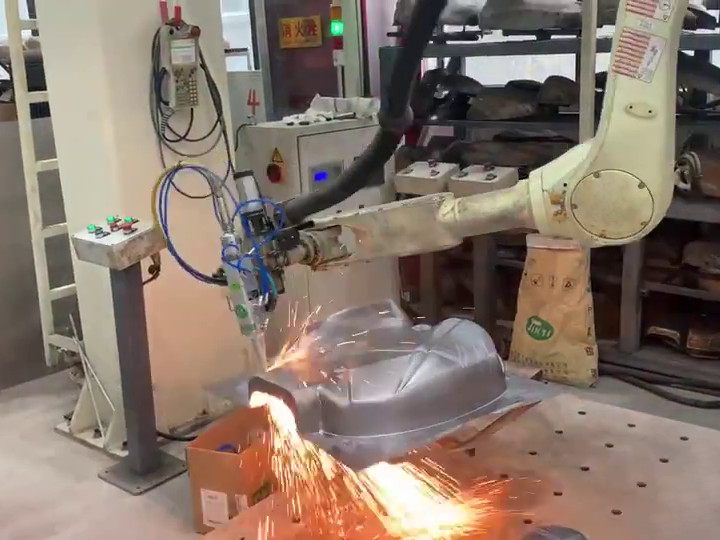
Robotic Welding & Cutting Machine for Motorcycle Fuel/Gas Tanks
Pickling paste and electropolishing restore corrosion resistance after the fact, but they add a chemical handling process, a rinse stage and an environmental permit. Preventing tint is cheaper than removing it, and it is the reason a modern
stainless steel welding machine with gas control and a trailing shield option is worth the premium over a bare power source.
Purging in practice
Purge dams at each end of a pipe or vessel, a flow rate that fills the volume in a defined time, and an oxygen meter at the exit. For a 200 mm pipe with a 3 m purge length, the fill volume is roughly 0.09 m³; at 15 litres per minute, allow about 12 minutes to reach a low-oxygen atmosphere, then reduce to a maintaining flow. Written purge procedures prevent the most common stainless defect in fabrication shops: a sugared root.
Choosing Power and Process by Thickness
|
Thickness |
Process |
Current range |
Note |
|
0.5–1.5 mm |
TIG or laser |
30–90 A |
Fit-up dominates; gap must be near zero |
|
1.5–3.0 mm |
TIG, plasma, or pulsed MIG |
80–160 A |
Plasma keyhole becomes viable at 3 mm |
|
3.0–6.0 mm |
Plasma or MIG |
150–280 A |
Plasma gives full penetration in one pass |
|
6.0–12 mm |
MIG multi-pass or plasma |
220–350 A |
Groove design and interpass control matter |
|
12 mm and up |
MIG with narrow groove |
300 A+ |
Distortion control is the limiting factor |
Plasma Keyhole and P+T for Pressure Work
How keyhole plasma works
A constricted arc at high current density penetrates the full thickness and forms a keyhole that the weld pool closes behind. The result is a single-pass, full-penetration weld with a narrow heat-affected zone and very little distortion. It is the standard process for stainless vessel shells and tube-to-tubesheet work in the 3 to 8 mm range.
Plasma plus TIG
Combining a plasma root with a TIG fill and cap gives full penetration plus a controlled cap profile. Dade Heavy Industry supplies plasma P+T welding equipment for pressure vessel work, where the requirement is a leak-tight root with a cap that meets radiographic acceptance without a back purge failure.
The advantage over all-TIG is speed: one pass instead of three or four, which cuts heat input and distortion at the same time as labour.
Distortion and Fit-Up
Stainless work-hardens and has a lower thermal conductivity than carbon steel, so heat stays near the weld and distortion concentrates. Three practical controls:
• Weld in a balanced sequence, alternating sides of a symmetric part
• Use copper or aluminium backing bars to sink heat
• Tack in a pattern that lets the part move predictably, then clamp before welding
Fit-up tolerance is tighter than carbon steel. A 0.3 mm gap on 1.5 mm stainless will open into a burn-through. Laser-cut edges help, which is why shops that cut and weld stainless increasingly pair a fiber laser cutter with the welding cell — Dade's motorcycle fuel tank application cuts 304 and carbon steel shells on a Kawasaki RA20N with a 1000W Raycus source to a burr-free edge before welding.
Consumables and Contamination Control
Stainless is contaminated by carbon steel. Keep separate:
• Wire brushes, with stainless-only wheels marked and stored apart
• Grinding discs, since iron particles embed and rust
• Workbenches and fixtures, which should have stainless or aluminium contact faces
• Cutting tools and shear blades
Welding wire should match the base metal or be slightly over-alloyed: 308L for 304, 316L for 316, 309L for dissimilar joints. Shielding gas for MIG stainless is typically 98% Ar / 2% O₂ or a tri-mix; for TIG, pure argon with 2 to 5% hydrogen for austenitic grades where faster travel and a brighter bead are wanted.
What to Test
Weld appearance and tint level against a visual standard, photographed and agreed at first article
• Ferrite content on austenitic welds where specified, measured with a ferrite scope
• Penetrant testing on the root and cap for crack detection
• Radiography on pressure-tight seams
• Corrosion resistance: ASTM A262 practice or a salt-spray sample, when the service demands it
• Dimensional check after welding, since stainless moves more than expected
Working With Dade Heavy Industry
Dade Heavy Industry (stock code 870547) builds
stainless steel welding equipment and the cells around it, from plasma P+T pressure vessel equipment to robotic cells welding thin stainless assemblies. The company operates a 100,000 m² plant in Wuxi, Jiangsu with roughly 600 employees, holds IATF and ISO management system certifications, and has delivered close to 10,000 sets across 50 series and 200 specifications to customers in 30 Chinese provinces and export markets including Southeast Asia, the Middle East, Japan, Europe and the Americas.
Its stainless references include laser cutting of stainless fuel tank shells before welding, and welding lines where multi-process MIG/TIG capability is required on the same station. The company's pre-purchase analysis reviews the joint, the base metal grade and the service environment before recommending a process — which is the sequence that avoids buying a stainless steel welding machine that produces welds nobody can passivate.